
Looking for a smartwatch with compass built in — not a GPS arrow that only works with a phone signal, but an actual dial you can read at a glance? A real-time compass is one of the most underrated navigation tools on an outdoor watch, and it works whether or not you have cell coverage.
If you hike, trail run or just get turned around in unfamiliar woods more often than you’d like to admit, here’s how three REXQU models handle it, using their real specs.
What a Smartwatch With Compass Actually Gives You
A dedicated compass sensor reads the earth’s magnetic field directly, so it works instantly on power-up with no satellite lock required. That makes it useful the moment you step off the trailhead, in tree cover, in a canyon, or anywhere GPS takes a minute to find its footing.
The REXQU TrekNav builds this around a numbered steel compass bezel and a real-time compass function on its 1.43″ AMOLED (466×466) display. It also runs 24/7 heart rate and sleep tracking, Bluetooth calls, and is IP68-rated. The 400mAh battery runs 7-10 days of normal use and up to 15 days on standby, with magnetic charging. It’s $149.97.
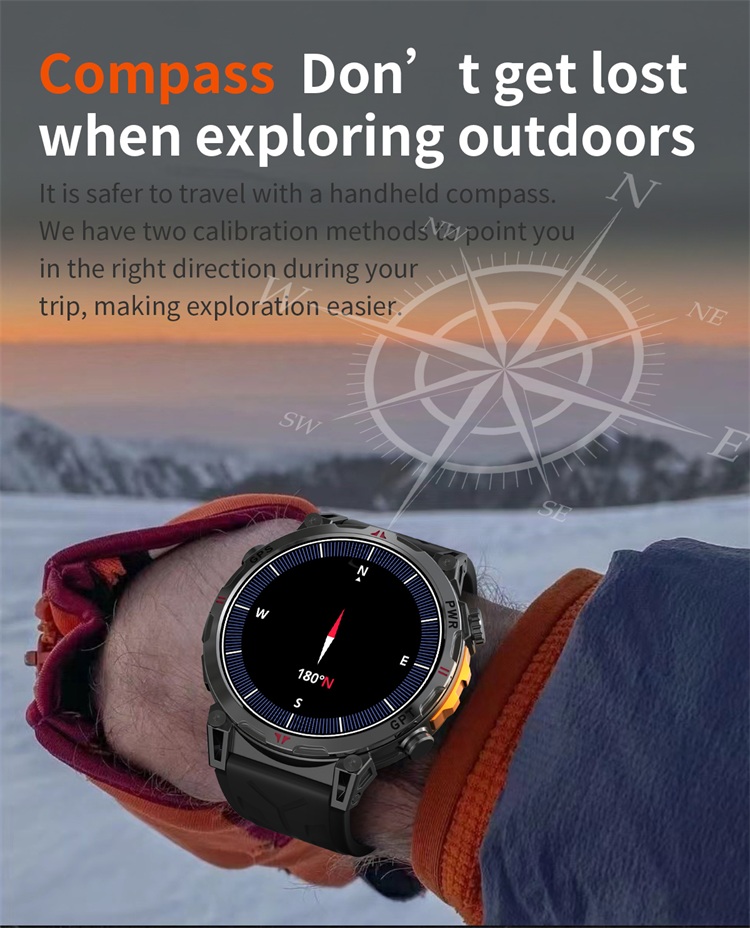
When a Compass Comes With a Full Navigation Toolkit
The REXQU Zenith Pro pairs its compass with dual calibration methods, a live altimeter and barometer, plus multi-satellite GPS (GPS, Beidou, GLONASS and Galileo with L1+L5 positioning) for about 10 hours of continuous GPS tracking on its 650mAh battery. It also includes all-day heart rate with blood pressure and SpO₂ checks, Bluetooth calling and a built-in AI voice assistant. It’s $159.97.
The REXQU MaxTrail takes a battery-first approach: a real-time compass heading plus barometric altitude on a big 1.73″ AMOLED display (466×466), backed by a huge 1000mAh cell built to last multi-day trips without a charger. It also tracks heart rate, sleep and SpO₂, and supports Bluetooth calling across 100+ sport modes. It’s rated 1ATM (splashes and rain, not swimming) and priced at $159.97.
Choosing a Smartwatch With Compass for Your Trail
All three give you an on-wrist bearing without pulling out a phone, but they lean into different priorities. If health tracking and a compact everyday build matter most, TrekNav’s steel bezel and 24/7 heart rate make sense. If you want a complete outdoor instrument — altitude, barometric pressure, multi-satellite GPS — Zenith Pro goes furthest. If battery anxiety is your main concern on longer trips, MaxTrail’s 1000mAh cell is hard to beat.
| Feature | TrekNav | Zenith Pro | MaxTrail |
|---|---|---|---|
| Compass | Real-time, steel bezel | Real-time, dual calibration | Real-time heading |
| Extra navigation tools | — | Altimeter, barometer, multi-satellite GPS | Barometric altitude |
| Display | 1.43″ AMOLED | 1.56″ AMOLED | 1.73″ AMOLED |
| Water rating | IP68 | Rugged three-proof build | 1ATM |
| Battery | 7-10 days | ~10 hrs continuous GPS | 1000mAh, multi-day |
| Price | $149.97 | $159.97 | $159.97 |
How to Get the Most From Your Watch Compass
- Calibrate before you rely on it — most REXQU models use a figure-eight wrist motion to calibrate; do this at the trailhead, away from cars and large metal objects.
- Keep it away from magnets and speakers. Phone cases with magnetic closures and car mounts are common sources of temporary interference.
- Remember a compass points to magnetic north, not true north — for serious backcountry navigation, know your local magnetic declination and adjust for it.
- Pair the compass with the altimeter or barometer (on models that have one) to cross-check your position against a known trail map.
- Recalibrate periodically, especially after travel to a very different latitude or after the watch has been near strong magnets.
For the deeper dive on magnetic north versus true north and why the gap between them changes by location, Wikipedia’s explainer on magnetic declination is a solid independent reference if you’re planning a route in unfamiliar terrain.
FAQ
Does a smartwatch compass need a phone connection to work?
No. A dedicated compass sensor reads the earth’s magnetic field directly on the watch itself, so it works with no phone nearby and no GPS lock, unlike a GPS-only “north” indicator.
Is a watch compass as accurate as a handheld compass?
It’s close for general trail navigation once properly calibrated, though a dedicated baseplate compass is still the standard for technical off-trail route-finding. Treat the watch compass as a strong everyday tool, not a replacement for map-and-compass skills on serious routes.
Which of these three should I pick if I mainly hike day trips?
TrekNav covers the basics well for day hikes with strong health tracking. If you regularly lose trail markers or go off-route, Zenith Pro’s altimeter and multi-satellite GPS add a real safety margin.
Bottom line: a smartwatch with compass is genuinely useful gear, not a gimmick, as long as you calibrate it and understand its limits. Compare the full lineup on REXQU’s rugged smartwatches and GPS smartwatches pages, or see the GPS smartwatch buying guide for the full navigation feature breakdown.