
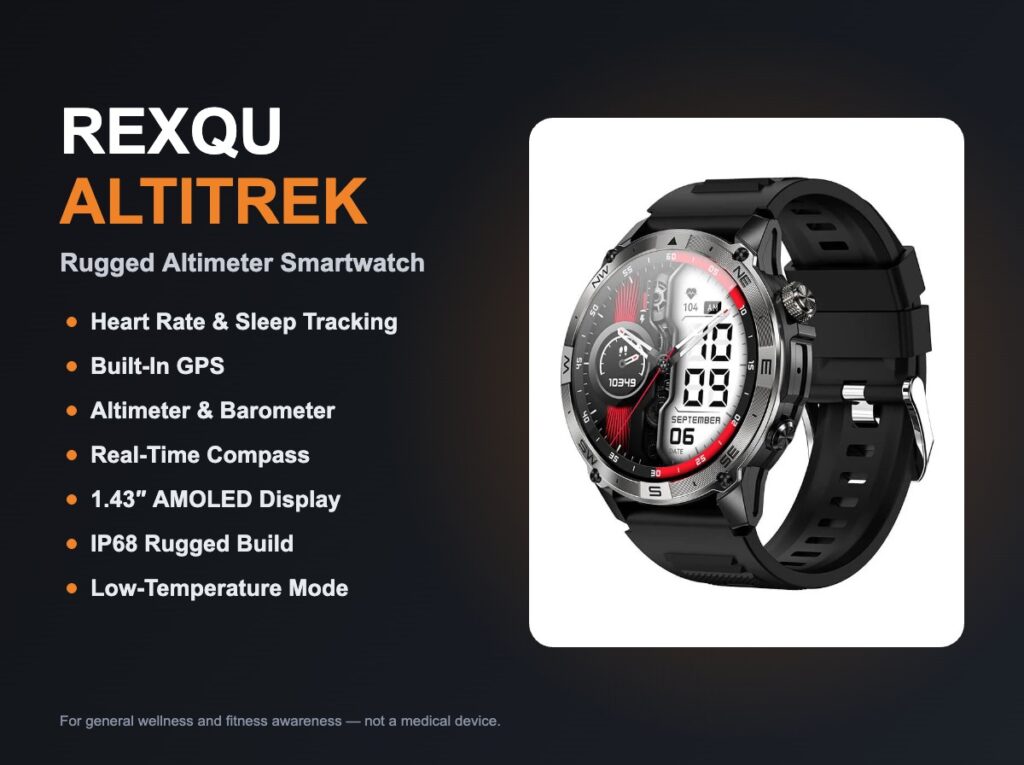
Looking for a smartwatch with altimeter readings you can actually trust above the treeline? Most fitness watches guess your elevation from GPS alone, which can be off by dozens of feet in canyons or under tree cover. REXQU’s AltiTrek pairs GPS with a dedicated barometric sensor, so climbers and hikers get real elevation gain instead of an estimate.
Not every rugged watch needs this. If you mostly want a tough case and a compass for trail navigation, a simpler model like BaseCamp covers that without the extra sensor. Here’s how the two compare, and which one actually fits your next trip.
Why a Smartwatch With Altimeter Matters on Elevation Gain
A barometric altimeter measures air pressure and converts it to elevation, updating in real time as you climb or descend. GPS-only elevation, by contrast, triangulates from satellites and can drift significantly when signal is weak — exactly when you’re deep in a canyon, under dense forest, or between rock walls.
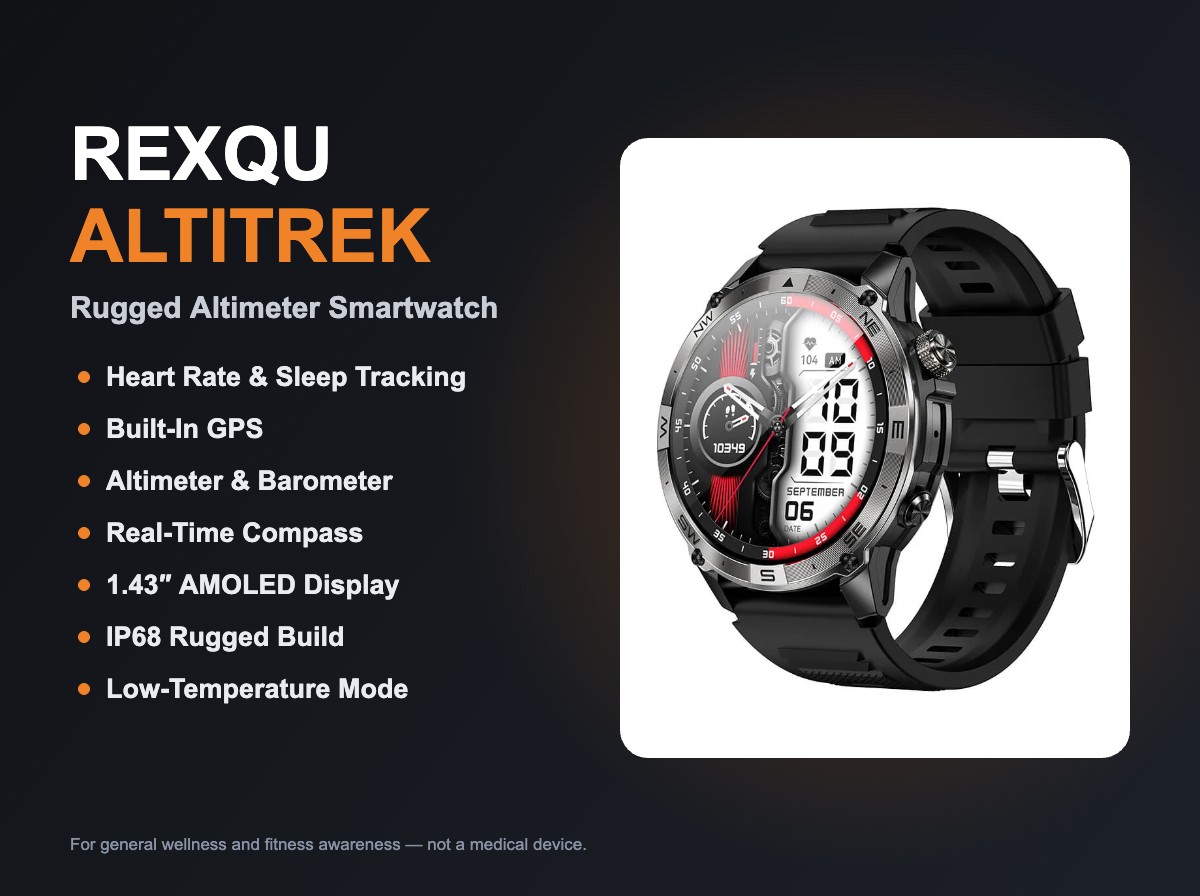
The REXQU AltiTrek ($149.97) combines both: built-in GPS for position and route tracking, plus a precision barometer, altimeter and compass for reading the terrain itself. It’s built into a rugged IP68 case with a 1.43″ AMOLED display, backed by a 530mAh battery and a Low-Temperature Mode for cold starts above the snow line. Heart rate tracking runs 24/7, and there’s no subscription required to use any of it.
AltiTrek vs. BaseCamp: Do You Need the Altimeter?
The REXQU BaseCamp ($119.97) is built for the same rugged use case — IP68 dust and water resistance, a 50mm case, and a built-in compass for bearing — but it skips the barometric altimeter and GPS altitude correction. For day hikes on familiar trails where knowing direction matters more than exact elevation, that’s a reasonable trade for a lower price and a 420mAh battery rated for up to 20 days of standby.
| Feature | REXQU AltiTrek | REXQU BaseCamp |
|---|---|---|
| Price | $149.97 | $119.97 |
| Barometric altimeter | Yes | No |
| Compass | Yes | Yes |
| Built-in GPS | Yes | Not specified |
| Water resistance | IP68 | IP68 |
| Battery | 530mAh | 420mAh, ~20 days standby |
| Cold-weather mode | Low-Temperature Mode | Not specified |
Who Actually Needs Altimeter Tracking
Elevation gain matters most when you’re planning effort around a climb — mountaineers, backcountry hikers and trail runners tracking vertical feet per mile all benefit from a barometric reading that updates instantly rather than lagging behind a GPS fix. It’s also useful for rough weather forecasting, since sudden barometric pressure drops often signal an incoming storm.
If your trips stay mostly flat, or you’re navigating by trail markers rather than terrain, the extra sensor is less critical. In that case BaseCamp’s compass and rugged build handle the basics at a lower price point.
Getting the Most Accurate Readings
Like any barometric altimeter, the AltiTrek reads relative pressure, so it benefits from a manual calibration at a known elevation (a trailhead sign or topo map reading) before a serious climb. Weather changes can shift barometric pressure independent of altitude, so recalibrating at the start of a multi-day trip helps keep the numbers honest — the same practice recommended for any barometric altimeter, wrist-worn or otherwise.
Barometric Altimeter vs GPS Elevation
Neither method is perfect, and the best outdoor watches use both. GPS elevation comes from satellite geometry and can be noisy when the sky is partly blocked. A barometric altimeter responds smoothly to pressure changes as you climb, but weather can change pressure even when you have not moved. That is why calibration matters.
For a steep hike, the most useful workflow is to calibrate at a known trailhead elevation, let the barometric sensor track relative ascent and descent, and use GPS as a second reference. Over a long day, a weather front can shift the pressure baseline, so checking against a known summit, junction or map elevation can keep the reading sensible.
Smartwatch With Altimeter Buyer Checklist
- Choose a barometric altimeter if elevation gain is part of how you pace hikes, climbs or trail runs.
- Choose a compass too if you need direction while standing still; GPS alone infers heading from movement.
- Check built-in GPS if you want route recording without carrying a phone.
- Check water and dust protection for the conditions you actually hike in, not just the word “rugged.”
- Check cold-weather behavior if you hike in winter; the REXQU cold-weather hiking guide compares AltiTrek with TrailGuard.
For the wider navigation decision, see the GPS smartwatch buying guide. You can compare current models on the GPS & hiking smartwatch category.
FAQ: Smartwatch Altimeter Basics
Does a smartwatch with altimeter drain the battery faster? Barometric sensors sip very little power compared to continuous GPS tracking, so AltiTrek’s 530mAh battery holds up well even with the altimeter running throughout a hike.
Can I recalibrate the altimeter mid-hike? Yes — recalibrating at any known elevation point, such as a marked trail junction, resets the baseline and improves accuracy for the rest of the route.
Is GPS elevation ever good enough on its own? For casual walks and flat trails, GPS elevation is usually close enough. It’s steep, forested, or canyon terrain where the gap between GPS and barometric readings grows.
Bottom Line
A smartwatch with altimeter tracking earns its keep on real elevation gain — mountaineering, backcountry routes and steep trail runs where GPS alone isn’t precise enough. For flatter trails and casual hikes, a compass-only rugged watch like BaseCamp gets the job done for less. Compare both alongside the rest of the lineup on REXQU’s rugged smartwatches and GPS smartwatches pages.