
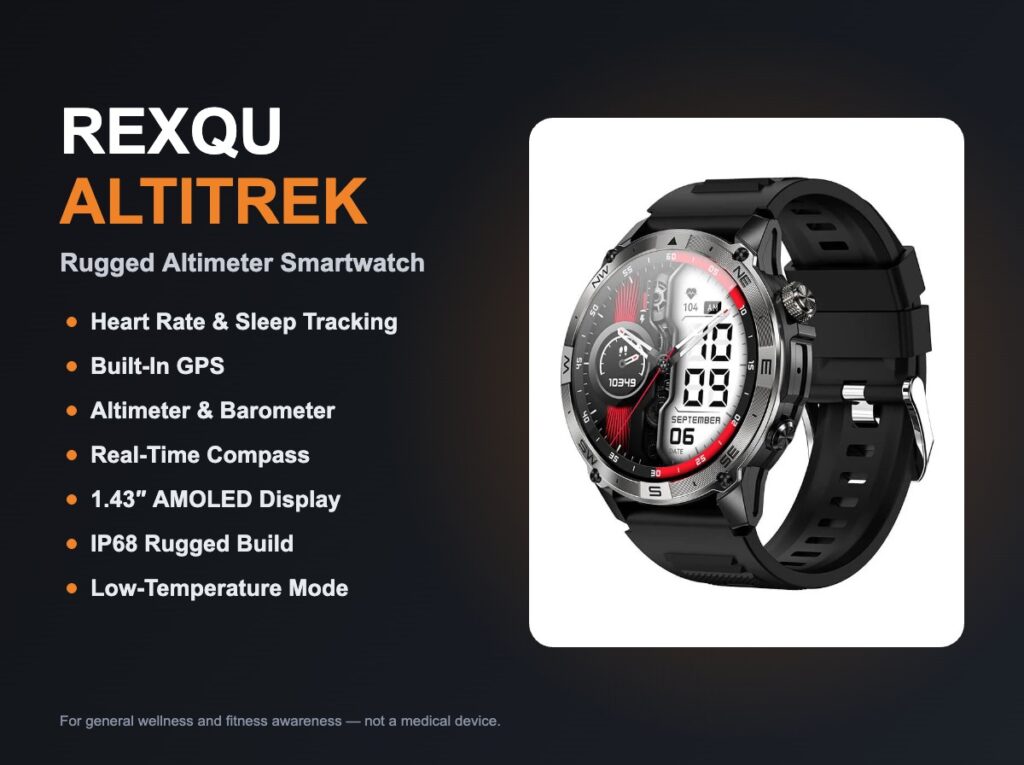
Looking for a smartwatch for cold weather hiking that keeps working when the temperature drops instead of freezing up mid-trail? Most fitness watches are tested for splashes and sweat, not for standing around at a trailhead at 15°F while you wait for a hiking partner. REXQU builds two rugged watches that can handle winter trail conditions, but only one of them is actually engineered for the cold itself.
Here’s how the REXQU AltiTrek and REXQU TrailGuard compare for cold-weather use, and which one is worth the extra step up.
What a Smartwatch for Cold Weather Hiking Actually Needs
Lithium-ion batteries lose capacity as temperatures fall, and touchscreens can get sluggish or unresponsive in freezing air — problems that show up fastest on exposed ridgelines and early-morning winter starts. A smartwatch for cold weather hiking needs a case and battery management built to handle that swing, not just a water-resistance rating for rain and sweat.
REXQU AltiTrek: Built With a Low-Temperature Mode
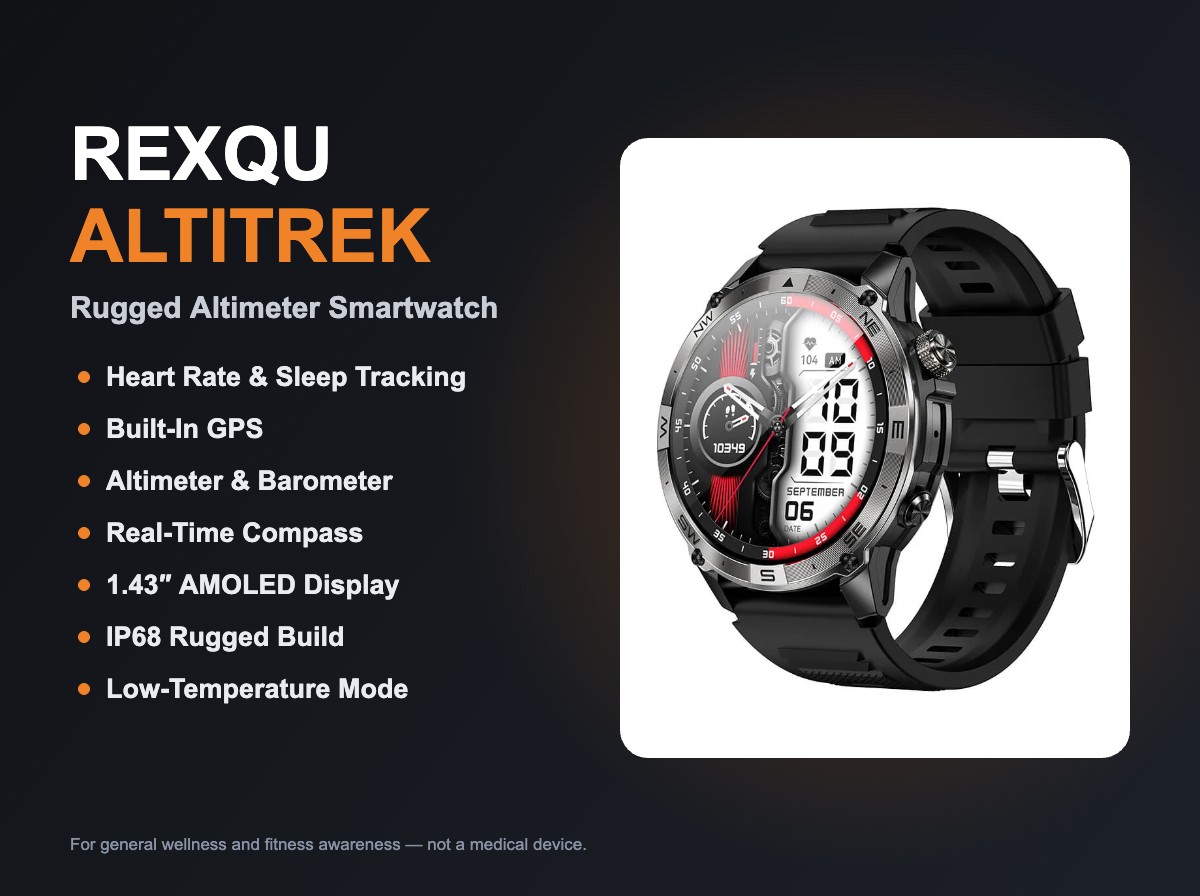
The REXQU AltiTrek ($149.97) is the one REXQU watch that names cold weather directly: a dedicated Low-Temperature Mode that helps the watch keep working as the mercury drops, alongside built-in GPS, a precision barometer, altimeter and compass. It runs on a 530mAh battery inside a rugged IP68 case with a 1.43″ AMOLED display, and tracks heart rate 24/7 with no subscription required.
For anyone doing dawn starts on snow-covered trails, that combination of cold-weather protection and real elevation data (rather than a GPS-only estimate) is the practical reason to pick AltiTrek over a watch that only has the compass and toughness half of the equation.
REXQU TrailGuard: Tough Glass, No Cold-Weather Mode
The REXQU TrailGuard ($149.97) takes a different approach to ruggedness: a Gorilla Glass face over an IP68 body, a real-time compass, altitude readings, and GPS track sync through the paired phone app, plus 90+ sport modes and on-wrist blood pressure tracking. It’s built to survive drops and scrapes on the trail, but REXQU doesn’t list a dedicated cold-weather or low-temperature mode for it.
That makes TrailGuard a strong pick for three-season hiking, trail running and general durability — just not the first choice specifically for sub-freezing conditions.
| Feature | REXQU AltiTrek | REXQU TrailGuard |
|---|---|---|
| Price | $149.97 | $149.97 |
| Low-Temperature Mode | Yes | Not listed |
| Built-in GPS | Yes, on-watch | Track sync via phone app |
| Altimeter & barometer | Yes | Altitude readings (no barometer listed) |
| Compass | Yes | Yes, real-time |
| Case protection | IP68 rugged | IP68 + Gorilla Glass |
| Sport modes | Standard tracking | 90+ sport modes |
| Blood pressure tracking | No | Yes |
Which One Fits Your Winter Trail?
If your hikes run through genuinely cold conditions — alpine starts, snow-season trails, or just a climate where single-digit mornings are normal — the AltiTrek’s Low-Temperature Mode and onboard GPS make it the more purpose-built smartwatch for cold weather hiking. The barometric altimeter is a bonus for anyone tracking real elevation gain rather than a GPS estimate.
If your priority is a tough, glass-protected case for year-round trail running and day hikes, with blood pressure tracking and a deep sport-mode library, TrailGuard covers more everyday bases even without a dedicated cold-weather setting. Cold isn’t off the table for TrailGuard — it’s simply not the feature REXQU built the watch around.
Heart rate and blood pressure readings on both watches are for general wellness awareness, not medical diagnosis — talk to a doctor about any health concerns.
How to Keep a Smartwatch Working Better in the Cold
Cold-weather performance is partly about the hardware and partly about how you wear and manage the watch. A few habits can preserve both battery life and usability on winter hikes:
- Start with a full charge. Cold reduces usable lithium-battery capacity, so do not begin a winter route already at 40%.
- Keep the watch under a sleeve when possible. Your body heat helps keep the battery warmer without blocking normal wrist sensing.
- Reduce unnecessary screen use. High brightness and always-on display consume power you may want later for GPS or navigation.
- Allow extra GPS lock time. Start tracking outdoors before you leave the trailhead rather than beginning under dense trees or beside a building.
- Carry a backup navigation method. A watch is useful, but winter routes deserve a charged phone, map, compass or other backup appropriate to the terrain.
If runtime is your main concern, see the hiking smartwatch battery-life guide. If elevation and pressure data matter, the smartwatch-with-altimeter comparison explains why AltiTrek’s barometric sensor is useful on climbing routes.
Cold-Weather Hiking Smartwatch Buyer Checklist
- Look for a published low-temperature feature or operating range rather than assuming “rugged” means cold-tested.
- Choose enough battery headroom for the expected temperature and GPS hours.
- Check glove usability and physical-button access.
- Match water resistance to snow, slush and rain exposure.
- Decide whether you need built-in GPS, compass, altimeter and barometer for the route.
You can compare the wider outdoor range on the REXQU GPS & hiking smartwatch category and rugged smartwatch category.
FAQ: Smartwatches for Cold-Weather Hiking
Do smartwatch batteries really drain faster in the cold? Yes — lithium-ion batteries temporarily lose capacity in freezing temperatures, which is why a mode built to manage power and touchscreen response in the cold, like AltiTrek’s, matters more than raw battery size alone.
Is IP68 water resistance enough for winter hikes? IP68 protects against dust and sustained water immersion, which covers snow and slush, but it’s a separate spec from cold-temperature performance — a full breakdown of what the IP Code rating system actually tests is worth a look if you want the technical detail.
Can TrailGuard be used in winter at all? Yes — its IP68 and Gorilla Glass build handles winter trail conditions fine. It just doesn’t include a dedicated low-temperature mode the way AltiTrek does.
Bottom Line
For a dedicated smartwatch for cold weather hiking, the REXQU AltiTrek’s Low-Temperature Mode and built-in GPS make it the more specialized pick, while the REXQU TrailGuard trades that cold-specific feature for a tougher Gorilla Glass case and a deeper sport-mode library. Compare both alongside the rest of the collection on REXQU’s rugged smartwatches and GPS & hiking smartwatches pages.