
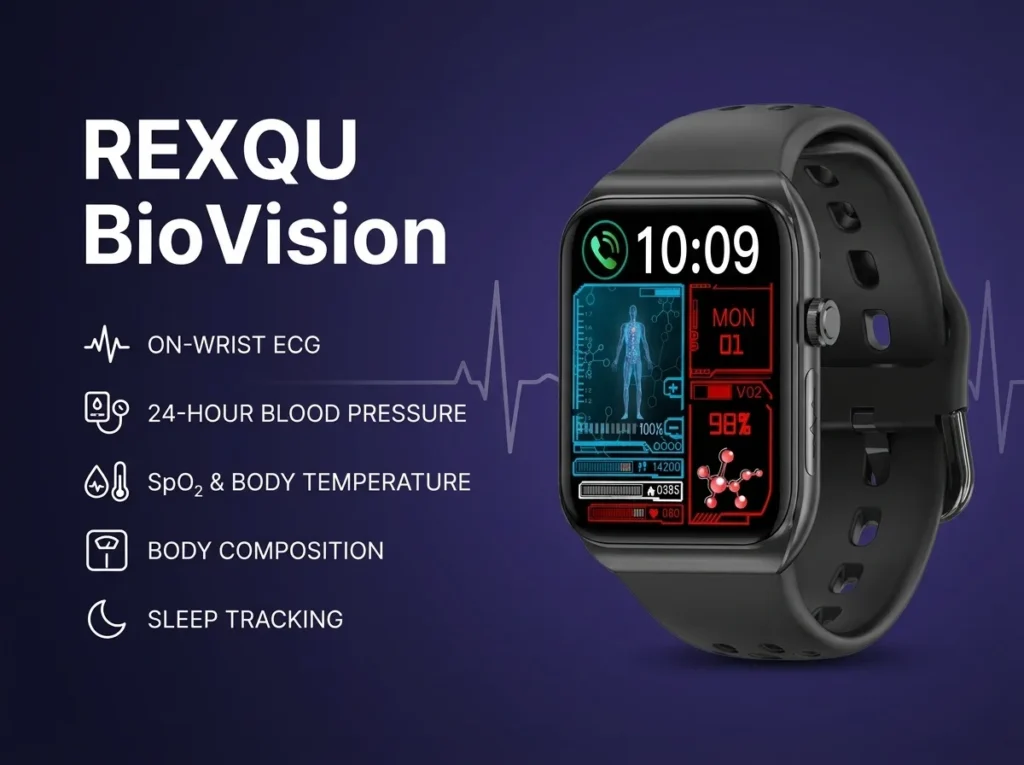
An automatic health monitoring watch is useful if you want wellness data to accumulate in the background instead of remembering to start every reading yourself. But “automatic” can mean different things: some metrics such as heart rate and sleep are well suited to passive tracking, while ECG and some multi-vital checks still require you to sit still and deliberately start a measurement.
REXQU’s BioVision and VitaCore illustrate those two approaches. BioVision emphasizes background blood-pressure trend collection, while VitaCore centers its experience around a fast 30-second multi-vital check. This comparison explains which approach fits different users.
What Is an Automatic Health Monitoring Watch?
A watch earns the “automatic” label when at least some of its sensors gather data without you manually starting each reading. Common examples include:
- continuous or periodic heart-rate estimates;
- automatic sleep detection when the watch is worn overnight;
- background activity and step tracking;
- selected wellness trend features that sample during the day;
- alerts based on configured thresholds or changes in the collected data.
Other measurements are better taken on demand. A wrist ECG, for example, normally requires you to sit still and touch an electrode for a short recording. Blood oxygen and blood-pressure spot checks are also more consistent when you deliberately stop moving and position the wrist properly.
For a broader explanation of the sensors themselves, read Daily Health Monitoring Smartwatch: What It Tracks & How It Works.
BioVision vs VitaCore: Automatic Health Monitoring Watch Comparison
| Feature | REXQU BioVision | REXQU VitaCore |
|---|---|---|
| Best for | Passive/background wellness trends | Deliberate all-in-one wellness checks |
| Blood-pressure style | Background trend collection plus spot checks | On-demand multi-vital check |
| ECG | On-demand wrist ECG | On-demand ECG/multi-vital workflow |
| SpO₂ | Included | Included |
| Temperature | Included | Included |
| Body composition | Included in product feature set | Not the primary focus |
| Display | 1.81-inch HD display | 2.04-inch always-on AMOLED |
| Typical use style | Wear it and review accumulated trends | Stop, take a 30-second check, review the result |
REXQU BioVision: Best for Passive Health Trend Tracking
REXQU BioVision is designed for users who want more information collected without turning every metric into a separate task. Its product feature set combines blood-pressure wellness trends with heart-rate, SpO₂, temperature, sleep, body-composition estimates and an on-demand ECG.
The advantage is convenience. If you forget to take manual readings, background data gives you a fuller day-to-day record to review later. That does not make every reading clinically accurate; it simply reduces the chance that your wellness log contains only the moments when you happened to remember to check.
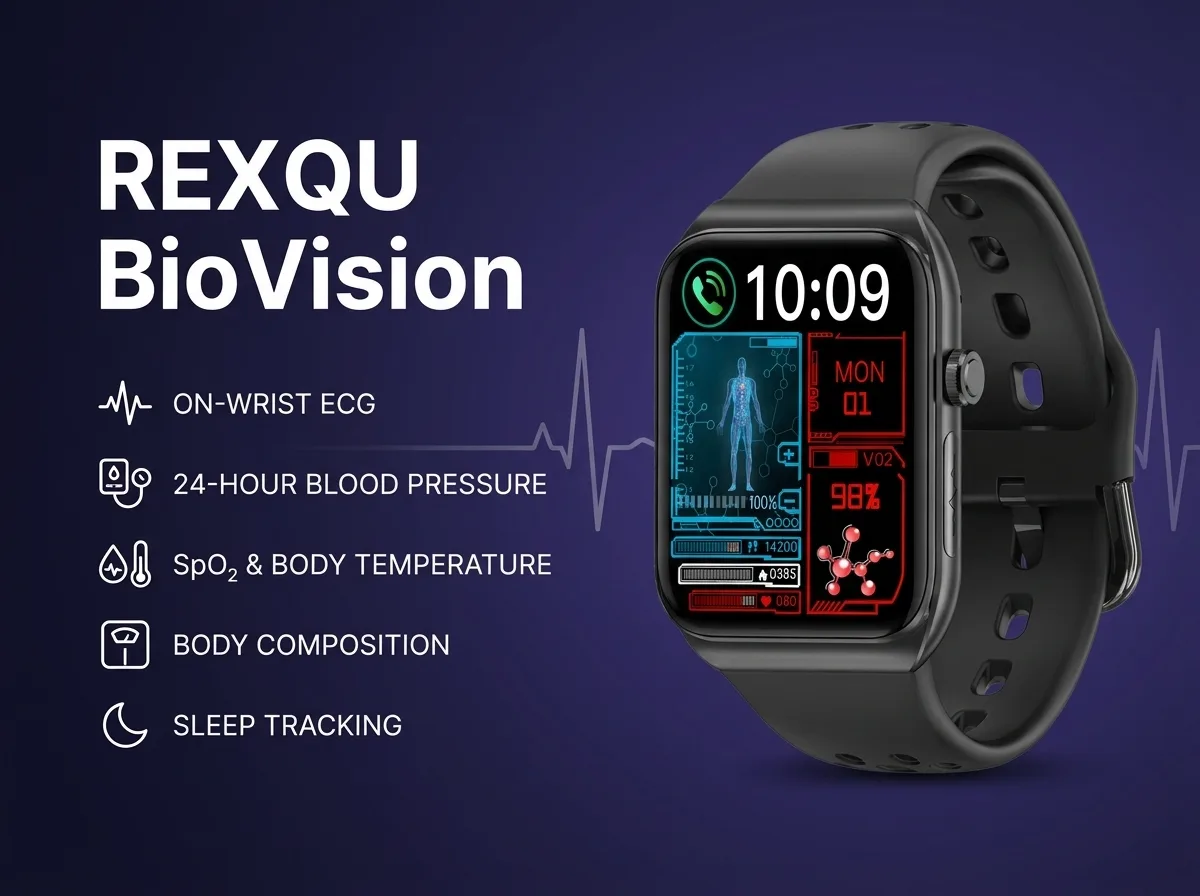
View BioVision specs and current price →
REXQU VitaCore: Best for a Fast Multi-Vital Check
REXQU VitaCore takes a more deliberate approach. Its headline workflow is a 30-second multi-vital check that brings heart rate, blood-pressure wellness estimates, blood oxygen, temperature and stress information together on its 2.04-inch AMOLED display.
This suits someone who prefers a repeatable daily routine: sit down at roughly the same time, keep the wrist still, run one check and review the result. That consistency can be more useful than collecting many readings if you otherwise struggle to interpret a busy dashboard.
View VitaCore specs and current price →
Automatic vs On-Demand Monitoring: Which Is Better?
Neither method is automatically “better.” The right choice depends on what problem you are trying to solve.
Choose automatic/background monitoring if:
- you regularly forget to start readings;
- you want to review patterns across different parts of the day;
- you value passive trend collection more than a single dashboard reading;
- you are comfortable interpreting data as wellness trends rather than clinical measurements.
Choose on-demand multi-vital checks if:
- you prefer a simple daily routine;
- you want to sit still and control the conditions of the reading;
- you find too much background data distracting;
- you want several metrics shown together in one short check.
Does More Automatic Data Mean More Accurate Data?
No. More data points can make patterns easier to see, but quantity does not automatically improve the accuracy of each individual reading. Sensor fit, movement, wrist position and the underlying technology still matter.
This distinction is especially important for cuffless blood pressure. The American Heart Association’s current scientific statement says cuffless BP technologies offer convenience but that their accuracy and clinical utility remain uncertain for diagnosis and treatment decisions. REXQU therefore treats these readings as wellness trend information rather than a substitute for a validated upper-arm cuff.
For the full evidence-based explanation, read Understanding Your Blood Pressure Numbers and Blood Pressure Smartwatch Accuracy: What to Know.
How Automatic Heart-Rate Tracking Fits In
Heart-rate tracking is one of the most natural uses of background monitoring because optical sensors can estimate pulse repeatedly with little effort from the wearer. The result is a resting-heart-rate and daily-activity pattern rather than only a handful of manually captured values.
The American Heart Association notes that heart rate changes with factors including activity and fitness. For wearable users, the useful question is often whether your own baseline is changing consistently—not whether one isolated reading is “good” or “bad.”
Automatic Blood Oxygen Tracking: Use Trends Carefully
SpO₂ is another metric buyers often expect to run automatically. Whether a model samples in the background or uses spot checks, wrist pulse-oximetry should be interpreted carefully. The FDA notes that pulse-oximetry performance can be affected by factors such as circulation, skin pigmentation and skin temperature.
REXQU’s Blood Oxygen (SpO₂) Accuracy Health Guide explains these limitations and how to think about a smartwatch reading in context.
Sleep Is Where Passive Monitoring Makes the Most Sense
Sleep tracking works best when the watch simply stays on your wrist overnight. You should not need to remember to start and stop a timer every night. Automatic detection lets the app estimate sleep duration and stages using movement and heart-rate signals, then compare those patterns across multiple nights.
If sleep is a major purchase reason, see Daily Health Monitoring Watch Sleep Tracking Explained.
How to Get Better Results From an Automatic Health Monitoring Watch
- Wear it consistently. Automatic tracking cannot build a trend when the watch spends half the week on a dresser.
- Keep the fit snug but comfortable. Optical sensors need steady skin contact.
- Do not treat background readings as perfect measurements. Movement can affect wrist-sensor data.
- Take deliberate spot checks when something looks unusual. Sit still and support your arm.
- Review weekly rather than constantly. Trends are easier to interpret than a stream of isolated readings.
- Confirm medically important concerns appropriately. Consumer wellness data should not replace clinical evaluation.
How BioVision and VitaCore Fit Into the Wider REXQU Range
BioVision and VitaCore are not your only choices. If you want a broader comparison by sensor set, display, simplicity and use case, read the Best Daily Health Monitoring Watch buying guide.
If blood-pressure tracking is your main reason for shopping, browse the Blood Pressure Smartwatches category. If you want a wider health-first selection, browse REXQU Health Smartwatches.
Frequently Asked Questions
What does an automatic health monitoring watch track without me doing anything?
That depends on the model. Heart rate, activity and sleep are commonly passive. Selected watches also collect background wellness trends. ECG and some detailed multi-vital checks normally require you to deliberately start the measurement.
Is automatic blood-pressure monitoring better than taking one reading a day?
It can provide more trend data, but more readings do not guarantee greater accuracy. Cuffless wrist BP remains a wellness feature rather than a replacement for clinically validated measurement when medical decisions are involved.
Does automatic monitoring use more battery?
Background sensors consume power, but displays, GPS, calls and other features can also have a large effect. Real-world battery life depends on the combination of features you use.
Can I still take an on-demand reading with BioVision?
Yes. BioVision’s background approach does not prevent you from taking deliberate checks when you want a specific reading.
Which should I choose: BioVision or VitaCore?
Choose BioVision if passive trend collection and body-composition features are more important. Choose VitaCore if you prefer a larger display and one repeatable 30-second multi-vital check.
The Bottom Line
The best automatic health monitoring watch is the one whose monitoring style fits your habits. BioVision is the stronger choice for passive background wellness trends; VitaCore is better for a controlled, all-in-one daily check. For more options, compare the best REXQU daily health monitoring watches or browse the full Health Smartwatches collection.
REXQU watches are consumer wellness devices and are not intended to diagnose, treat, cure or prevent disease. Product features can change; check the linked static product pages for current specifications.