
Looking for a smartwatch flashlight for emergencies — something more useful in a blackout or a roadside breakdown than fumbling for your phone? Here’s how REXQU’s four flashlight watches actually hold up when the lights go out, and which one is worth wearing for that reason alone.
A phone flashlight means digging through a pocket or bag with cold hands, in the dark, possibly one-handed. A wrist light is already there. That difference matters most exactly when you’re least prepared for it: a power outage, a car that won’t start on a dark road, or a fall in an unlit stairwell.
What Makes a Smartwatch Flashlight for Emergencies
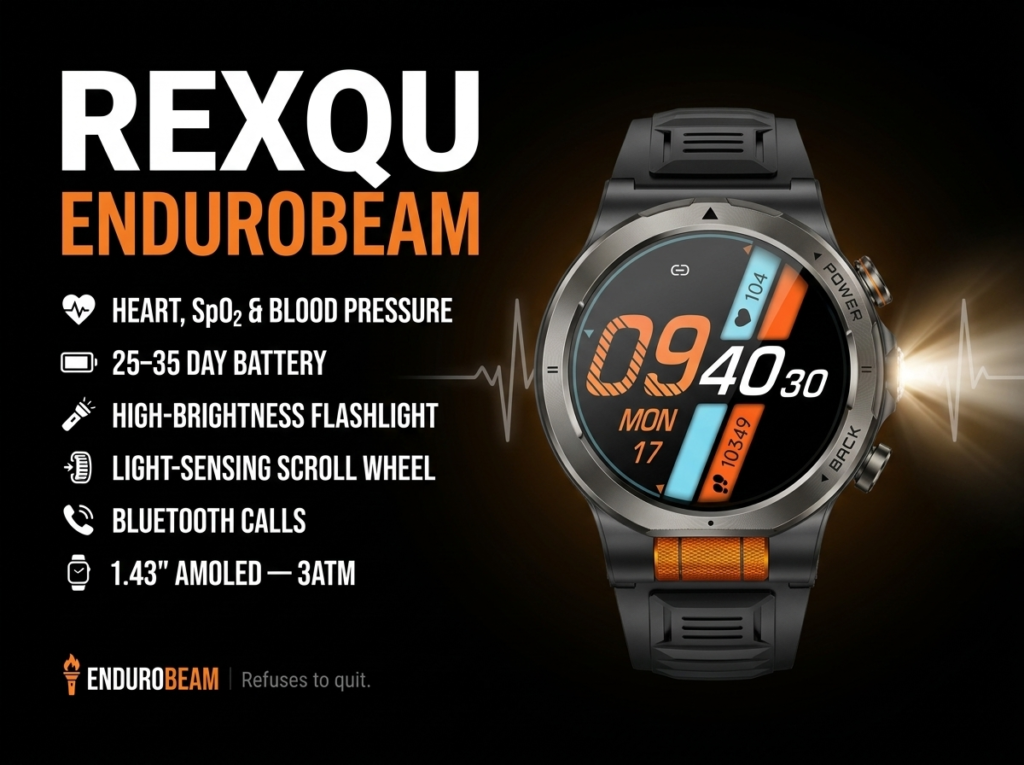
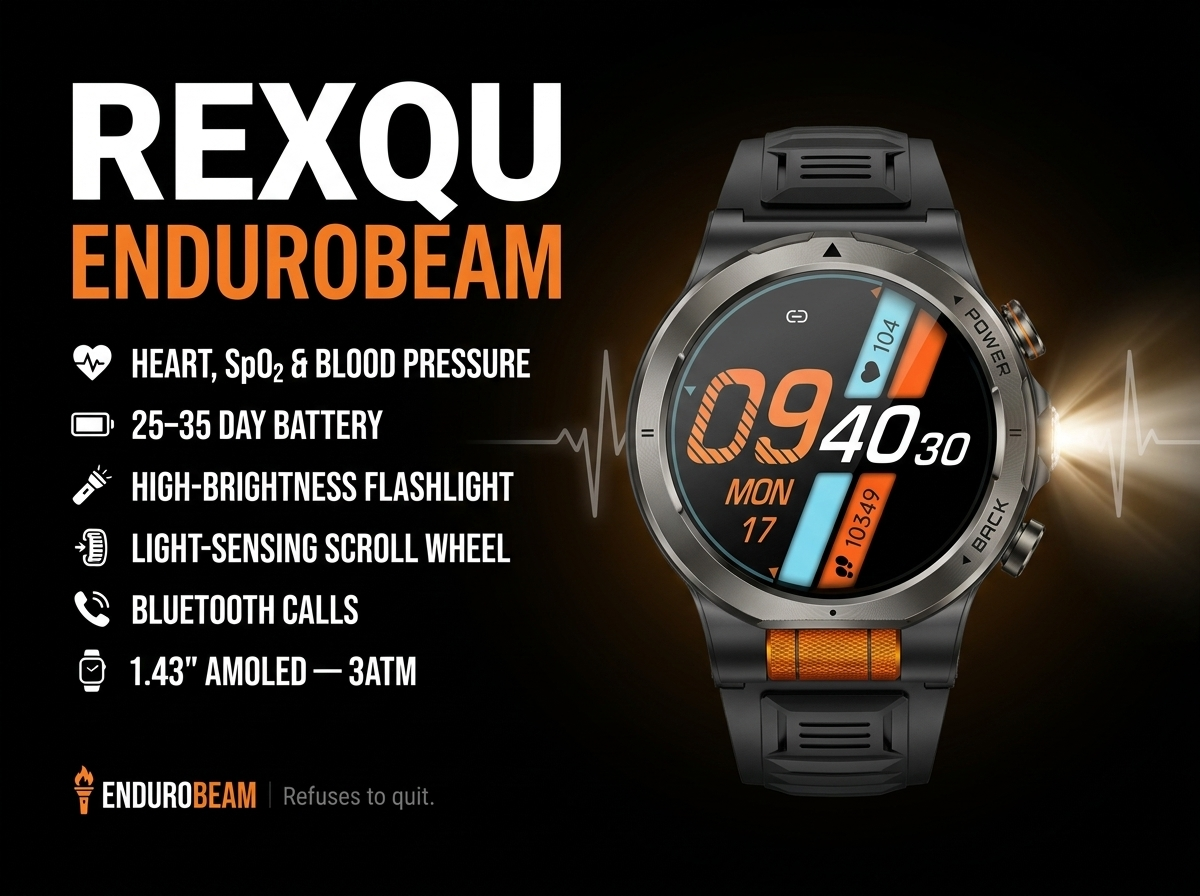
Not every built-in light is equal once you’re actually depending on it. The REXQU EnduroBeam ($159.97) pairs a high-brightness, focused-beam LED with a dedicated SOS strobe mode — a rapid flash pattern meant to get attention from a distance, separate from the steady beam you’d use to read or walk by. Brightness adjusts straight from the scroll wheel, so you’re not hunting through menus while it’s dark. An 1100mAh battery covers 25–35 days of typical use, which matters more here than almost any other spec: an emergency light with a dead battery is worse than no light at all.
SOS Strobe vs. Steady Beam — When Each One Matters
The distinction between a steady beam and an SOS strobe is worth understanding before you need it. A steady beam is for seeing — finding a fuse box, reading a map, checking on a noise. A strobe is for being seen — signaling a passing car, marking your position for someone searching for you, or drawing attention in a crowd. The REXQU Beacon Pro ($149.97) covers both with a 20-metre-plus beam and a dedicated SOS light mode layered on top of UV, all behind a 5ATM water-resistance rating — the highest in the lineup, which counts for anything that happens in bad weather.
An SOS-labelled light mode is best understood as a visual attention signal. Do not assume a consumer watch automatically contacts emergency services or that its flash sequence meets a formal rescue standard unless the manufacturer explicitly says so. On REXQU’s flashlight watches, the light mode is a manual signaling aid; calling for help still requires a phone, cellular-capable device or another emergency communication method.
Real Situations Where It Actually Gets Used
- Power outages: the light is already on your wrist when the breaker trips, no searching a drawer for a working flashlight.
- Car trouble after dark: checking under the hood or setting out a warning triangle hands-free, with the SOS strobe as backup if you need a passing driver to notice you.
- Losing a trail or a dropped item: a focused beam for reading a map or finding a dropped key ring beats holding a phone at an awkward angle.
- Home emergencies at night: a fall, a strange noise, a smoke alarm — instant light without patting around a nightstand.
It’s worth being clear about what this is and isn’t. A smartwatch flashlight for emergencies is a useful backup light — not a certified emergency beacon, medical alert system or substitute for contacting emergency services. Treat it as one layer in a broader preparedness plan. For power cuts, for example, Ready.gov’s power-outage guidance recommends keeping dependable lighting and backup power available rather than relying on a single device.
Emergency Flashlight Watch Checklist
- Charge reserve: choose enough normal-use battery life that the watch is likely to be charged when an unexpected outage happens.
- Fast activation: make sure you can turn the light on without navigating several menus.
- Steady + signaling modes: a steady beam helps you see; a flashing mode helps draw attention.
- Weather resistance: outdoor emergencies often involve rain, so compare 3ATM, 5ATM and IP ratings rather than assuming every rugged-looking watch is equally water resistant.
- Communication backup: a light cannot call for help. Keep your phone or another communication device available where possible.
For water-rating differences, see the flashlight smartwatch water-resistance guide. For runtime, compare the flashlight smartwatch battery-life guide.
Choosing a Smartwatch Flashlight for Emergencies
If battery life is the priority — because a light that dies mid-emergency defeats the purpose — the EnduroBeam’s 25–35 day runtime is the strongest option in the lineup. If beam distance and water resistance matter more, because you might be caught outdoors in bad weather, the Beacon Pro’s 20-metre throw and 5ATM rating are the better fit. Either way, the SOS strobe mode is the feature actually worth checking before you buy, not just the presence of a flashlight.
If battery reserve and a dedicated signaling light are the priorities, start with the EnduroBeam. If outdoor beam distance and 5ATM water resistance matter more, compare the Beacon Pro. The Ridgeline is the better fit when Bluetooth calling belongs in the same package, while the Prisma is designed more for everyday close-range light than emergency-oriented outdoor use.
FAQ: Smartwatch Flashlights and Emergencies
Does the SOS mode call for help automatically? No — REXQU’s SOS mode is a visual strobe light for signaling, not an automatic emergency call or fall-detection alert. It’s meant to help you be seen, not to contact emergency services on its own.
Which REXQU watch has the best flashlight for emergencies? The EnduroBeam is the strongest all-round pick, thanks to its SOS strobe and 25–35 day battery life. The Beacon Pro is the better choice if you also want a longer beam throw and higher water resistance.
How long does the flashlight last on a full charge? On the EnduroBeam, the flashlight is available throughout the watch’s full 25–35 day battery life, since it draws from the same charge as the rest of the watch.