
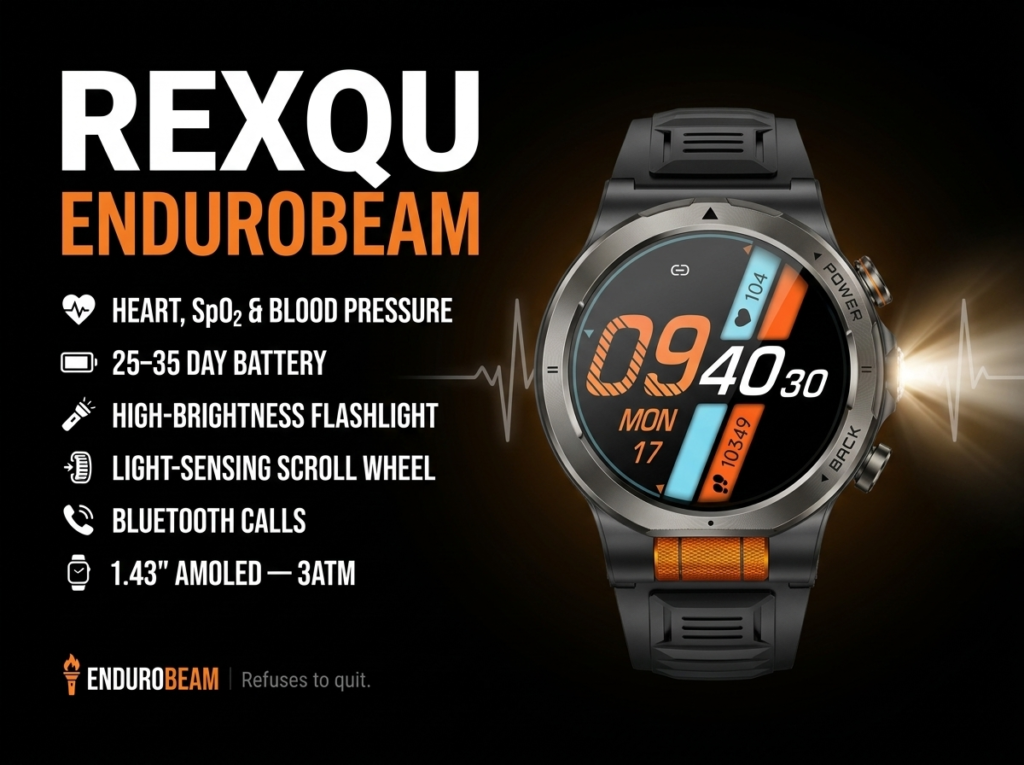
Trying to settle the smartwatch flashlight vs phone flashlight question before your next power outage, camping trip, or dark walk to the car? Both put light exactly where you need it, but they get there very differently — one is already strapped to your wrist, the other is buried in a pocket or bag. Here’s how REXQU’s four flashlight watches actually compare against the torch already on your phone.
Smartwatch Flashlight vs Phone Flashlight: The Core Difference
The biggest advantage of a watch flashlight is availability: the light is already attached to you. Modern phones often provide a flashlight shortcut from the lock screen or control centre, so the difference is not necessarily the number of taps — it is whether you have to find and hold the phone. On a dark dog walk, while carrying bags, or when working with both hands, a wrist light can be more convenient even when the phone produces more light.
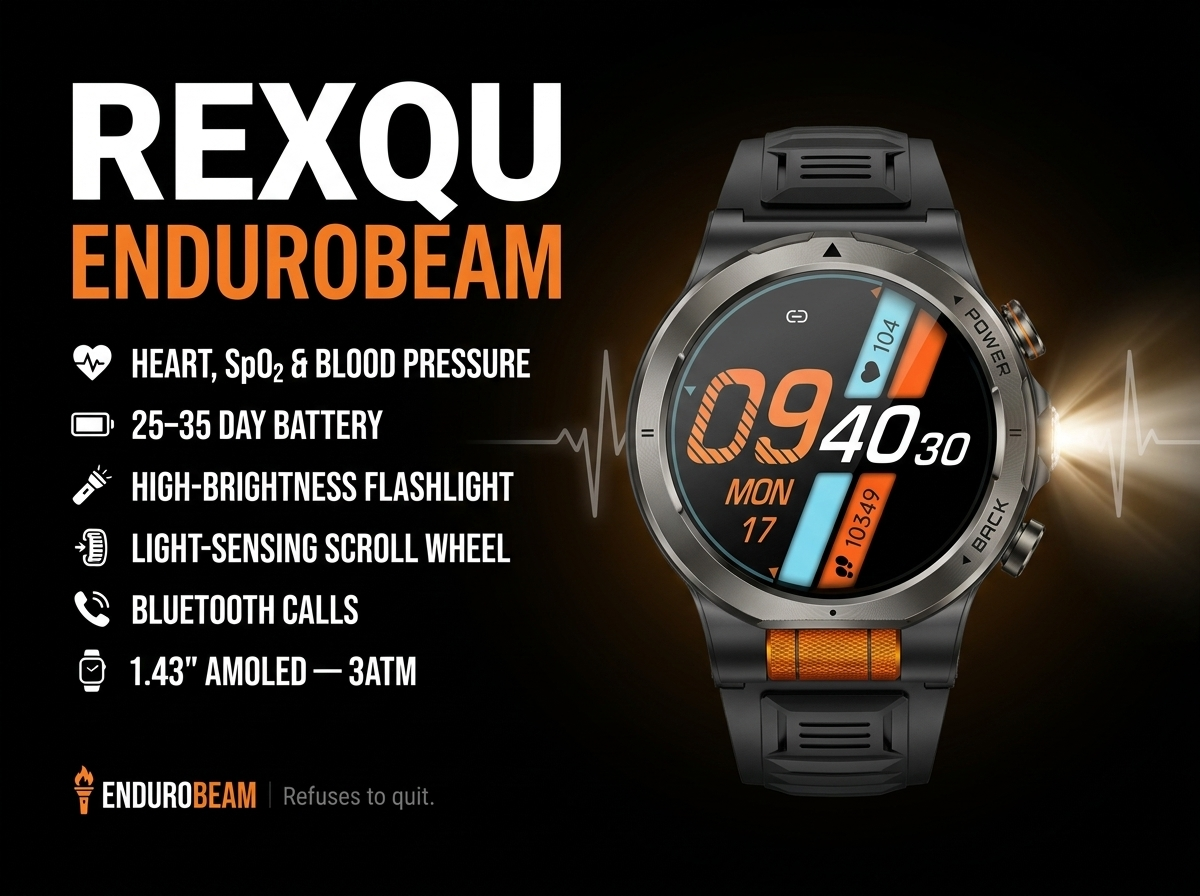
REXQU’s EnduroBeam ($159.97) is the long-battery outdoor option, while the Beacon Pro ($149.97) publishes a 20-metre beam distance and adds UV and SOS light modes.
Where a Phone Flashlight Still Wins
Where a phone often has the advantage is broader illumination. Output varies by phone model, and REXQU does not publish comparable lumen figures for every watch, so it would be misleading to declare one universally brighter. A phone’s camera-flash LEDs can illuminate a wider nearby area, while a purpose-built watch light such as Beacon Pro is designed around quick wrist access and a stated beam distance. For any light, raw output and beam distance are different measurements.
Where a Smartwatch Flashlight Wins
- Already there: no digging through a bag or pocket with cold hands — the light is on your wrist the moment you need it.
- Doesn’t drain your phone: running a phone’s flashlight for an extended period pulls noticeably on its battery; a watch light draws from a separate, dedicated cell.
- Hands genuinely free: holding a phone to light something means one hand is committed. A wrist light leaves both hands open — useful for a tent zipper, a leash, or carrying something at the same time.
- No screen to unlock in the cold: gloved hands and face-unlock don’t always cooperate outdoors; a scroll-wheel flashlight toggle does.
- SOS signaling: the EnduroBeam and Beacon Pro both include a dedicated SOS strobe mode, something a standard phone flashlight app doesn’t offer without a third-party download.
Smartwatch Flashlight vs Phone Flashlight: Quick Comparison
| Factor | REXQU Watch Flashlight | Phone Flashlight |
|---|---|---|
| Access | Already on your wrist; activation depends on model | Usually available from a lock-screen or control-centre shortcut |
| Hands needed | Zero — worn on the wrist | One, to hold the phone |
| Battery drawn from | Dedicated watch battery | Shared with calls, apps, GPS |
| Total brightness | Good for close-range tasks | Usually brighter for wide areas |
| SOS strobe mode | Yes, on EnduroBeam & Beacon Pro | Not built in on most phones |
Real Situations Where the Watch Wins
A power outage where your phone is charging in another room. A dropped key at the front door with grocery bags in both hands. A dog walk before sunrise where you’d rather keep your phone in your pocket. A tent zipper at 2am when your phone is already tucked away for the night. In every one of these, reaching for a phone means finding it first — a smartwatch flashlight is already exactly where your hand already is.
The REXQU Prisma ($129.97), the lightest of REXQU’s flashlight watches at 30 grams, is built specifically for these everyday moments rather than serious outdoor use, while the REXQU Ridgeline ($149.97) pairs its side-mounted light with Bluetooth calling for hands-free convenience beyond just illumination.
So Which One Should You Reach For?
For a quick, close-range task where your hands need to stay free, the smartwatch flashlight vs phone flashlight debate favors the watch every time — it’s faster to activate and doesn’t cost you a free hand. For lighting up a large area, camping, or genuinely bright output, the phone (or a dedicated flashlight) still has the edge on raw lumens. Most people end up using both: the watch for the fast, everyday moment, and the phone when they specifically need maximum brightness.
Flashlight Comparison FAQs
Is a smartwatch flashlight always a separate LED?
No. “Flashlight” can mean different implementations depending on the watch. REXQU’s rugged flashlight models are built around dedicated light hardware, while Prisma is marketed with a built-in flashlight mode for close-range everyday use. Check the individual product specification rather than assuming every watch uses the same emitter or produces the same beam.
Does using the watch flashlight instead of my phone save phone battery?
Yes. Any time spent using a wrist flashlight instead of a phone’s torch is time your phone’s battery isn’t being drawn down by its own flash LED.
Which REXQU model has the brightest flashlight for outdoor use?
The Beacon Pro’s 20-metre-plus beam is the strongest throw in the lineup, ahead of EnduroBeam, Ridgeline and Prisma.
Can I use a smartwatch flashlight and my phone flashlight at the same time?
Yes — there’s nothing stopping you from using both together for extra brightness in a genuinely dark situation.
If you need maximum output for sustained darkness, neither a watch nor a phone is as purpose-built as a dedicated light; see our smartwatch flashlight vs headlamp comparison. If you are comparing REXQU models specifically, use the complete flashlight smartwatch buying guide and the brightness guide.