
Trying to decide between a smartwatch flashlight vs headlamp for your next hike, camping trip, or dark-parking-lot walk to the car? Both put light exactly where you need it without tying up your hands — but they’re built for different jobs, and picking the wrong one means carrying gear you don’t actually need.
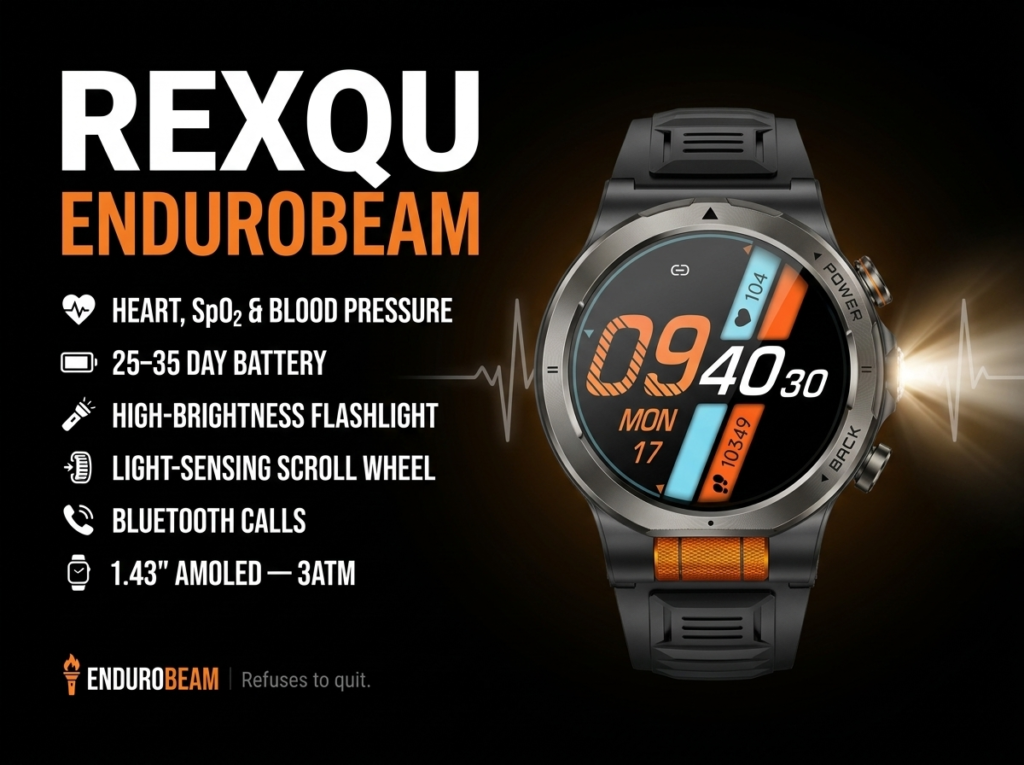
REXQU builds a real LED flashlight into four of its watches, led by the EnduroBeam and Beacon Pro. A dedicated headlamp is still the standard tool for serious night hiking. Here’s how the two actually compare, and when each one wins.
Smartwatch Flashlight vs Headlamp: The Core Difference
The smartwatch flashlight vs headlamp question really comes down to purpose-built brightness versus everyday convenience. A dedicated headlamp is designed from the ground up for one job: throwing a wide, bright beam directly ahead of you for hours of continuous use, often with output in the hundreds of lumens and a beam that reaches well beyond what a wrist-mounted LED can manage.
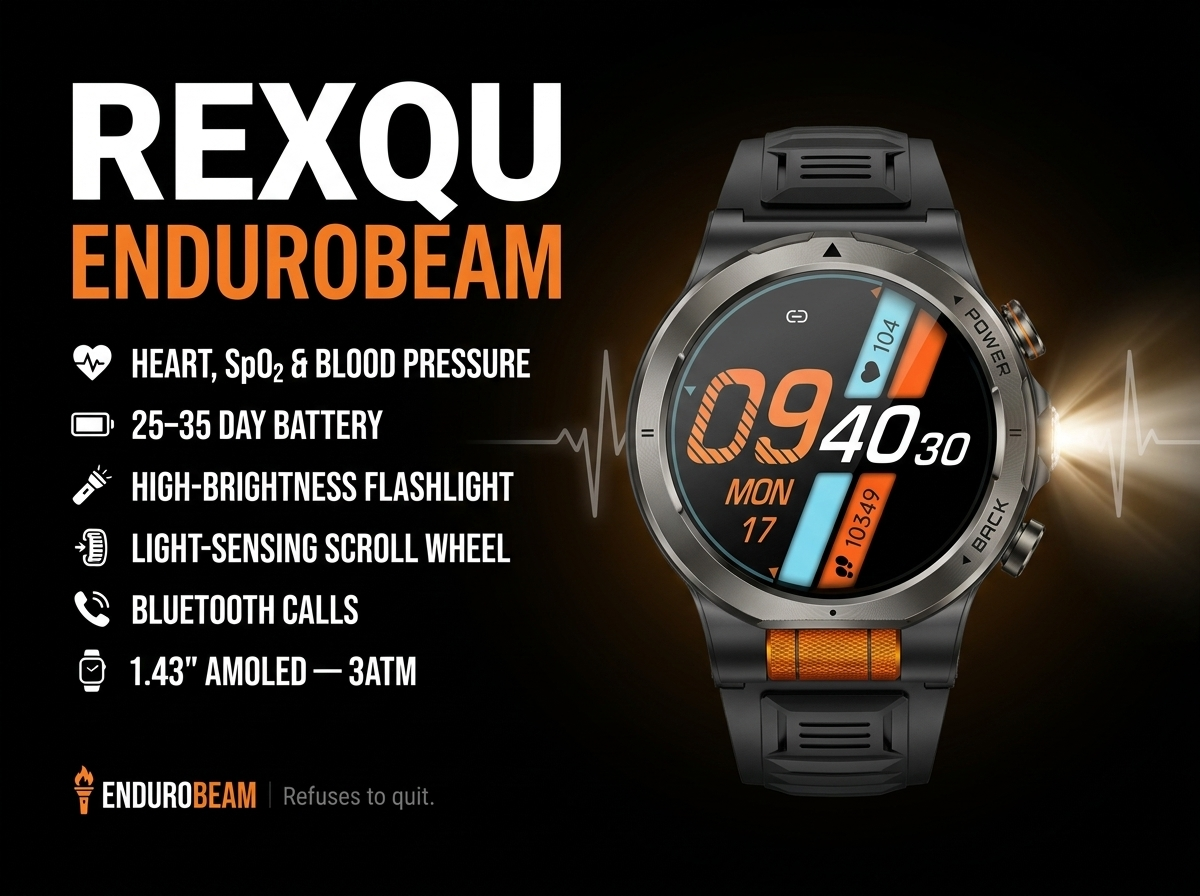
A watch flashlight trades raw brightness for the fact that it’s already on your wrist, all the time, with zero extra gear to remember. REXQU’s EnduroBeam ($159.97) pairs a high-brightness, focused-beam LED with a dedicated SOS strobe mode, adjustable straight from the scroll wheel, backed by a 1100mAh battery good for 25–35 days of typical use. The Beacon Pro ($149.97) throws a 20-metre-plus beam with UV and SOS modes at a 5ATM water-resistance rating, the highest in REXQU’s flashlight lineup.
Where a Headlamp Still Wins
For sustained trail use in full darkness — a multi-hour night hike, setting up camp after sunset, or trail running before dawn — a dedicated headlamp still throws more usable light for longer, with a wider beam spread designed to illuminate the ground ahead of your feet rather than a single focused point. If continuous, hands-free illumination over real distance is the main requirement, a headlamp remains the more capable tool, full stop.
Headlamps also don’t have to share battery capacity with a display, heart-rate sensor, and Bluetooth radio the way a smartwatch does, so a fresh set of batteries can outlast a watch’s flashlight mode running at similar brightness.
Where the Smartwatch Flashlight Wins
- Always there: no separate device to pack, charge, or forget in a drawer — it’s already strapped to your wrist.
- Quick, hands-free tasks: finding a dropped key, checking a fuse box, reading a trailhead sign, or fumbling for a tent zipper.
- Emergency signaling: EnduroBeam and Beacon Pro both include an SOS strobe mode built for getting attention, something most basic headlamps skip entirely.
- One less thing to carry: for short walks, power outages, or everyday carry, a watch flashlight covers the moment without extra gear in a bag.
Smartwatch Flashlight vs Headlamp: Quick Comparison
| Factor | REXQU Watch Flashlight | Dedicated Headlamp |
|---|---|---|
| Always on you | Yes — worn all day | No — must be packed separately |
| Beam strength for night hiking | Good for short, close-range tasks | Stronger, wider beam for sustained use |
| SOS strobe | Included on EnduroBeam & Beacon Pro | Model-dependent, often absent |
| Extra gear needed | None — already on the watch | Separate device plus batteries or charger |
| Battery shared with other features | Yes — display, sensors, Bluetooth | No — dedicated to the light alone |
Smartwatch Flashlight vs Headlamp: Which Should You Pack?
The honest answer depends on whether darkness is planned or unexpected. If you know you will spend an hour or more moving through darkness, a headlamp should be your primary light. If you mainly want something for short tasks, a backup light, or the unexpected walk back to the car after sunset, the watch flashlight is far easier to have with you consistently.
- Choose a headlamp first for night trail running, technical hiking, route-finding, campsite setup or any activity where you need continuous illumination.
- Choose a smartwatch flashlight first for dog walks, brief power outages, keys, repairs, tent tasks and everyday backup lighting.
- Carry both when a failed primary light would create a safety problem. The watch then becomes a useful backup rather than being asked to do the headlamp’s job.
If your decision comes down to beam distance, read the smartwatch flashlight brightness comparison. For emergency backup use, see the emergency flashlight-watch guide.
Frequently Asked Questions
Can a smartwatch flashlight replace my headlamp entirely? For serious night hiking or trail running, no — a dedicated headlamp still throws more light for longer. For everyday convenience and quick emergencies, the watch flashlight is often all you need.
Which REXQU model has the brightest flashlight? The Beacon Pro’s 20-metre-plus beam is the strongest throw in the lineup, while the EnduroBeam trades a bit of distance for the longest battery life at 25–35 days.
Does the SOS strobe work the same as on a dedicated headlamp? REXQU’s SOS mode is a rapid visual strobe for signaling, similar in concept to distress-signal modes found on some headlamps, though it’s a manual feature rather than an automatic alert.
Whether you land on a smartwatch flashlight, a headlamp, or both, matching the tool to how you actually use it beats guessing. Compare specs and pricing on the smartwatches with flashlight shop page before you decide.