
An ECG smartwatch risk assessment can make heart-rhythm information easier to understand by combining an on-wrist ECG trace with other wellness metrics and presenting the result as a readable summary. The important distinction is that a consumer smartwatch can help you capture patterns and organise information; it does not turn a wrist ECG into a clinical diagnosis.
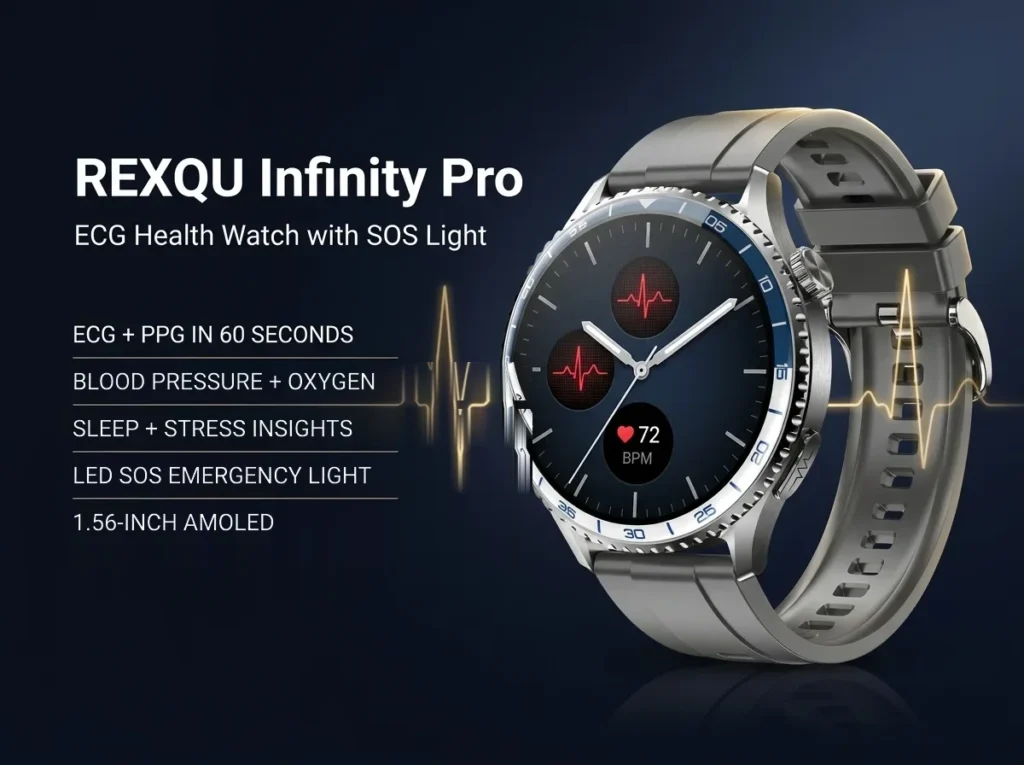
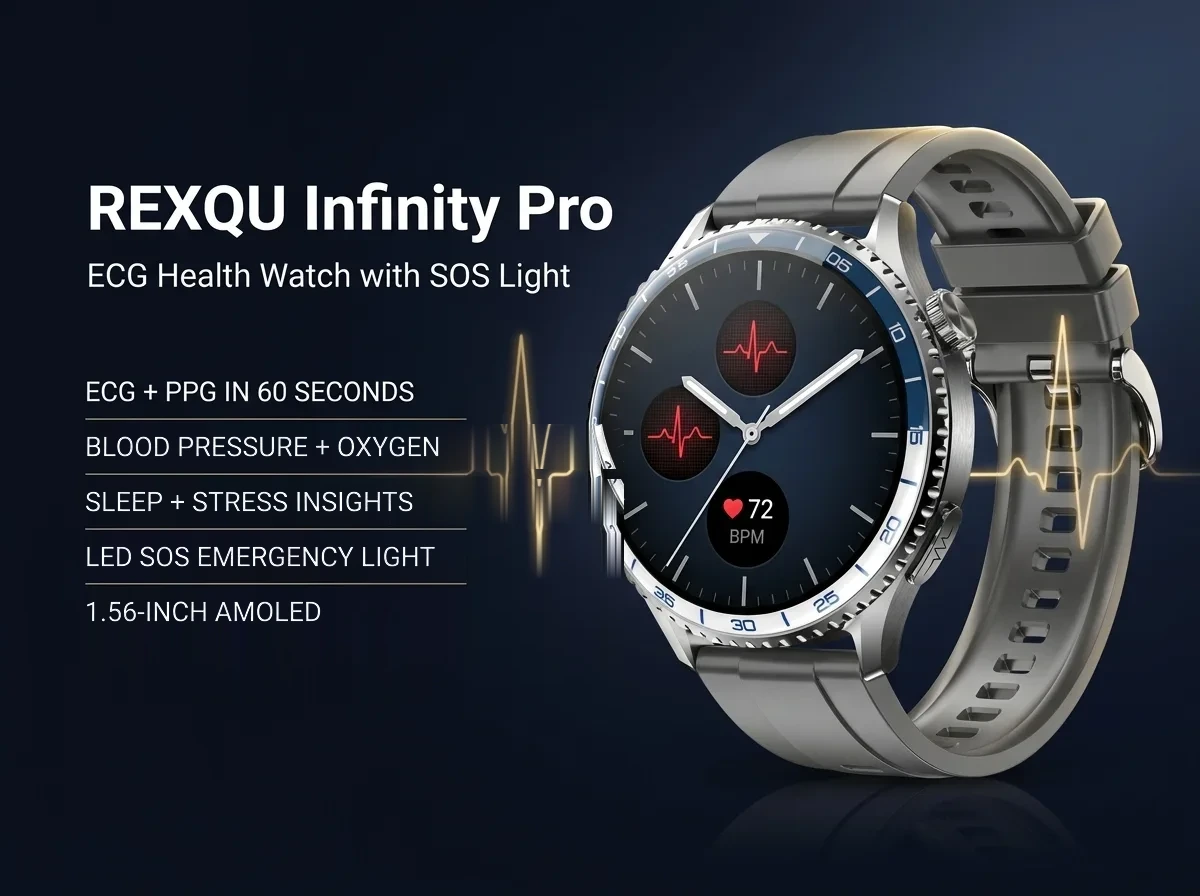
REXQU’s Infinity Pro is built around this idea. Its ECG+PPG system records a wrist ECG, provides rhythm and HRV summaries in the companion app, and can place those readings alongside heart rate, blood pressure, blood oxygen and body temperature from its 60-second health check. Used correctly, that can give you a more useful record to review over time or discuss with a healthcare professional.
What Is an ECG Smartwatch Risk Assessment?
A standard smartwatch ECG records a short electrical trace from the heart, usually by completing an electrical circuit between the watch on one wrist and a finger touching an electrode on the watch case. This is typically a single-lead ECG, which is much simpler than the 12-lead ECG used in clinical settings.
An ECG smartwatch risk assessment adds a software layer. Instead of showing only the waveform, the app may summarise rhythm characteristics, HRV information or other indicators derived from the sensor data. Some watches also place that ECG information beside optical PPG measurements such as heart rate or blood-oxygen wellness readings.
The useful part is organisation: a 60-second trace, the time it was recorded, your heart rate at that moment and other wellness readings can all be stored together. That makes the watch a convenient way to build a personal record instead of relying on memory.
How ECG and PPG Work Together on a Smartwatch
ECG and PPG measure different things. ECG senses the electrical activity associated with each heartbeat. PPG uses light to detect changes in blood volume close to the skin. Combining the two can give a wearable more context than either sensor alone.
ECG: Electrical Rhythm Information
A wrist ECG can produce a waveform showing the timing of heartbeats during the recording window. That is why ECG-equipped wearables can be more informative for rhythm awareness than a basic optical heart-rate monitor.
PPG: Optical Pulse Information
PPG is the optical technology used by many watches for continuous heart-rate tracking. It can help show pulse trends throughout the day, although movement, sensor contact and other factors can affect the signal.
If you want a deeper explanation of the distinction, REXQU’s single-lead ECG smartwatch guide explains what a one-lead wrist recording can and cannot show.
What the REXQU Infinity Pro ECG Report Actually Shows
The REXQU Infinity Pro records an on-wrist ECG and stores rhythm-related summaries in the H Band app. According to the current product specification, its ECG+PPG system also presents HRV and QT-related indicators over time. These should be understood as wellness indicators and app-generated summaries, not as clinically validated diagnoses.
The watch also includes a 60-second health check that places four wellness readings together:
- Heart rate — your pulse during the check.
- Blood pressure estimate — a consumer wellness reading rather than a replacement for a validated upper-arm cuff.
- Blood oxygen (SpO₂) — an optical wellness estimate that can be affected by fit, movement, circulation and other factors.
- Body temperature trend — useful for personal trend awareness rather than diagnosis.
The value of having them together is context. If you take a reading under similar conditions each time, you can compare your own pattern across days instead of focusing on one number.
What an ECG Smartwatch Risk Assessment Cannot Diagnose
This is the most important part of using the feature responsibly. A consumer wrist ECG does not have the same diagnostic scope as a clinical ECG interpreted in a medical setting.
A smartwatch report should not be used by itself to diagnose:
- atrial fibrillation or another arrhythmia;
- a heart attack or myocardial infarction;
- coronary artery disease;
- heart failure;
- long-QT syndrome or another QT-related condition;
- the cause of chest pain, breathlessness, dizziness or fainting.
That does not make the data useless. It means the watch’s strongest role is capturing a trace when you want one and making trends easier to save and share.
How Accurate Is a Single-Lead Smartwatch ECG?
Research on single-lead wearable ECG devices is encouraging, particularly for rhythm screening, but results vary by device, study population and recording quality. An overview of systematic reviews published in 2024 found that single-lead ECG devices can show strong performance for atrial-fibrillation detection in studied settings, while also noting substantial variation between tools and populations. The review is available through PubMed.
That evidence should not be transferred automatically to every consumer watch. The performance of a specific smartwatch depends on its hardware, algorithm, regulatory status and how the recording is taken.
For REXQU specifically, the responsible framing is that the ECG function is for wellness awareness and rhythm recording. If you want a broader evidence discussion, see Can a Smartwatch Detect AFib? and the accompanying REXQU AFib Health Guide.
Why an ECG Smartwatch Reading Can Be Inconclusive
A wrist ECG depends on a clean electrical signal. Several everyday factors can make the trace noisy or difficult to interpret:
- Movement: talking with your hands, walking or shifting position can distort the recording.
- Poor skin contact: the watch and finger electrode both need consistent contact.
- A loose strap: movement between the sensor and wrist can reduce signal quality.
- Very dry or cold skin: electrical contact may be less consistent.
- Recording too soon after exercise: rapid breathing and movement can make a clean trace harder to capture.
- Other rhythm patterns: a single-lead algorithm may not classify every rhythm confidently.
How to Take a Better ECG Smartwatch Recording
If you want readings that are easier to compare, use the same simple routine each time:
- Sit down and rest your forearm on a table or your lap.
- Wear the watch snugly, slightly above the wrist bone.
- Open the ECG function and place the required finger lightly on the electrode.
- Keep both arms still and avoid talking during the recording.
- Let the full recording finish rather than stopping early.
- If the result is noisy or inconclusive, wait a moment and repeat it calmly.
- Save the trace with a note if there was a reason you took it, such as noticing palpitations during a particular activity.
When Is an ECG Smartwatch Report Worth Sharing With a Doctor?
A wearable can be particularly useful when it helps you capture information that would otherwise disappear before an appointment. For example, if you occasionally notice a fluttering or unusually fast heartbeat and can take a short ECG at that moment, saving the trace gives your healthcare professional more context than saying only, “my heart felt strange last Tuesday.”
Useful information to bring with the trace includes:
- the date and time of the recording;
- what you were doing immediately beforehand;
- whether you noticed symptoms;
- your heart-rate trend around the same period;
- whether the same pattern has occurred more than once.
The watch does not decide whether the trace is medically significant. It simply makes the information easier to collect.
Infinity Pro vs Other REXQU ECG Smartwatches
REXQU has several ECG-equipped models, but they emphasise different use cases. Infinity Pro is the clearest fit for shoppers interested in an ECG smartwatch risk-assessment style report and broader wellness dashboard.
| Model | ECG Approach | Best For | Other Useful Features |
|---|---|---|---|
| Infinity Pro | On-wrist ECG with rhythm/HRV summaries | Broad wellness dashboard | 60-second health check, SOS, AMOLED, flashlight |
| CardioSense | Short on-wrist ECG recording | Large, easy-to-read display | Blood-pressure wellness tracking and health metrics |
| PulseBand | Screenless ECG-focused band | Long battery life and low-distraction wear | HRV-related tracking, no subscription |
| HealthWave | On-wrist ECG | Straightforward everyday health tracking | Heart rate and blood-pressure wellness features |
ECG Smartwatch Risk Assessment vs a Clinical ECG
A smartwatch ECG is usually a short, single-lead recording. A clinical 12-lead ECG views the heart’s electrical activity from multiple angles and is interpreted in the context of symptoms, history and other tests. Those are not interchangeable tools.
The advantage of the smartwatch is availability: it is already on your wrist when you decide to capture a trace. The advantage of clinical testing is diagnostic depth, professional interpretation and validated medical context.
The most sensible approach is therefore complementary: use the watch to organise wellness information and capture short traces, then use appropriate medical evaluation when a health concern requires diagnosis.
Frequently Asked Questions About ECG Smartwatch Risk Assessments
Can an ECG smartwatch tell me if I have heart disease?
No. A consumer smartwatch can record rhythm information and display wellness summaries, but it cannot diagnose heart disease by itself.
Can the Infinity Pro diagnose AFib?
No. Infinity Pro is a consumer wellness device. Its ECG can help you record rhythm information that may be useful to review or share, but a diagnosis requires appropriate clinical assessment.
What is the difference between ECG and HRV?
ECG records the heart’s electrical waveform during the recording window. HRV describes variation in the time between heartbeats. They are related but different measurements.
What does a QT indicator on a smartwatch mean?
It should be treated as an app-generated wellness indicator rather than a diagnosis of a QT abnormality. Clinical QT assessment depends on a properly recorded ECG and professional interpretation.
How often should I take an ECG on my smartwatch?
There is no universal schedule for consumer wellness use. Many people take a reading when they want a baseline or when they notice something they want to document. If a healthcare professional has given you a monitoring plan, follow that plan rather than a generic smartwatch routine.
Bottom Line: What Does an ECG Smartwatch Risk Assessment Really Give You?
An ECG smartwatch risk assessment is most valuable as a structured record of wellness information—not as a diagnosis. A watch such as the REXQU Infinity Pro can capture a short ECG, organise rhythm and HRV-related summaries, and place those results beside other daily-health metrics. That can make patterns easier to notice and conversations with a healthcare professional more informed.
If ECG is your main buying priority, compare Infinity Pro with the rest of the REXQU ECG smartwatch range. If your main question is what wrist ECG can tell you about irregular rhythms, start with the evidence-based REXQU AFib & Smartwatch ECG Health Guide.
This article is for general information and wellness education and is not medical advice. REXQU smartwatches are consumer wellness devices, not diagnostic medical devices. See our Editorial & Research Standards for how REXQU approaches evidence, limitations and product-related health content.