
Choosing the best ECG smartwatch comes down to more than whether the watch can record a 30-second rhythm trace. Display size, battery life, design, blood-pressure tracking, screenless wear and how easily you can review your recordings all matter in day-to-day use.
This guide explains how a wrist ECG works, what a single-lead smartwatch ECG can and cannot show, how to choose between different REXQU models, and when you should still rely on clinical testing. You can also browse the full static REXQU ECG Smartwatches collection for current models and specifications.
What Is an ECG Smartwatch?
An ECG smartwatch is a wearable with electrodes that can record the electrical activity of your heart over a short period, usually while you remain still and touch a sensor on the watch with your opposite hand.
Unlike an optical heart-rate sensor, which estimates pulse from blood-flow changes, an ECG measures an electrical signal. That gives you a short rhythm trace rather than simply a beats-per-minute number.
Most consumer smartwatch ECGs are single-lead ECGs. A clinical ECG uses multiple leads and gives healthcare professionals a much broader view of the heart’s electrical activity.
How Does a Smartwatch ECG Work?
When you start an ECG recording, electrodes in the watch create an electrical circuit between your wrist and the finger touching the sensor. The watch records the signal for roughly 30–60 seconds and stores a waveform in the companion app.
The American Heart Association explains how clinical electrocardiography records the heart’s electrical activity. A smartwatch uses the same basic principle, but in a much simpler single-lead format.
For a deeper explanation, read Single-Lead ECG Smartwatch: What It Can and Can’t Show.
Can an ECG Smartwatch Detect AFib?
A wrist ECG can provide useful rhythm information, but a consumer wellness device should not be treated as a stand-alone diagnosis of atrial fibrillation. Signal quality, motion, electrode contact and the timing of the recording all matter.
REXQU has a separate evidence-based guide focused specifically on this topic: Can a Smartwatch Detect AFib? What a Wrist ECG Can Show.
Best REXQU ECG Smartwatches: Quick Comparison
| Model | Best For | ECG Style | Battery | Standout Feature |
|---|---|---|---|---|
| Infinity Pro | Classic watch styling | On-demand wrist ECG | Multi-day use | Round AMOLED, broader heart-wellness feature set |
| CardioSense | Large display + blood pressure | 30-second on-demand ECG | About 5–7 days | 2.01-inch display, blood-pressure trends |
| PulseBand | Screenless tracking | App-based on-band ECG | About 25–30 days | No display, long battery life, HRV features |
| HealthWave | Simpler ECG experience | On-demand wrist ECG | Multi-day use | Large AMOLED and heart-rate tracking |
Best Overall ECG Smartwatch: REXQU Infinity Pro
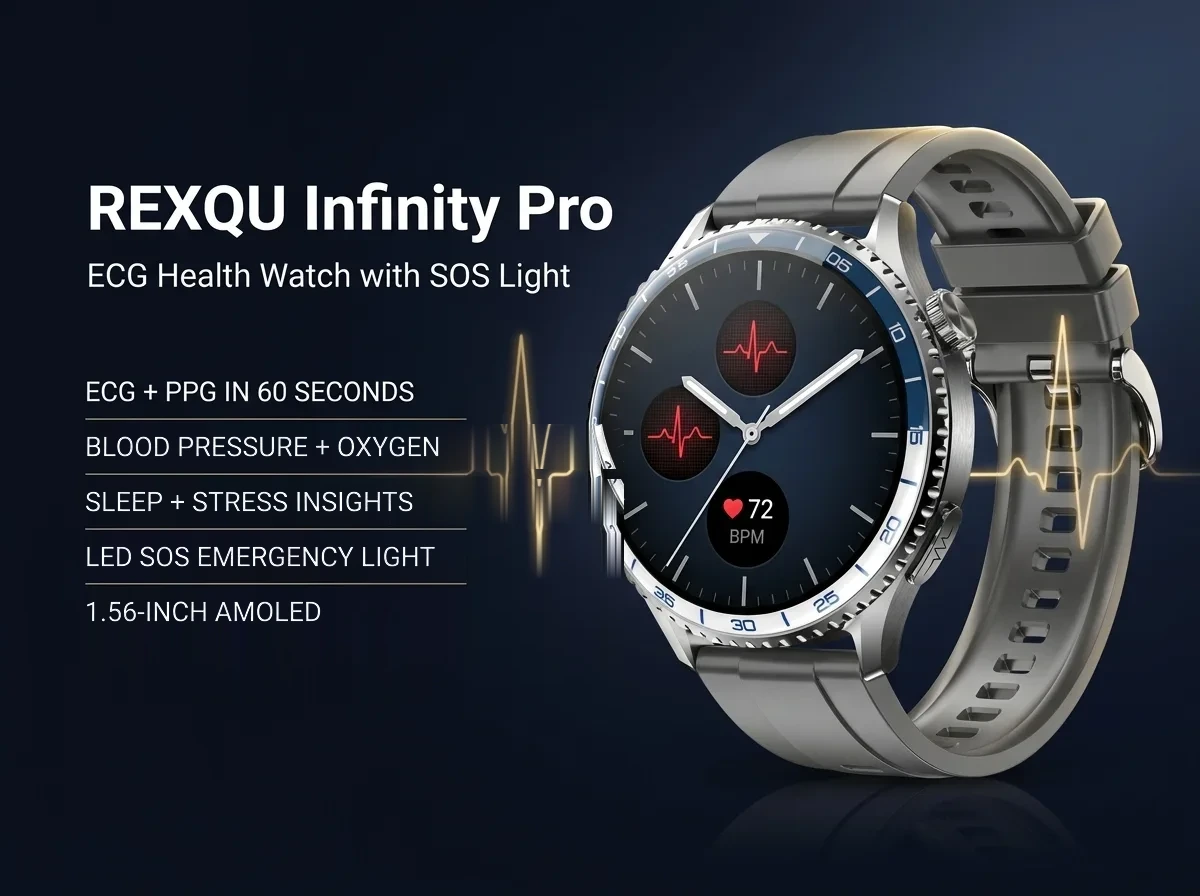
The REXQU Infinity Pro is a strong all-round ECG choice if you want a watch that looks more traditional while still offering on-wrist rhythm recording and broader wellness features.
Its round AMOLED design makes it a better fit for buyers who want an ECG smartwatch that can work in both casual and dressier settings.
Choose Infinity Pro if you want:
- A more traditional round-watch appearance.
- On-demand ECG rhythm recordings.
- Additional heart-wellness information beyond a basic heart-rate tracker.
- A watch that does not look primarily like a fitness band.
View REXQU Infinity Pro →
Best ECG Smartwatch With Blood Pressure: REXQU CardioSense
The REXQU CardioSense is the stronger choice if you specifically want ECG plus blood-pressure wellness trends on a large display.
Its 2.01-inch screen is useful for buyers who find smaller smartwatch displays difficult to read. CardioSense also includes heart-rate tracking, sleep-stage estimates, guided breathing exercises and IP67 water resistance.
For a dedicated review, see Blood Pressure Smartwatch With ECG: REXQU CardioSense.
View REXQU CardioSense →
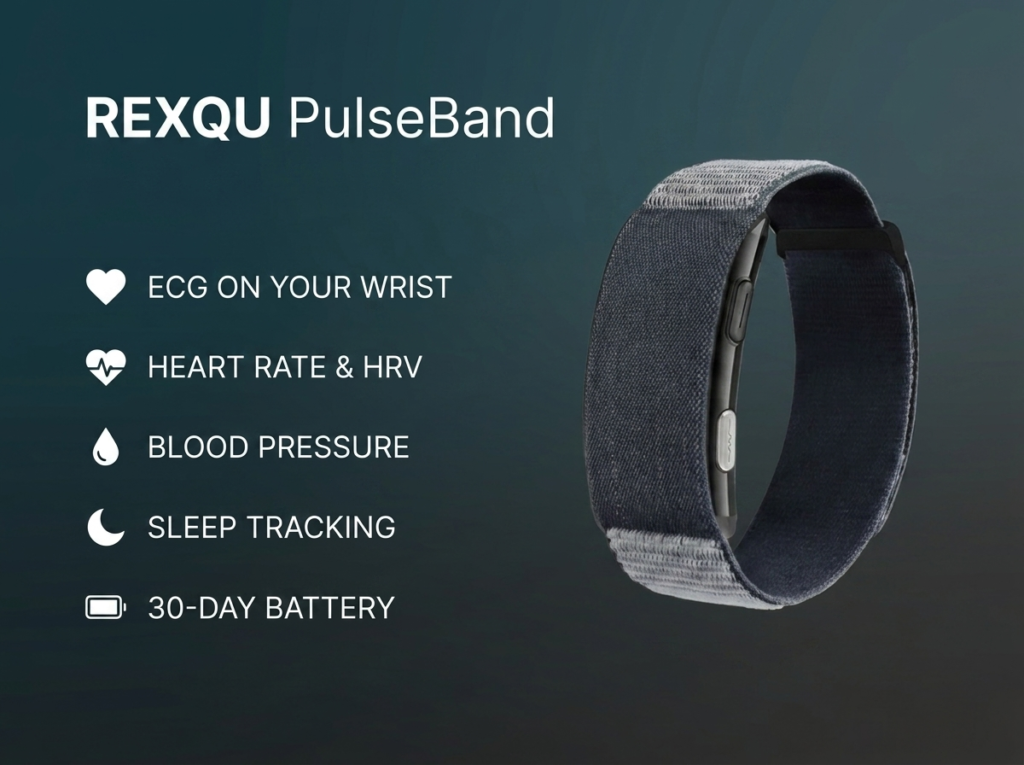
Best Screenless ECG Tracker: REXQU PulseBand
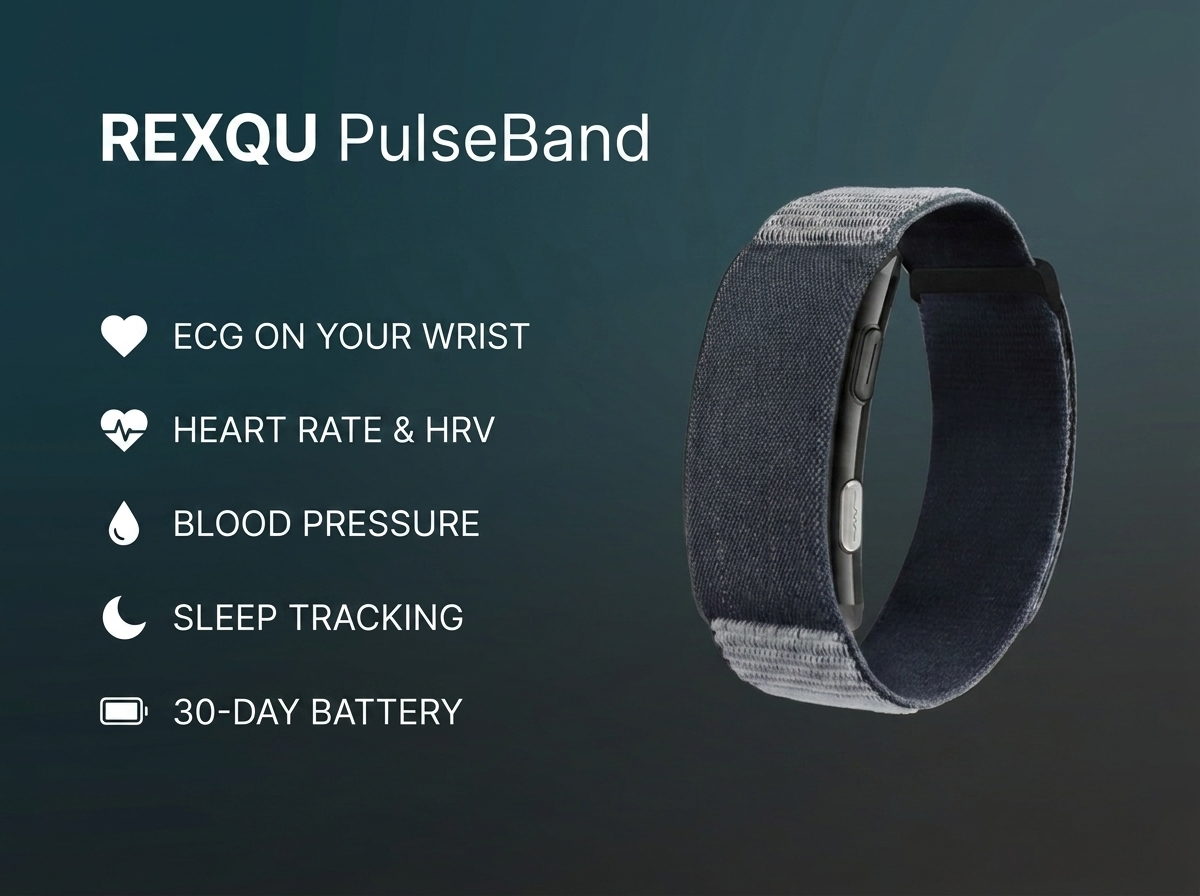
The REXQU PulseBand is the best fit if you want ECG and heart-rate information without wearing another illuminated screen.
Its biggest practical advantage is battery life. Without a conventional display drawing power, PulseBand can run far longer between charges than many smartwatch-style devices.
Choose PulseBand if you want:
- A screenless design.
- Long battery life.
- ECG and HRV information in the companion app.
- A tracker that is less distracting overnight.
View REXQU PulseBand →
Best Simple ECG Smartwatch: REXQU HealthWave
The REXQU HealthWave is worth considering if you want a simpler ECG-oriented smartwatch without making the buying decision entirely about advanced secondary metrics.
It combines on-demand ECG with heart-rate tracking and a large display, making it a more straightforward option for buyers who mainly want ECG awareness plus everyday smartwatch functions.
How to Choose the Best ECG Smartwatch
1. Decide whether ECG is your main priority
If ECG is the feature you care about most, start with models where rhythm recording is central to the experience. If you also want blood pressure, SpO₂ or safety features, compare those secondary functions carefully.
2. Choose between a screen and a screenless band
A conventional smartwatch gives you immediate on-wrist feedback. A screenless tracker gives you fewer distractions and typically better battery life.
3. Consider display size
If readability matters, CardioSense is especially attractive because of its 2.01-inch display.
4. Check battery life
Battery life affects how much overnight and all-day data you actually collect. PulseBand is particularly strong if charging frequency is a major concern.
5. Think about how you will review the ECG
The real value of a wearable ECG often appears after the recording, when you can review the trace, compare it with previous recordings and bring selected information to a healthcare appointment.
How Accurate Is a Smartwatch ECG?
A smartwatch ECG can be useful for rhythm awareness, but accuracy depends on several factors:
- Electrode contact.
- Movement during the recording.
- Skin contact and band fit.
- The quality of the watch hardware and software.
- The type of rhythm being recorded.
- Whether the signal is clean enough to interpret.
Do not assume that a smartwatch ECG is equivalent to a clinical ECG simply because both use electrical signals. A clinical 12-lead ECG captures the heart from multiple electrical viewpoints and is interpreted in a medical context.
How to Take a Cleaner ECG Reading
- Sit down and rest for a moment.
- Wear the watch snugly against the wrist.
- Place your arm on a stable surface.
- Touch the ECG sensor lightly and steadily.
- Keep your wrist and fingers still for the full recording.
- Repeat the reading if the first trace is noisy or incomplete.
Can You Share a Smartwatch ECG With Your Doctor?
Wearable ECG information can be useful as supporting context during an appointment, particularly when it shows when a recording occurred and whether similar traces appeared more than once.
The exact sharing or export method depends on the companion app and app version. Before an appointment, review the recordings you want to discuss so you are not searching through weeks of data in the exam room.
For a step-by-step preparation guide, see How to Share ECG Smartwatch Readings With Your Doctor.
ECG Smartwatch vs Heart-Rate Monitor
| Feature | ECG Smartwatch | Standard Heart-Rate Tracker |
|---|---|---|
| Measures | Electrical rhythm trace | Pulse/heart-rate estimate |
| Typical recording | Short on-demand trace | Continuous or frequent optical monitoring |
| Useful for rhythm context | Yes | Limited |
| Best for workouts | Not during the ECG recording itself | Yes, depending on device |
| Replaces clinical ECG | No | No |
Who Should Consider an ECG Smartwatch?
An ECG smartwatch may be useful if you want:
- More rhythm information than a simple heart-rate number.
- A convenient way to capture a short trace when you choose.
- A record you can review later.
- A wearable that combines ECG with other everyday health and fitness features.
If you have symptoms, a diagnosed heart condition or concerns about arrhythmia, a smartwatch should complement—not replace—professional evaluation.
Frequently Asked Questions About ECG Smartwatches
Can an ECG smartwatch diagnose AFib?
No consumer wellness watch should be treated as a stand-alone diagnosis. A wrist ECG can provide useful rhythm information, but medical evaluation remains important when AFib or another rhythm problem is suspected.
How long does a smartwatch ECG recording take?
Many REXQU ECG models use a short on-demand recording of around 30 seconds.
Can I record an ECG while exercising?
For a cleaner trace, sit still and support your arm during the ECG recording. Movement can introduce noise into the waveform.
Which REXQU ECG smartwatch has the best battery life?
The screenless PulseBand is the strongest choice if long battery life is your priority.
Which REXQU ECG smartwatch is easiest to read?
CardioSense is a strong choice for readability because of its large 2.01-inch display.
Do REXQU ECG watches require a subscription?
REXQU’s core ECG and wellness features do not require a recurring REXQU subscription.
Best ECG Smartwatch: Final Recommendations
- Best overall: REXQU Infinity Pro
- Best ECG + blood pressure watch: REXQU CardioSense
- Best screenless ECG tracker: REXQU PulseBand
- Best simple ECG option: REXQU HealthWave
Ready to compare the full range? Visit the static REXQU ECG Smartwatches category → or open the individual product pages above for current specifications and pricing.
REXQU smartwatches are consumer wellness devices and are not intended to diagnose, treat, cure or prevent disease. Seek professional medical advice for symptoms, diagnosis or treatment decisions.