
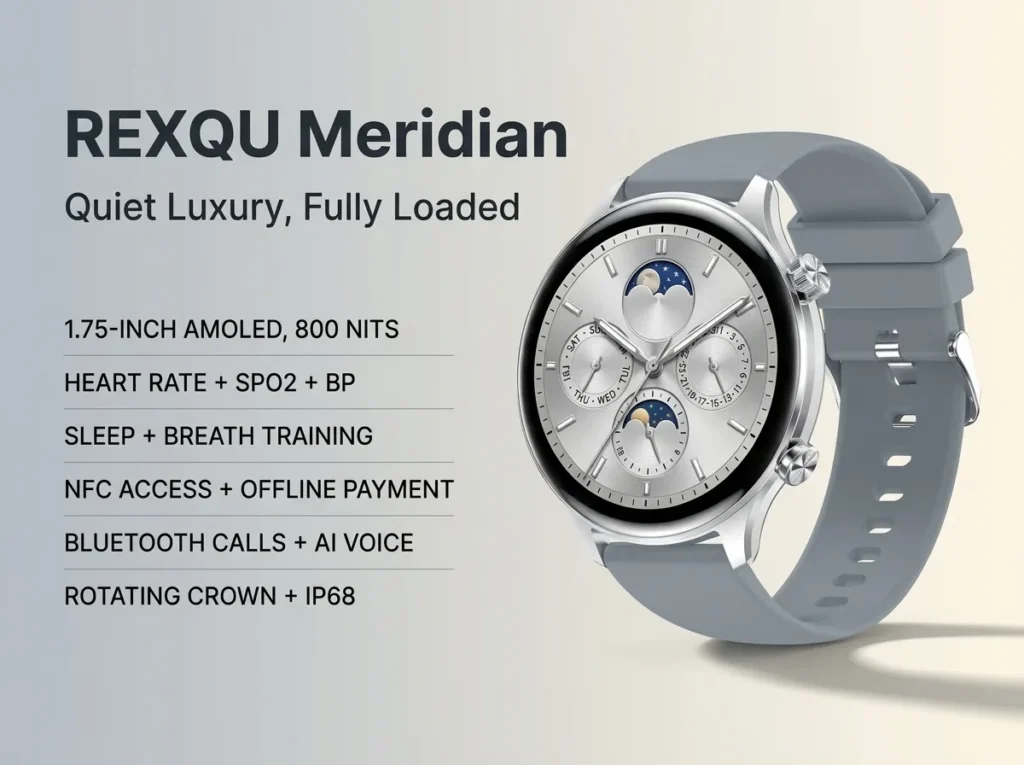
Looking for a smartwatch with Bluetooth calls that still looks appropriate for everyday wear? The REXQU Meridian and REXQU Verve both let you answer and make calls from the wrist through a paired phone, but they target different buyers: Meridian leans toward everyday convenience and NFC, while Verve emphasizes a brighter round display, music and sport modes.
REXQU Meridian: Calls, NFC and a Rotating Crown
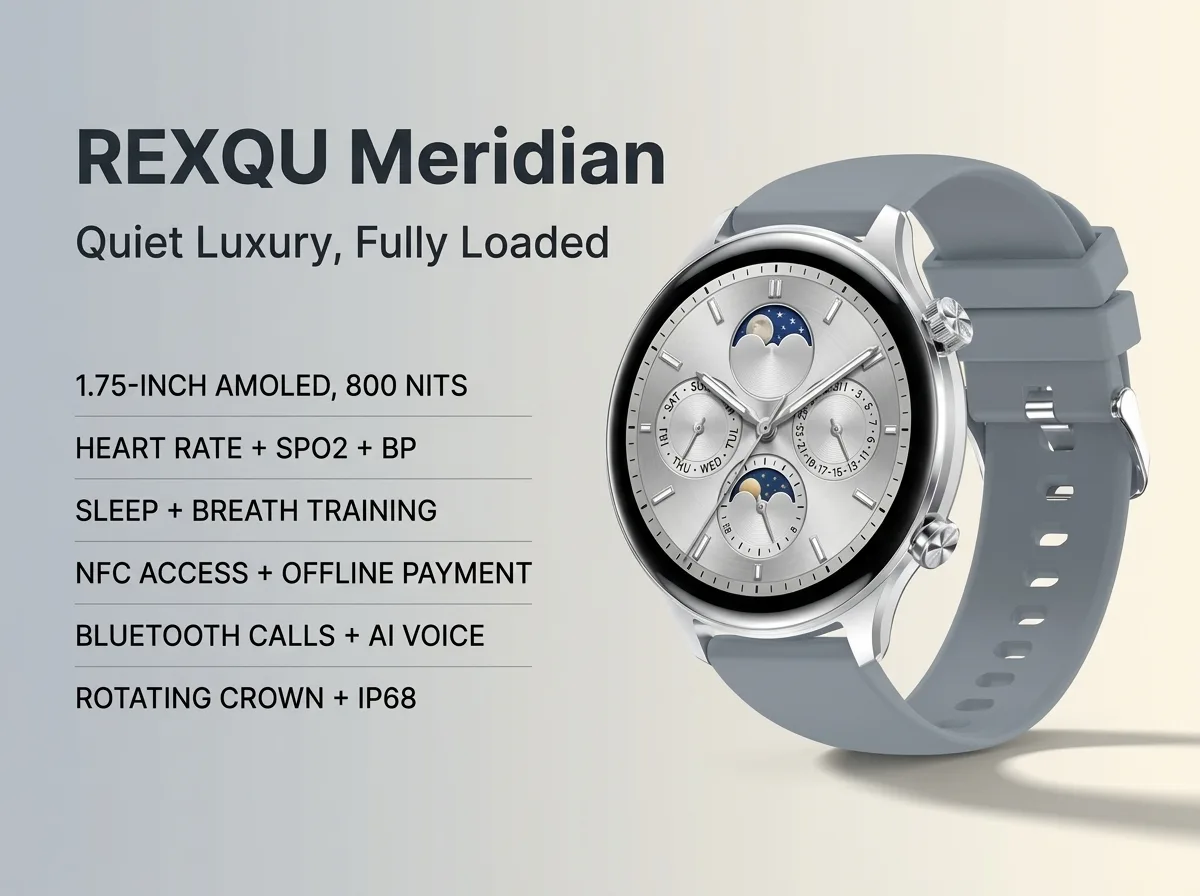
The REXQU Meridian ($139.97) pairs a 1.75″ AMOLED display (466×466) with Bluetooth 5.3 calling through a built-in speaker and mic, plus an AI voice assistant for hands-free questions. Its signature fluted crown spins through a 3D visual menu, and built-in NFC adds access control and offline payment — tap your wrist instead of digging for keys or a card.
Underneath that polish sits the usual REXQU health stack: continuous heart-rate tracking, on-demand cuff-free blood pressure readings, SpO₂ spot checks, guided breathing sessions and automatic sleep tracking, all logged in the Fitcloud Pro app. A 300mAh battery runs 5–7 days of normal use and over 30 days on standby.
REXQU Verve: Calls, Music and 100+ Sports Modes
The REXQU Verve ($129.97) takes a sportier route to the same idea. Its 1.43″ AMOLED runs at 800 nits — bright enough to read in direct sun — and one-touch Bluetooth calling is joined by Bluetooth music playback straight from the watch.
Health tracking covers 24/7 heart rate, on-demand blood oxygen, on-wrist blood pressure and automatic sleep tracking, plus 100+ sports modes with 1ATM water resistance for sweat and rain. It comes in a softer, rounder case that leans casual rather than formal.
Meridian vs. Verve at a Glance
| Feature | REXQU Meridian | REXQU Verve |
|---|---|---|
| Display | 1.75″ AMOLED, 466×466 | 1.43″ AMOLED, 800 nits |
| Bluetooth calls | Bluetooth 5.3 + AI voice assistant | One-touch calling |
| Extra connectivity | NFC hardware (payment/access compatibility varies) | Bluetooth music playback |
| Blood pressure & SpO₂ | Included | Included |
| Sports tracking | Standard activity tracking | 100+ sports modes |
| Water resistance | Splash-resistant daily wear | 1ATM |
| Battery | 5–7 days use, 30+ days standby | Standard daily charging |
| Price | $139.97 | $129.97 |
Which Smartwatch With Bluetooth Calls Fits You?
Both models qualify as a genuine smartwatch with Bluetooth calls rather than a fitness band that only mirrors notifications. Meridian leans more formal and feature-dense, with a rotating crown, larger display and NFC hardware. Verve leans sportier and brighter, with an 800-nit round AMOLED, music playback and a deeper sports-mode library.
If NFC is important, read what Meridian NFC actually supports before buying specifically for payment or access-control use; compatibility varies by system and region. If outdoor readability, music and sport modes matter more, Verve is the stronger fit.
How Meridian’s NFC Changes the Comparison
NFC is a useful differentiator only if it works with the system you need. Meridian includes NFC hardware, but that does not automatically guarantee support for Apple Pay, Google Wallet, a particular bank card, transit network or access-control reader. Treat NFC as a compatibility feature to verify, not a universal payment promise. The dedicated Meridian NFC guide explains the distinction in more detail.
What to Check Before Buying a Smartwatch With Bluetooth Calls
- Phone compatibility: confirm the companion app works with your current iPhone or Android version.
- Speaker and microphone: decide whether you mainly want quick wrist calls or expect to use the watch for longer conversations.
- Battery expectations: frequent calls use more power, so compare the Everyday Smartwatch Battery Life guide.
- Display preference: Meridian gives you a larger rectangular AMOLED; Verve gives you a smaller round 800-nit AMOLED.
- Extras you will actually use: Meridian adds NFC hardware and a rotating crown; Verve adds music playback and 100+ sport modes.
Frequently Asked Questions
Do I need my phone nearby for either watch to make calls? Yes. Both route calls through the paired phone over Bluetooth, so the phone needs to remain within a usable Bluetooth range. Walls, interference and where the phone is carried can affect call reliability.
Will calls sound as clear as using the phone itself? Not always. Wrist speakers and microphones are convenient for short calls, but wind, traffic and other background noise can reduce clarity. For longer or private calls, the phone or earbuds may still be better.
Does Bluetooth calling reduce battery life? Yes. Frequent calling generally uses more power than passive notifications, so heavy callers should expect shorter runtime than the highest published battery figures.
Are the blood-pressure and SpO₂ readings medical-grade? No. Both watches are consumer wellness devices for awareness and trends, not diagnosis or treatment decisions.
Bottom Line
A smartwatch with Bluetooth calls is most useful when you want quick hands-free calling without giving up everyday style. Choose Meridian for the larger display, rotating crown, NFC hardware and published multi-day battery figures; choose Verve for the brighter round AMOLED, music playback and 100+ sport modes.
Compare the wider range in the Best Everyday Smartwatch Buying Guide or browse the static Everyday Style collection.