
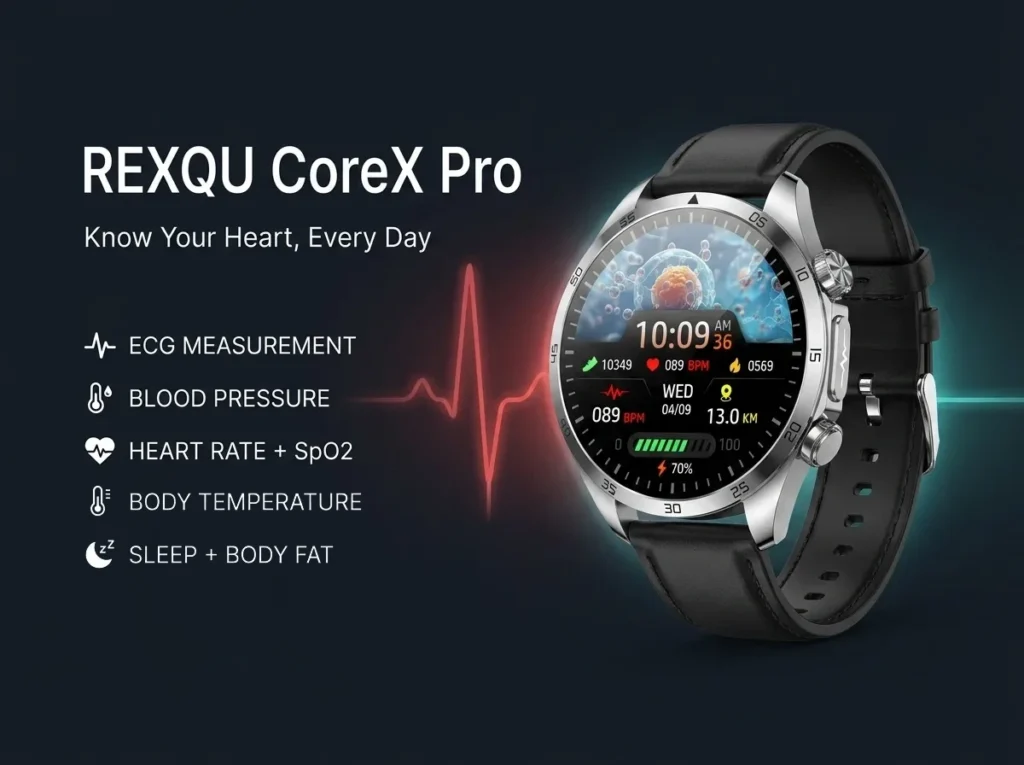
A single-lead ECG smartwatch records the heart’s electrical activity from one viewing angle, giving you a short rhythm trace you can save and review. That is different from ordinary optical heart-rate tracking and much simpler than the 12-lead ECG used in clinical care.
REXQU models such as CoreX Pro, CardioSense, Infinity Pro and PulseBand use on-demand ECG as a wellness feature. This guide explains what a single-lead trace can show, where its limits are and how to take a cleaner recording.
What Does “Single-Lead ECG” Mean?
An electrocardiogram measures the electrical activity generated by each heartbeat. The American Heart Association explains that clinical ECG testing can show heart rate, rhythm and the timing of electrical signals through the heart.
A clinical 12-lead ECG records the electrical signal from multiple perspectives using electrodes placed on the body. A smartwatch typically records one lead by completing an electrical circuit between the wrist and a finger touching an electrode on the watch.
So “single lead” does not mean fake ECG. It means a real electrical recording with a much narrower view.
Single-Lead ECG Smartwatch vs 12-Lead Clinical ECG
| Feature | Single-lead smartwatch ECG | Clinical 12-lead ECG |
|---|---|---|
| Number of electrical views | One | Multiple |
| Where it is taken | On the wrist, usually on demand | Clinical setting or medical device setup |
| Typical recording | Short rhythm trace | Broader electrical assessment |
| Main consumer value | Convenient rhythm information when you want to capture it | Diagnosis and clinical evaluation |
| Can it replace the other? | No | Clinical test remains the appropriate diagnostic tool |
How a Single-Lead ECG Smartwatch Works
Most wrist ECG watches use two contact points. One electrode is in contact with the wrist; the other is touched with a finger from the opposite hand. That creates an electrical path across the upper body long enough for the watch to record a short trace.
During the recording you need to stay still. Movement, poor contact or shifting finger pressure can introduce noise and make the trace harder to interpret.
ECG vs PPG Heart-Rate Tracking
These two technologies are often confused because both relate to heart activity.
- PPG heart-rate tracking: uses light to estimate pulse from blood-volume changes under the skin. It can run repeatedly in the background.
- ECG: measures the heart’s electrical signal through contact electrodes. It is normally a deliberate on-demand recording.
That is why your watch can show heart rate all day without you touching anything, but asks you to place a finger on the case or sensor for an ECG.
What Can a Single-Lead ECG Smartwatch Show?
A clean single-lead trace can provide useful information about rate and rhythm during the short recording window. Consumer wearable ECGs have attracted particular interest for atrial-fibrillation screening because irregular rhythm can sometimes be visible in a single-lead trace.
The American College of Cardiology notes that clinicians are increasingly seeing consumer-generated rhythm data and that some smartwatch and smartphone-paired devices have performed well for AF detection in studies, while performance is weaker for some other arrhythmias. That is a reason to view the technology as useful but condition-specific rather than assuming it can identify every heart problem.
For the AFib question specifically, read REXQU’s evidence-focused Can a Smartwatch Detect AFib? Health Guide.
What a Single-Lead ECG Cannot Show Reliably
A single wrist lead does not provide the same anatomical coverage as a clinical 12-lead ECG. It should not be relied on to diagnose heart attack, determine the location of a cardiac problem or rule out every arrhythmia.
It also records only the moment when you take the measurement. If an intermittent rhythm problem does not happen during that short window, the watch may not capture it.
REXQU Single-Lead ECG Smartwatch Options
| Model | Best for | Other key features |
|---|---|---|
| CoreX Pro | ECG plus broader health/safety features | Heart-rate and BP wellness trends, SpO₂, fall/safety features |
| CardioSense | Large display for heart-focused use | BP wellness trends, large 2.01-inch screen, guided breathing |
| Infinity Pro | Traditional-watch styling with ECG | Round AMOLED, broader multi-vital wellness tools |
| PulseBand | Screenless ECG and long battery life | Screenless design, HRV features, long runtime |
For the full commercial comparison, use the Best ECG Smartwatch Buying Guide or browse REXQU ECG Smartwatches.
REXQU CoreX Pro: ECG With Broader Health Tracking
CoreX Pro combines its on-demand ECG with a broader set of wellness and safety features. It is a strong fit if you want a single watch for rhythm information, BP wellness trends, blood oxygen and other daily metrics rather than buying primarily for ECG alone.
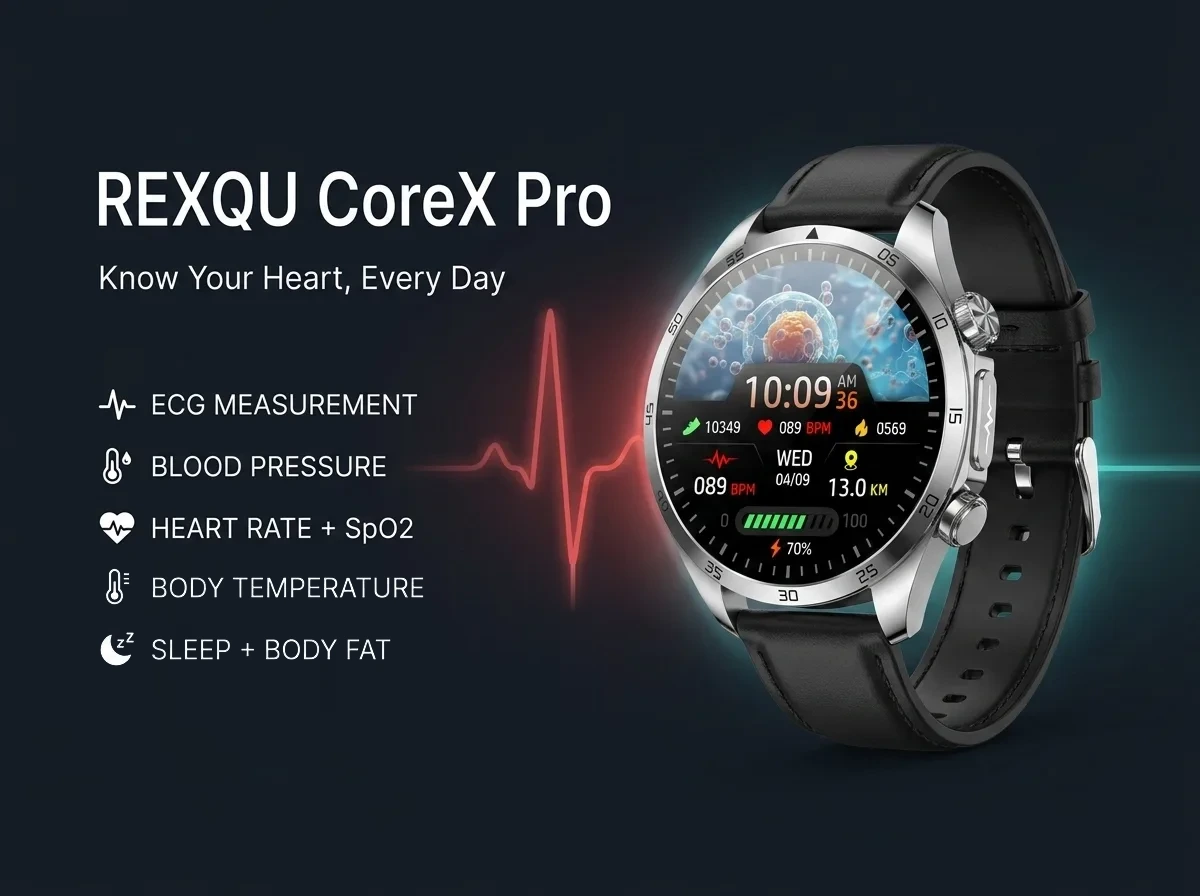
View CoreX Pro specs and current price →
REXQU CardioSense: ECG on a Larger Display
CardioSense is the natural alternative if display size matters. Its 2.01-inch screen makes the heart-focused interface easier to review at a glance while also combining ECG with blood-pressure wellness tracking.
How to Take a Cleaner Single-Lead ECG Reading
- Sit still. Do not record while walking or talking.
- Rest your arm on a table. Support reduces movement noise.
- Wear the watch snugly. The back electrode needs consistent skin contact.
- Touch the second electrode lightly and steadily.
- Complete the full recording. Do not lift your finger early.
- Repeat a noisy trace once. Poor contact is common and does not automatically mean a heart problem.
When Is a Wrist ECG Most Useful?
The practical advantage of a smartwatch is availability. If you experience a sensation you want to document, the watch may already be on your wrist. A saved trace can give you something more concrete to show at an appointment than trying to describe a moment from memory.
If you plan to discuss recordings with a clinician, see How to Share ECG Smartwatch Readings With Your Doctor.
Frequently Asked Questions
Is a single-lead ECG smartwatch accurate?
It can record a genuine electrical trace, but accuracy and usefulness depend on device design, contact quality, signal quality and what rhythm you are trying to assess. It should not be treated as equivalent to a 12-lead clinical ECG.
Can a single-lead ECG detect AFib?
Consumer single-lead ECGs can provide useful AFib-related rhythm information in some circumstances, but REXQU watches are wellness devices and should not be used to diagnose AFib without professional evaluation.
Why do I have to touch the watch with my other hand?
The second contact point completes the electrical circuit needed to record the ECG signal.
Can the watch run ECG continuously?
On-wrist ECG is normally an on-demand measurement because the electrical circuit requires your active contact. Background heart-rate tracking uses a different optical sensor.
Where can I compare all REXQU ECG models?
Visit the REXQU ECG Smartwatches category or the complete ECG smartwatch buying guide.
The Bottom Line
A single-lead ECG smartwatch gives you a convenient one-angle electrical rhythm trace, not a miniature replacement for a hospital 12-lead ECG. Used with the right expectations, it can be a useful way to capture information when you want it and keep a record for later discussion. Compare CoreX Pro, CardioSense, Infinity Pro and PulseBand, or browse the full REXQU ECG Smartwatch range →.
REXQU smartwatches are consumer wellness devices and are not intended to diagnose, treat, cure or prevent disease.