

Wondering what a smartwatch barometer actually does, beyond sitting on a spec sheet next to GPS and heart rate? It measures tiny shifts in air pressure, and REXQU builds one into several outdoor models to estimate altitude more precisely than GPS alone and flag incoming weather changes before you feel them.
What a Smartwatch Barometer Actually Measures
A barometric sensor tracks air pressure, which drops predictably as you climb and rises as you descend. A smartwatch barometer uses that relationship to calculate altitude in near real time, updating far faster than satellite-based elevation readings, which can lag or jump when GPS signal is weak under tree cover or in a canyon.
The same sensor doubles as a basic weather tool. A rapid, unexpected drop in pressure over a short window is a classic signal that a storm system is moving in — useful information a few hours before trailhead cell service disappears.
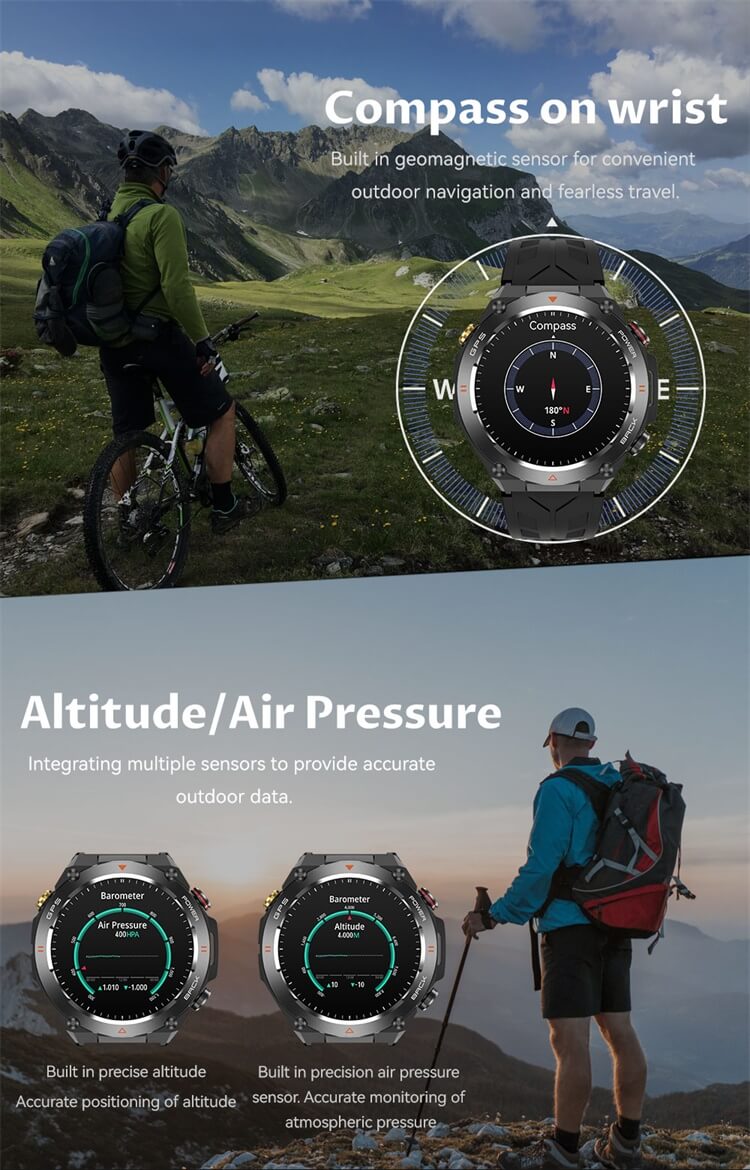
Barometer vs. GPS Altitude: Why Both Matter
GPS estimates elevation from satellite triangulation, which works well in open sky but degrades under dense forest, in steep valleys, or near tall rock walls. A barometric sensor doesn’t need a clear sky view at all — it just needs air, so it keeps reporting steady numbers exactly where GPS struggles most.
The tradeoff is that barometric altitude drifts with weather, since a passing pressure system can shift the baseline even if you haven’t moved a foot in elevation. That’s why the better outdoor watches, including REXQU’s, blend both inputs rather than relying on either sensor by itself.
Which REXQU Models Include This Sensor
Three current REXQU outdoor models pair a barometer with GPS and a compass:
- REXQU Horizon ($159.97) — built-in GPS, compass and barometer on a 1.96″ AMOLED, backed by a 530mAh battery rated for around 15 days and 100+ tracked sports.
- REXQU MaxTrail ($159.97) — barometric altitude and compass on a 1.73″ AMOLED with a 1000mAh cell, the largest battery in the lineup, plus 100+ sport modes.
- REXQU Adventurer ($159.97) — a geomagnetic compass plus altitude and air-pressure tools alongside four-satellite GPS (GPS, BDS, GLONASS and Galileo) and a 650mAh battery.
When It Actually Helps on the Trail
It matters most on multi-hour hikes, backcountry ski days, and any trip where you’re gaining or losing significant elevation under cover — thick tree canopy, narrow canyons, or heavy cloud that GPS handles poorly. On a flat road run or a gym session, a barometer adds little, so it’s not a feature worth chasing if your outdoor days are mostly pavement.
Pair it with sensible habits: check the reading against a known trailhead elevation at the start of a hike, since barometric drift means a multi-day trip can accumulate a few dozen feet of error without a reset point. For the physics behind how these sensors translate pressure into altitude, the Wikipedia entry on pressure altimeters is a solid independent reference.
FAQ
Does it need a GPS signal to work? No — a smartwatch barometer measures air pressure directly, so it keeps functioning under tree cover or indoors, though altitude accuracy is best when it can occasionally cross-check against a GPS fix.
Can weather change throw off the altitude reading? Yes. A fast-moving storm system changes air pressure independent of elevation, which is exactly the mechanism that makes the same sensor useful for basic weather awareness.
Is a barometer the same as an altimeter? Not quite — a barometer measures raw air pressure, while an altimeter is the calculation layered on top that converts that pressure reading into an estimated elevation. On a modern outdoor watch, the two work together as a single feature, so in everyday use “barometer” and “altimeter” end up describing the same on-wrist tool.
Browse REXQU’s full rugged outdoor smartwatch collection or the GPS smartwatch lineup to compare every current model side by side.