
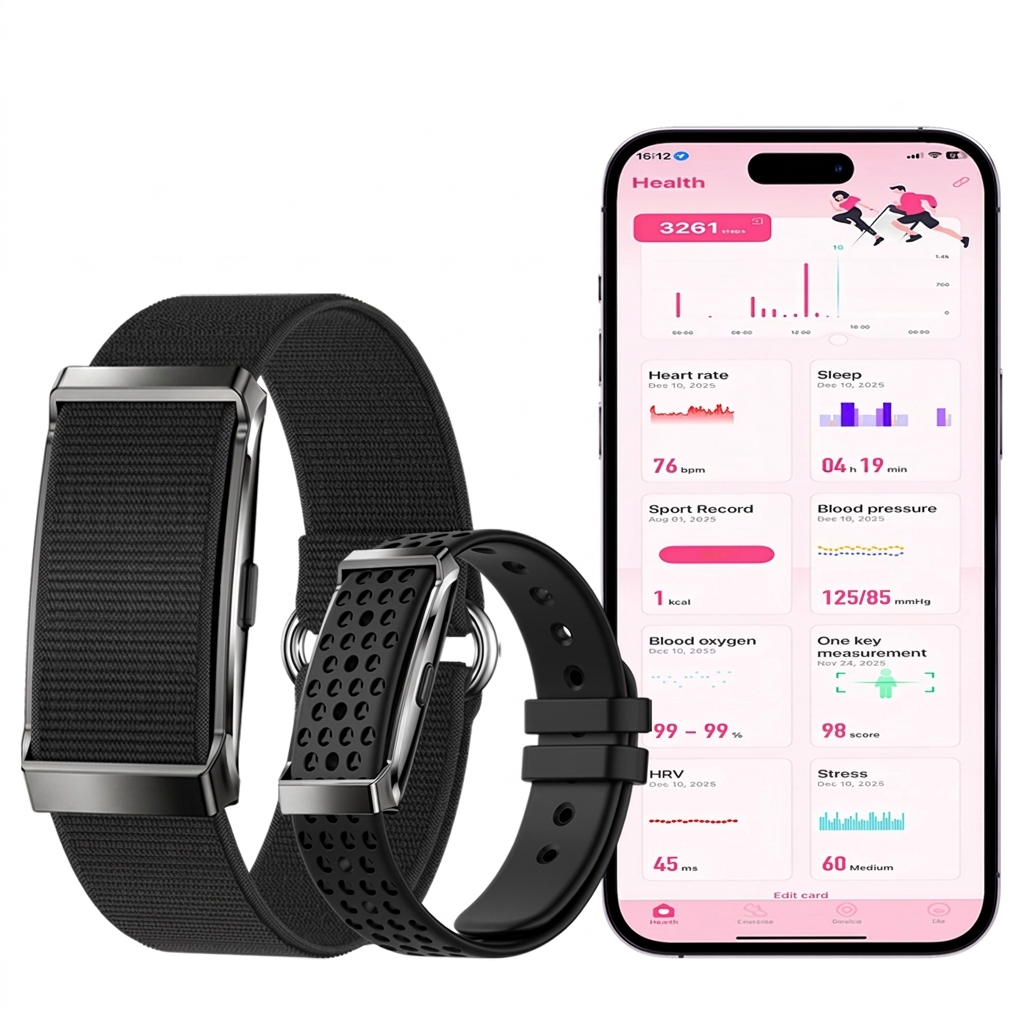
Screenless fitness tracker battery life is one of the biggest reasons to choose a band without a display. Remove the screen — normally one of the largest power users in a wearable — and a tracker can spend much more of its battery running sensors instead of lighting pixels.
Across REXQU’s current screenless range, normal-use battery life runs from roughly 7–10 days on the feature-heavy CardioBand and GuardBand to around 25–30 days on the PulseBand, while AeroBand is rated for approximately 11–30 days depending on use. All four are available in the static REXQU Screenless Fitness Trackers collection.
Screenless Fitness Tracker Battery Life by REXQU Model
| Model | Normal Use | Standby | Charge Time | Main Trade-Off |
|---|---|---|---|---|
| PulseBand | 25–30 days typical use | Varies with use | Under 2.5 hours | Long battery + ECG/heart features |
| AeroBand | 11–30 days depending on use | Varies | Magnetic charge | Simple all-round tracking |
| CardioBand | 7–10 days | 15–20 days | Under 2.5 hours | ECG, HRV, cycle tracking |
| GuardBand | 7–10 days | 15–20 days | Under 2.5 hours | GPS, SOS, automatic fall detection |
These figures are manufacturer/runtime estimates rather than guarantees. Real battery life changes with sensor settings, Bluetooth activity, alerts, GPS use, ECG checks, temperature, battery age and charging habits.
Why Does a Screenless Fitness Tracker Last Longer?
A smartwatch display consumes power every time it lights, refreshes, raises brightness or runs an always-on mode. A screenless band removes that demand entirely. The band still has to power Bluetooth, motion sensors, optical heart-rate sensors and any additional features, but one large source of daily power use disappears.
That is why removing the screen can produce a very different charging routine. Instead of thinking about the charger every night or every few days, some screenless users can treat charging as a weekly or even monthly task.
This is also one reason a screenless tracker can be useful for sleep tracking: the device is less likely to be sitting on a charger overnight. See Screenless Fitness Tracker for Sleep Tracking for the overnight use case.
PulseBand Battery Life: 25–30 Days Typical Use
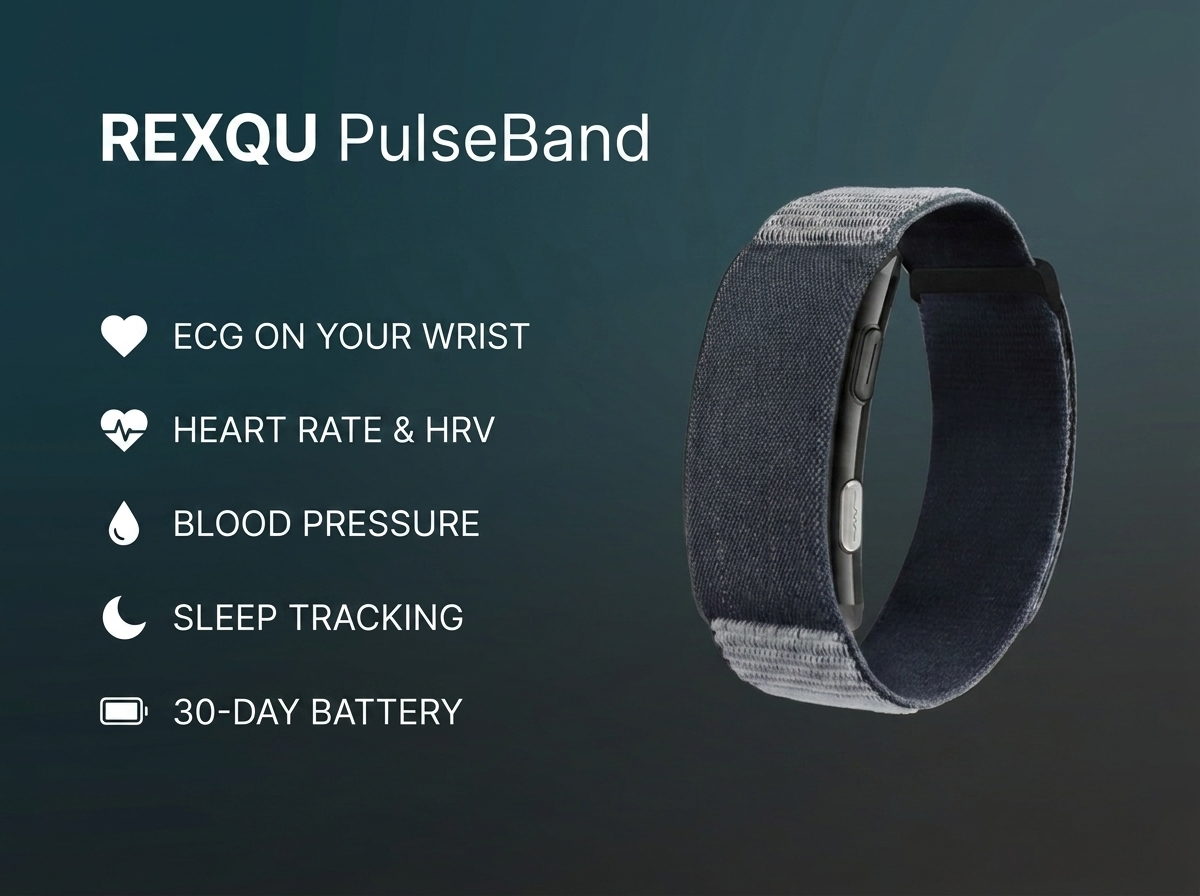
The PulseBand has the clearest long-battery specification in the current REXQU screenless range: approximately 25–30 days of typical use from one charge, with a magnetic recharge in under 2.5 hours.
That is notable because PulseBand is not a bare-bones pedometer. It includes heart-rate and HRV tracking, sleep, blood-pressure and blood-oxygen wellness features, body composition and an on-band ECG feature shown through the G BAND app.
If your priority is “charge as rarely as possible without giving up heart-focused tracking,” PulseBand is the strongest starting point. See the PulseBand product page for current specifications and pricing.
AeroBand Battery Life: 11–30 Days Depending on Use
The AeroBand is rated for approximately 11–30 days per charge. The wide range reflects how much settings and use can affect a battery: more alerts, more sensor activity and more frequent interaction can move a device toward the lower end.
AeroBand is the simpler all-rounder in the REXQU screenless lineup. It tracks 24-hour heart rate, blood-pressure trends, blood oxygen, sleep, steps and activity while sending calls and messages as gentle vibration alerts.
CardioBand Battery Life: 7–10 Days Normal Use
The CardioBand is rated for roughly 7–10 days of normal use and 15–20 days on standby. Its 220mAh battery recharges in under 2.5 hours according to the current product specification.
Why shorter than PulseBand? CardioBand is built around a more active feature mix that includes 24/7 heart rate, 24/7 HRV, blood-pressure and blood-oxygen tracking, on-demand ECG, AI sleep analysis, cycle tracking and activity modes.
If those features are more valuable to you than stretching every charge to a month, a weekly charging routine is still relatively low maintenance.
GuardBand Battery Life: 7–10 Days With Safety Features
The GuardBand also runs approximately 7–10 days under normal use and 15–20 days on standby, with a full magnetic charge in under 2.5 hours.
Its shorter battery range makes sense in context: GuardBand adds real-time GPS position upload, GPS sports tracks, one-press SOS and automatic fall detection. Location and safety features are more important to its purpose than winning the longest-battery contest.
If you are considering GuardBand for a parent or solo walker, see the fall-detection guide as well as the screenless GPS tracker guide.
Normal Use vs Standby Battery Life
Do not compare a 30-day standby figure with a 10-day normal-use figure as though they mean the same thing.
- Normal use assumes the tracker is worn, syncing, collecting sensor data and using its normal features.
- Standby is a lower-activity state with fewer interactions and less intensive use.
For a device you plan to wear continuously, normal-use battery is the more useful shopping number. Standby is still helpful for travel, storage or periods when features are used lightly.
What Drains a Screenless Fitness Tracker Battery?
Even without a screen, several features use meaningful power:
- GPS and frequent position uploads: especially relevant to GuardBand.
- Frequent ECG sessions: short electrical recordings use additional sensor power.
- More aggressive sensor intervals: frequent heart-rate or SpO₂ sampling can shorten runtime.
- Repeated vibration alerts: every call/message vibration consumes some energy.
- Constant Bluetooth communication: frequent syncing can use more battery than occasional syncs.
- Cold or very hot conditions: battery performance can change at temperature extremes.
Does Longer Battery Life Mean Better Tracking?
Not automatically. A long-battery band is better only if it matches your use. GuardBand gives up some runtime because it is doing location and safety work. CardioBand uses a shorter cycle while offering its particular heart and cycle-tracking mix.
The better question is: How often are you willing to charge in exchange for the features you actually need?
If you are choosing between all four models rather than battery alone, use the Best Screenless Fitness Tracker buying guide.
How to Extend Screenless Fitness Tracker Battery Life
- Keep only useful alerts enabled. Do not make the band vibrate for every app notification.
- Use the default sensor intervals first. Increase monitoring frequency only when you have a reason.
- Use GPS when it adds value. Location features can consume more power than passive wellness tracking.
- Keep firmware and the companion app current. Updates can include power-management fixes.
- Keep the charging contacts clean and dry. Poor contact can leave the battery only partly charged.
- Avoid prolonged extreme heat. Heat can accelerate lithium-ion battery ageing.
For general battery-care background, the University of Michigan summarizes research-backed tips for extending lithium-ion battery life, including avoiding unnecessary heat and extreme charge conditions.
Is Monthly Charging Better Than Nightly Charging?
From a convenience standpoint, it can be. The biggest benefit is not that a monthly routine is inherently healthier for the battery; it is that the tracker spends more time on the wrist and less time forgotten beside a charger.
For sleep and continuous trend tracking, fewer charging interruptions can mean fewer gaps in the data. That is one of the practical advantages of bands such as PulseBand and AeroBand.
How to Choose by Battery Life
- Travel frequently: start with PulseBand or AeroBand.
- Want ECG + HRV + cycle tracking: choose CardioBand and accept weekly-ish charging.
- Want safety, GPS and fall detection: choose GuardBand; battery is secondary to the safety feature set.
- Track sleep every night: prioritize a band whose charging routine will not regularly interrupt overnight wear.
Frequently Asked Questions
Which REXQU screenless fitness tracker has the longest battery life?
PulseBand is rated for roughly 25–30 days of typical use. AeroBand is rated for approximately 11–30 days depending on use.
How long do CardioBand and GuardBand last?
Both are currently rated for around 7–10 days of normal use and 15–20 days on standby.
Does GPS reduce battery life?
Location tracking and position uploads generally require more power than passive activity sensing. GuardBand’s GPS and safety functions are part of why its battery priorities differ from PulseBand’s.
Does taking an ECG use battery?
Yes, although a short on-demand recording is only one part of overall battery use. Frequent sensor sessions can reduce runtime compared with lighter use.
Should I wait until the battery reaches 0% before charging?
No special full-discharge routine is required. A convenient, regular charging habit that keeps the tracker available is more practical.
Do all REXQU screenless bands cost the same?
The current static product pages list PulseBand, CardioBand, AeroBand and GuardBand at $139.97 each, so feature mix and battery needs are stronger differentiators than price.
The Bottom Line
For maximum screenless fitness tracker battery life, PulseBand is the clearest REXQU choice at roughly 25–30 days typical use, while AeroBand offers roughly 11–30 days depending on use. CardioBand and GuardBand trade some runtime for additional heart, cycle, GPS and safety features. Compare all REXQU screenless fitness trackers →