
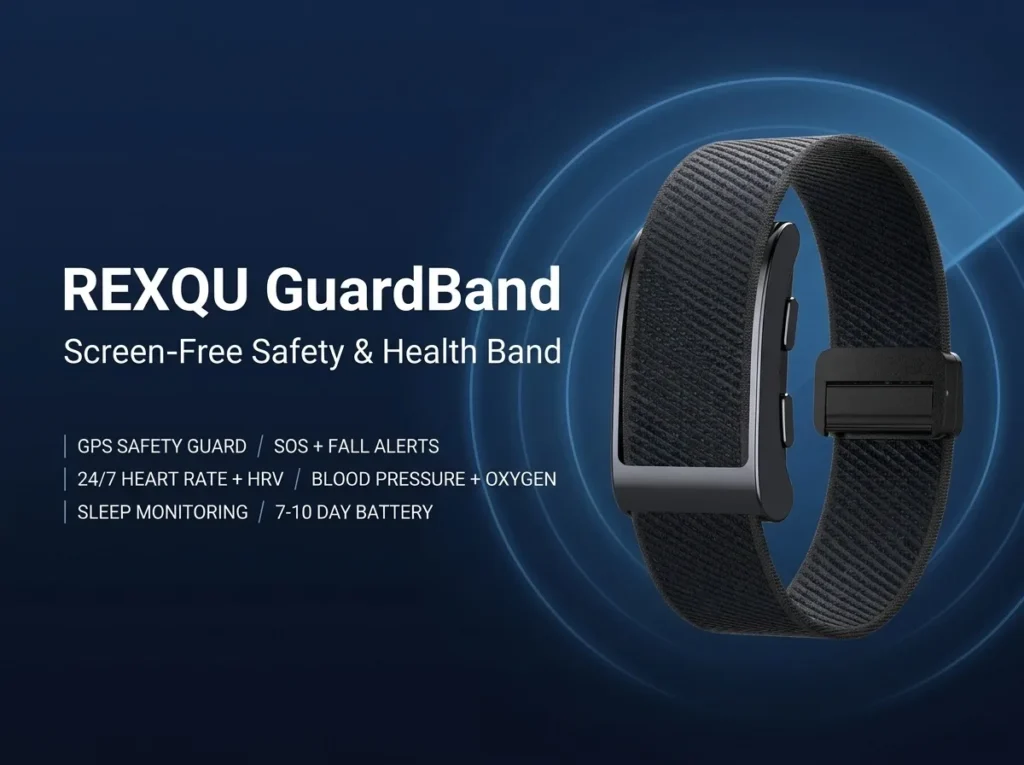
If you are shopping for a smartwatch for seniors with fall detection, the most important question is not how many health metrics it tracks. It is what the watch does after a fall — whether the alert is automatic, whether the wearer must press a button, how location is shared, and whether the paired phone needs to be available.
Within REXQU’s dedicated Smartwatches for Seniors category, the GuardBand is the model built most directly around automatic fall detection. Elsewhere in the wider REXQU health-watch range, the O2Max also includes an automatic fall-detection option alongside one-touch SOS. That gives shoppers two different form factors to compare: a screenless safety band and a classic round smartwatch.
How Fall Detection on a Senior Smartwatch Works
Fall detection uses motion sensors — typically accelerometer and gyroscope data — to look for a sudden movement and impact pattern that resembles a hard fall. The software then decides whether to start an alert sequence.
That sounds simple, but it is important to understand the limitation: no consumer wearable can guarantee that every fall will be detected. A hard, fast fall may be easier to recognize than a slow slide to the floor or a collapse where the wrist is cushioned. False alarms are also possible during vigorous movement.
That is why automatic fall detection should be treated as an additional safety layer, not a substitute for home fall prevention, regular check-ins, medical advice or a professional monitored alert service when those are needed.
GuardBand vs O2Max: Two REXQU Fall-Detection Options
| Feature | REXQU GuardBand | REXQU O2Max |
|---|---|---|
| Design | Screenless safety band | Classic round smartwatch |
| Automatic fall detection | Yes — designed to trigger emergency call/location flow after a detected hard fall | Yes — optional fall detection with an automatic help call after a detected fall |
| Manual SOS | One-press SOS | One-touch SOS |
| Location / emergency setup | GPS-oriented position upload and chosen contacts | Emergency contacts managed in the app |
| Display | None | 1.55-inch round display |
| Normal battery | About 7–10 days | Multi-day |
| Best for | Minimal interaction, safety-first wear | Fall detection plus a traditional smartwatch experience |
For a parent who dislikes screens, menus and frequent charging, the GuardBand is the more focused safety product. For someone who still wants a normal smartwatch display, blood-oxygen checks, HRV, sleep tracking and other health-watch functions, the O2Max is the broader option.
Why GuardBand Is a Strong Fall-Detection Watch for Seniors
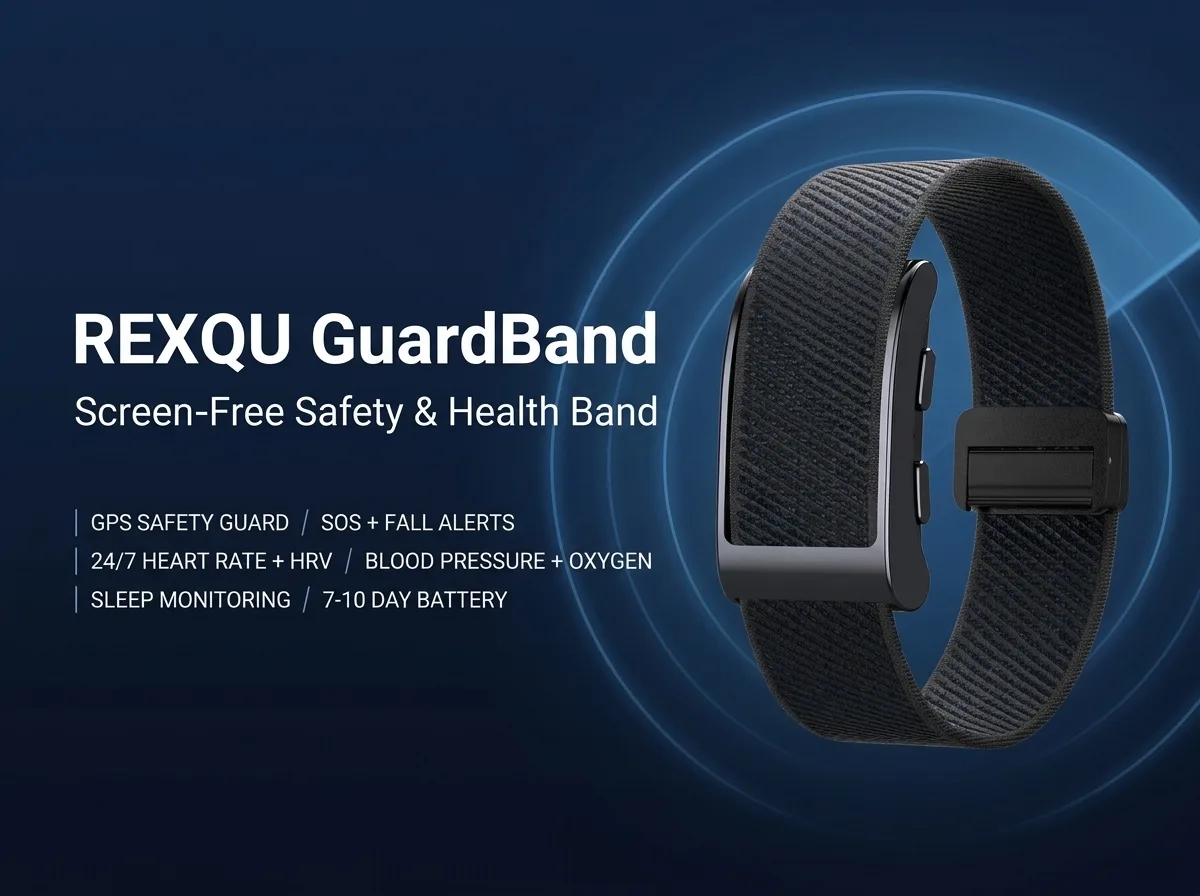
The GuardBand is designed around the idea that a safety wearable is most useful when the wearer does not have to think about it. There is no screen to navigate, and the band combines three safety layers:
- Automatic fall detection for hard-fall events.
- One-press SOS for situations where the wearer can deliberately ask for help.
- GPS-oriented position sharing through the free G BAND app for chosen contacts.
The current GuardBand product page states 7–10 days of normal battery life, up to roughly 15–20 days standby and magnetic charging in under 2.5 hours. That matters because a fall-detection watch cannot help while it is sitting on a charger.
GuardBand also includes everyday wellness tracking such as heart rate, HRV, blood-pressure trends, blood oxygen and sleep in the companion app. Those are wellness estimates rather than diagnostic medical measurements.
When O2Max May Be the Better Fall-Detection Smartwatch
The O2Max takes a different approach. It is a classic round health smartwatch with a 1.55-inch display, automatic fall detection that can be enabled in the app, and one-touch SOS. It also includes blood oxygen, HRV, sleep and other wellness features.
That makes O2Max relevant for an older wearer who wants the safety feature but does not want a screenless tracker. It is not currently one of the eight products displayed on REXQU’s dedicated seniors category, so it is best thought of as a fall-detection alternative from the wider health-watch range.
Automatic Fall Detection vs Manual SOS
This distinction should drive the buying decision:
| Situation | Automatic Fall Detection | Manual SOS |
|---|---|---|
| Wearer falls and can still press a button | May trigger automatically | Works if wearer presses it |
| Wearer is dazed or unable to press | Potentially useful because no manual action is required | May not help |
| False alarm risk | Possible | Lower because wearer activates it |
| Best fit | Higher fall concern or living alone | Independent wearer who wants a fast help button |
REXQU senior models such as VitaCore, IntelliFit and Chronex are useful manual-SOS alternatives. They may be a better fit when readability, calling, family monitoring or ECG features matter more than automatic detection.
Does a Fall-Detection Watch Need a Phone Nearby?
For REXQU consumer wearables, many communication features depend on the paired phone, Bluetooth connection, app permissions and available mobile signal. That means families should not assume the watch is a completely standalone cellular medical-alert system unless the specific product explicitly says so.
Before relying on any fall-detection setup, test it under realistic conditions: in the house, garden and the places the wearer normally walks. A specification sheet cannot tell you whether the phone is usually close enough or whether the app permissions are configured correctly.
How to Set Up a Fall-Detection Watch for a Parent
- Pair the watch and phone completely. Install the companion app and allow the permissions needed for Bluetooth, notifications and location where required.
- Add trusted emergency contacts. Use people who are likely to answer quickly and know the wearer’s address and routine.
- Turn fall detection on. On models where it is optional, make sure the feature is actually enabled rather than assuming it ships active.
- Test the manual SOS function. The wearer should know how to call for help deliberately even if fall detection does not trigger.
- Test the contact flow. Confirm what the family member actually receives — call, location information or app notification — before depending on it.
- Set a charging routine. Choose a predictable low-risk time so the watch is not repeatedly left off the wrist overnight.
- Review the setup after phone or app changes. New phones, permission changes and app updates can affect connectivity.
What Fall Detection Cannot Do
A fall-detection smartwatch can help with the response to a fall, but it does not prevent the fall itself. Home lighting, medication review, balance, footwear, vision, rugs, stairs and strength are all part of the bigger picture.
The National Institute on Aging recommends practical prevention steps around home hazards, physical activity and health review. A wearable is best used alongside those measures.
Questions to Ask Before Buying a Fall-Detection Smartwatch
- Is automatic fall detection truly required, or would manual SOS be enough?
- Will the wearer keep their phone nearby?
- Do they prefer a normal watch screen or a screenless safety band?
- Can they remember to charge the device regularly?
- Who will receive the emergency call or alert?
- Has the family tested the alert flow together?
- Does the person need professional 24/7 monitored emergency response instead of family-contact alerts?
Frequently Asked Questions
Does fall detection catch every fall?
No. Consumer wearables rely on motion patterns, so some falls can be missed and some non-fall movements can cause false alarms.
Which REXQU watch has automatic fall detection?
Within the dedicated seniors category, the GuardBand is the safety-focused fall-detection option. The O2Max in the wider health-watch range also includes an automatic fall-detection option.
Does GuardBand call 911 automatically?
GuardBand is designed around chosen personal contacts and GPS-oriented location sharing, not a staffed emergency-dispatch service. Families needing direct professional monitoring should consider a dedicated medical-alert system.
Can I use fall detection without paying a subscription?
REXQU does not charge a recurring monitoring subscription for the core GuardBand or O2Max features described here.
Is a fall-detection smartwatch better than a medical-alert pendant?
Not always. A smartwatch may be more wearable and multifunctional, while a dedicated monitored pendant can offer a simpler emergency-only workflow and professional response. The right choice depends on the person’s risk and support needs.
The Bottom Line
If you want a smartwatch for seniors with fall detection, start by deciding whether you want a screen or a safety-first band. The REXQU GuardBand is the strongest fit for simple, screenless protection with automatic fall detection, GPS-oriented safety and one-press SOS. The REXQU O2Max is the better alternative if the wearer wants automatic fall detection in a traditional round smartwatch. Compare all REXQU smartwatches for seniors →
REXQU smartwatches are consumer wellness and communication devices, not medical devices or professional emergency-dispatch services. Fall detection is not guaranteed to identify every fall. Consult appropriate healthcare and emergency-service professionals about individual safety needs.