
If you are shopping for a screenless fitness tracker, the appeal is simple: you get continuous health and activity tracking without a bright display demanding attention all day. Instead of checking numbers on your wrist, you review trends in a companion app — and because there is no screen to power, battery life can stretch far beyond a typical smartwatch.
REXQU currently offers four screenless bands: the PulseBand, CardioBand, AeroBand and GuardBand. All four sit in the static REXQU Screenless Fitness Trackers collection and work without a recurring REXQU subscription.
What Is a Screenless Fitness Tracker?
A screenless fitness tracker is a wearable band with sensors but no visual display. The band collects information such as heart rate, HRV, activity and sleep, then sends that data to a smartphone app over Bluetooth. Some models add extra wellness features such as blood-pressure trends, blood oxygen, ECG, cycle tracking, GPS-oriented location tools or fall detection.
The lack of a display changes the experience in three important ways:
- Less distraction: no glowing screen, watch-face notifications or constant temptation to check metrics.
- Longer battery life: the display is normally one of the biggest power drains in a smartwatch.
- App-first data: all detailed information lives on the phone rather than on the wrist.
If you are still deciding whether removing the screen makes sense at all, start with Do You Need a Screen on a Fitness Tracker?.
REXQU Screenless Fitness Tracker Comparison
| Model | Main Tracking | Battery | Stand-Out Feature | Price |
|---|---|---|---|---|
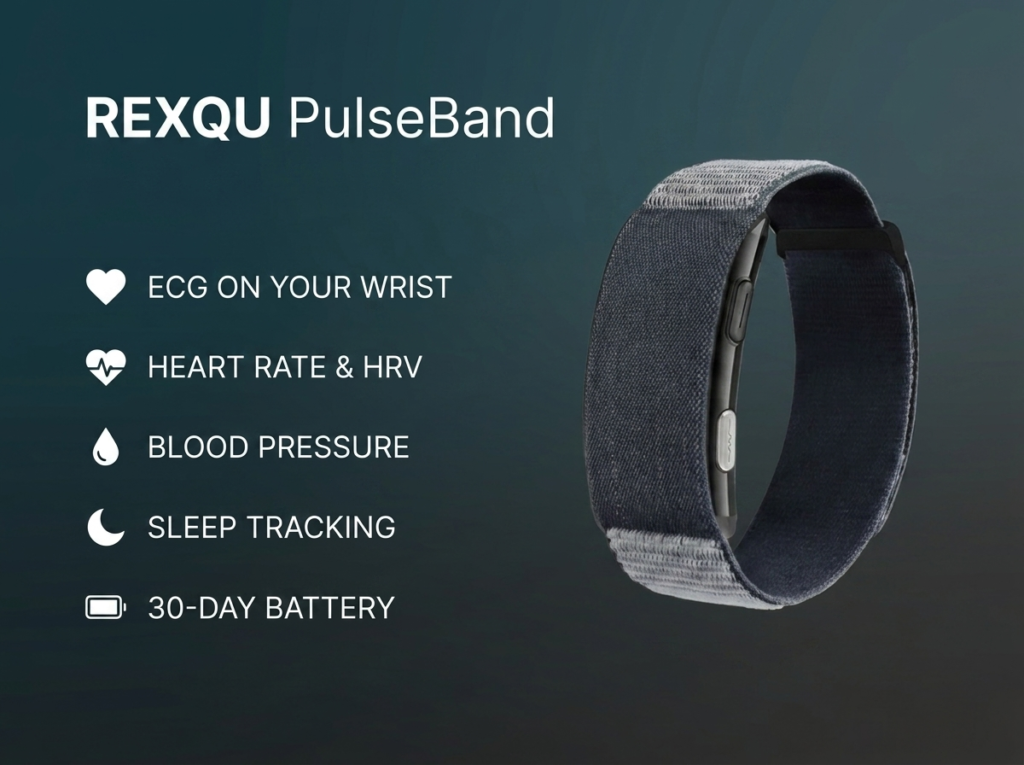
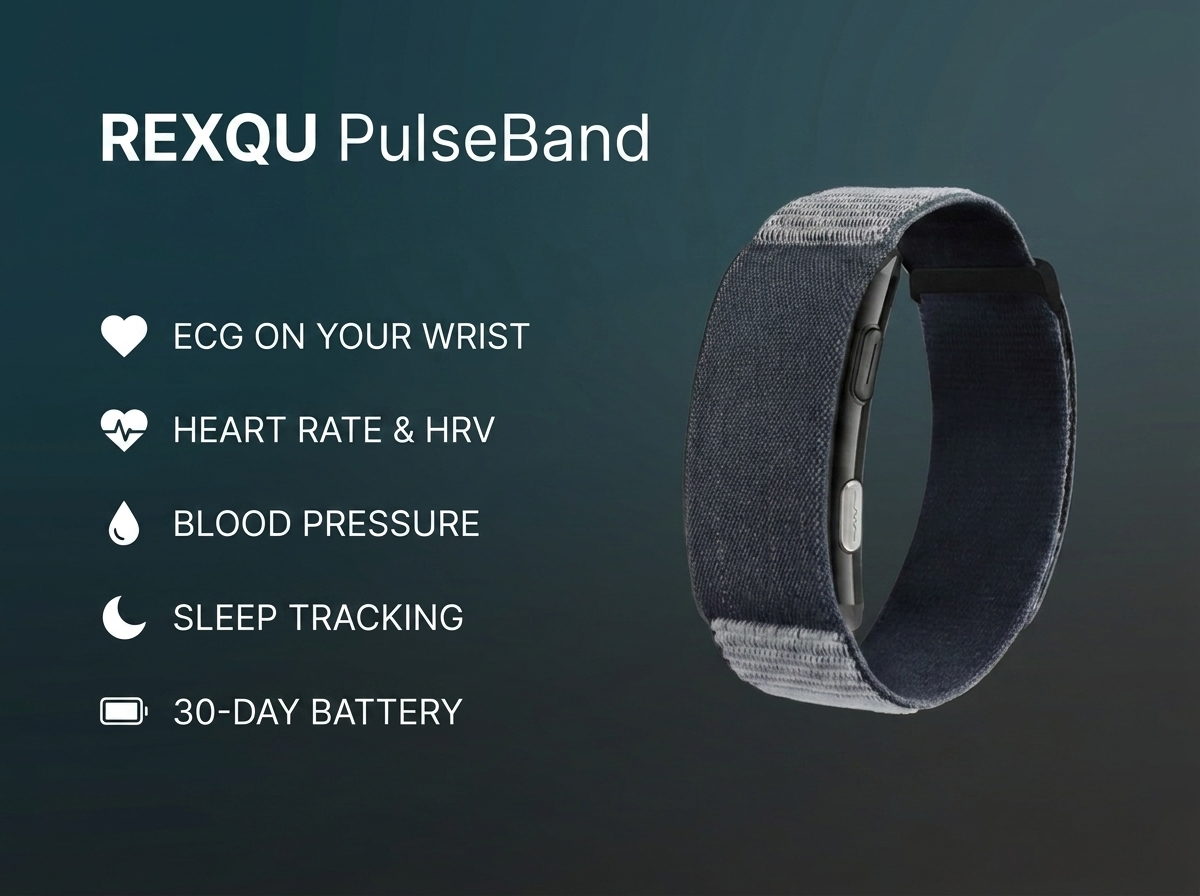
| PulseBand | ECG, 24/7 heart rate + HRV, blood-pressure trends, sleep | Up to 25–30 days | Longest battery with on-band ECG | $139.97 |
| CardioBand | 24/7 heart rate + HRV, blood pressure, SpO₂, ECG, sleep | 7–10 days normal / 15–20 standby | Heart-first tracking + cycle tracking | $139.97 |
| AeroBand | 24-hour heart rate, blood pressure, SpO₂, sleep, activity | 11–30 days | Simplest all-rounder | $139.97 |
| GuardBand | 24/7 heart rate + HRV, blood-pressure trends, SpO₂, sleep | 7–10 days normal / 15–20 standby | GPS-oriented safety + SOS + fall detection | $139.97 |
PulseBand: Best Screenless Fitness Tracker for ECG and Long Battery
The PulseBand is the most obvious choice if you want a screenless band but still care about ECG. It combines continuous heart-rate and HRV tracking with an on-band ECG feature, sleep information and other wellness trends, while current REXQU specifications list roughly 25–30 days between charges depending on use.
That combination makes PulseBand especially attractive for someone who wants detailed heart information without wearing a conventional smartwatch. If ECG is a major reason for buying, compare it with REXQU’s wider ECG smartwatch collection and the Best ECG Smartwatch buying guide.
CardioBand: Best for Heart Tracking, ECG and Cycle Features
The CardioBand is built around 24/7 heart rate and HRV. The current static product page also lists on-demand ECG, 24/7 blood-pressure and blood-oxygen trend tracking, AI sleep analysis and menstrual-cycle tracking through the G BAND app.
Battery life is shorter than PulseBand at roughly 7–10 days of normal use, with 15–20 days standby, but that is still considerably longer than many display-based smartwatches.
If heart-rate accuracy is the main concern, see Screenless Fitness Tracker Heart Rate Accuracy Explained.
AeroBand: Best Simple Screenless Fitness Tracker
The AeroBand is the easiest model to explain: it is a screenless everyday tracker for heart rate, blood-pressure trends, blood oxygen, sleep, steps, calories and sport modes. Current REXQU specifications list a broad 11–30 day battery range depending on use.
AeroBand is a good fit if you want the benefits of screenless tracking without paying for a more safety-focused or ECG-heavy feature set. It also includes vibration alerts for calls and messages, so going screenless does not mean you must miss every notification.
GuardBand: Best Screenless Tracker for Safety and Fall Detection
The GuardBand is the outlier in the lineup because its main selling point is not fitness — it is safety. It adds real-time GPS-oriented position upload, one-press SOS and automatic fall detection to the same kind of screenless wellness tracking found elsewhere in the range.
That makes it a strong option for an older parent, someone who walks alone, or anyone who values emergency-contact features more than cycle tracking or ECG. For a fuller comparison, see the fall-detection guide and the static Smartwatches for Seniors category.
Why Choose a Screenless Fitness Tracker Instead of a Smartwatch?
The main benefit is not simply battery life. A screenless tracker changes the relationship you have with the wearable. Rather than checking numbers constantly, you let the band collect data quietly and review trends later.
A screenless band may suit you better if:
- you dislike glowing screens at night
- you already use your phone for detailed health data
- you want a wearable that disappears under a sleeve
- you care more about trend history than live readouts
- you want longer intervals between charges
- you find smartwatch notifications distracting
A traditional smartwatch may still be better if you want navigation, large on-wrist numbers, full message previews, contactless controls or frequent phone-free interaction.
Screenless Fitness Tracker Battery Life
Battery is one of the strongest reasons to remove the screen. REXQU’s current screenless lineup ranges from around a week to nearly a month between charges depending on the model and how heavily it is used.
For the detailed comparison, read Screenless Fitness Tracker Battery Life Compared. The short version is that PulseBand and AeroBand are the strongest options when the longest possible runtime matters, while CardioBand and GuardBand trade some battery life for additional features.
Do Screenless Fitness Trackers Show Notifications?
They can alert you without displaying a message. On models that support notifications, calls or messages arrive as vibrations while the detailed content remains on the phone.
That is one of the defining compromises of a screenless design: you can be notified without turning the band into another screen. Read Screenless Fitness Tracker Notifications: How They Work for the model-by-model differences.
Screenless Fitness Tracker App Compatibility
Because there is no display, the companion app matters more than it does with a normal smartwatch. Health trends, sleep, activity history, ECG traces and settings all live there.
Before buying, confirm that your phone meets the current app requirements and that Bluetooth permissions are enabled. See Screenless Fitness Tracker App Compatibility Explained for setup guidance.
How Accurate Is a Screenless Fitness Tracker?
Removing the display does not inherently make the sensor more or less accurate. Accuracy depends on the sensor, fit, skin contact, motion, placement and the type of metric being measured.
For heart rate, wrist-worn optical sensors tend to work best when the band fits snugly and movement is steady rather than highly erratic. For blood-pressure, SpO₂ and other wellness estimates, treat the data as trends rather than a substitute for clinical equipment.
See the dedicated heart-rate accuracy article for practical tips and the evidence behind wrist-sensor limitations.
Screenless Fitness Tracker for Sleep Tracking
A screenless design can be especially comfortable at night because there is nothing lighting up when you move. All-day wear also helps avoid gaps in the overnight trend.
For the sleep-specific use case, read Screenless Fitness Tracker for Sleep Tracking: How It Works.
Water Resistance: 1ATM Does Not Mean Swimming
Several REXQU screenless bands use a 1ATM rating. That is useful for rain, hand-washing and sweaty workouts, but REXQU does not recommend swimming or showering with the 1ATM models discussed here.
See Waterproof Screenless Fitness Tracker: What 1ATM Means before buying if water exposure is part of your routine.
No Subscription: Why It Matters
REXQU’s screenless bands do not require a recurring REXQU membership to access the core app, trends and history. That matters because screenless products rely heavily on the app — a cheap band can become expensive over time if the useful data is locked behind a monthly fee.
With REXQU, the main purchase decision is therefore the hardware and feature mix, not an ongoing software cost.
How to Choose the Best Screenless Fitness Tracker
- Decide whether ECG matters. Start with PulseBand or CardioBand if it does.
- Decide whether safety matters more than fitness extras. Choose GuardBand if SOS, location and fall detection are central.
- Check how often you want to charge. PulseBand and AeroBand are strongest for long intervals.
- Think about notifications. If you need message text on the wrist, a screenless band may not suit you.
- Check the app and phone compatibility. The app is your screen.
- Match water resistance to your habits. Do not assume 1ATM means swim-ready.
Frequently Asked Questions
What is the best REXQU screenless fitness tracker?
PulseBand is the strongest all-round heart-focused choice, CardioBand is ideal for heart tracking plus ECG and cycle features, AeroBand is the simplest long-battery option, and GuardBand is best when safety and fall detection are the priority.
Do REXQU screenless fitness trackers require a subscription?
No. REXQU does not charge a recurring subscription for the core companion-app access, health trends and history described in this guide.
Can a screenless fitness tracker take an ECG?
Yes. PulseBand and CardioBand include on-band ECG functionality according to their current product specifications. REXQU positions these as wellness features rather than medical diagnostic tools.
Which screenless tracker has the longest battery life?
PulseBand can reach roughly 25–30 days, while AeroBand is rated for roughly 11–30 days depending on use.
Can I see my heart rate without opening the app?
Not on a truly screenless band. The detailed number and trend live in the companion app rather than on the wrist.
Which screenless tracker is best for an older parent?
GuardBand is the clearest safety-oriented choice because it adds one-press SOS, GPS-oriented location sharing and automatic fall detection.
The Bottom Line
The best screenless fitness tracker depends on what you want the missing screen to give you in return. Choose PulseBand for ECG and long battery, CardioBand for heart-first tracking plus ECG and cycle features, AeroBand for simple long-battery everyday tracking, or GuardBand for safety and fall detection. Compare all REXQU screenless fitness trackers →
REXQU fitness trackers are consumer wellness devices intended for general awareness and lifestyle tracking. They are not medical devices and should not be used as a substitute for professional medical advice, diagnosis or treatment.