
A screenless fitness tracker for sleep tracking can make a lot of sense if you want overnight data without wearing a bright smartwatch display to bed. With no screen to light up, fewer reasons to take the band off, and battery life that can stretch for days or weeks, a screenless tracker is well suited to collecting consistent sleep and recovery trends.
REXQU offers several screen-free bands that record sleep-related data through a companion app rather than on the wrist. The main question is not whether a tracker needs a screen to monitor sleep—it does not—but which sensors, battery life and app features matter most to you.
How a Screenless Fitness Tracker for Sleep Tracking Works
A fitness tracker does not need a display to estimate sleep. The important hardware is on the underside of the band: motion sensors and optical heart-rate sensors that collect signals while you wear it. The companion app then turns those signals into a sleep summary after you wake.
Depending on the model, the app may show estimated sleep duration, sleep stages, heart-rate trends, HRV and other overnight wellness information. These are useful for observing patterns over time, but they are not the same as a clinical sleep study.
Why Going Screenless Can Be Better for Overnight Wear
Sleep tracking only works when the tracker is actually on your wrist. That makes comfort and battery life particularly important. A device that needs charging every night cannot record every night, and a bulky watch that feels uncomfortable in bed may be removed before the most useful data is collected.
- No glowing display: nothing lights up when you turn over in bed.
- Longer battery life: fewer nights lost because the tracker is on the charger.
- Slimmer design: a screenless band is easier to forget you are wearing.
- Morning-first data: you review the information after waking instead of repeatedly checking a sleep score during the night.
If you are deciding whether giving up a display is worth the trade-off, see Do You Need a Screen on a Fitness Tracker?.
REXQU Screenless Sleep Trackers Compared
| Model | Sleep & Recovery Focus | Battery | Best For |
|---|---|---|---|
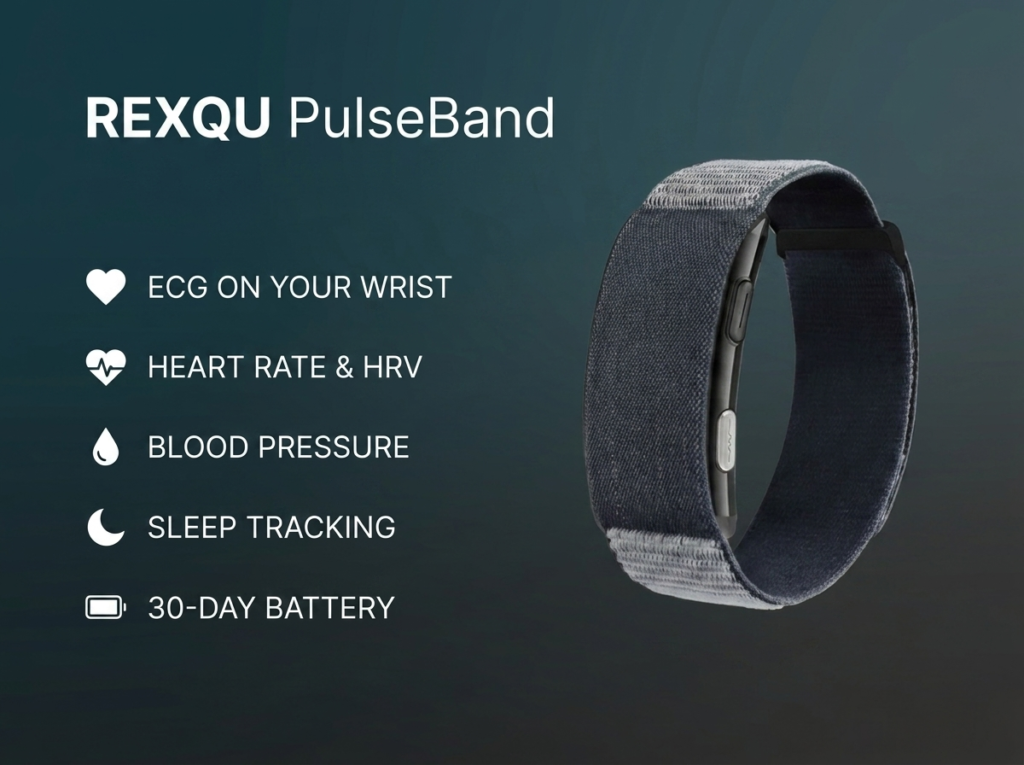
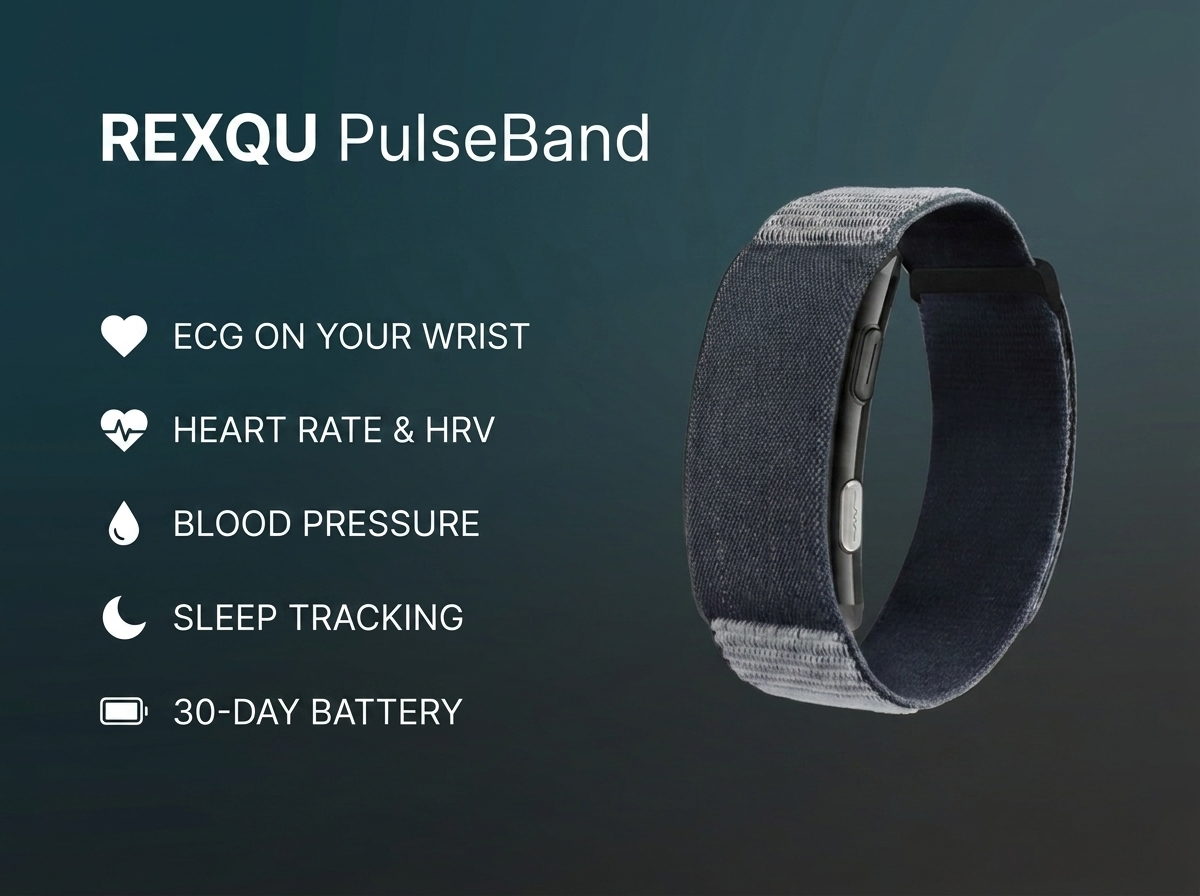
| PulseBand | Automatic sleep, 24h HRV, heart rate, stress and temperature trends | 25–30 days | Deepest recovery-oriented tracking |
| CardioBand | Automatic sleep analysis, stages, duration and weekly patterns | 7–10 days | Sleep analysis plus ECG/HRV |
| AeroBand | Sleep tracking alongside heart rate and activity | 11–30 days depending on use | Simple, long-running overnight tracking |
| GuardBand | All-round sleep tracking plus safety features | 7–10 days | Sleep tracking with GPS/SOS/fall detection |
PulseBand: Best for Sleep Plus HRV Trends
The REXQU PulseBand is the strongest fit if your main interest is seeing how sleep, heart rate and HRV change together. It records 24/7 heart rate and 24-hour HRV, including overnight analysis, and also tracks sleep, stress and body-temperature trends through the free G BAND app.
The biggest practical advantage is battery life. With 25–30 days of typical use, PulseBand can remain on the wrist through many nights without forcing you to choose between charging and sleep tracking.
CardioBand: Best for Sleep Stages and Weekly Patterns
The REXQU CardioBand is a strong alternative if you want a more sleep-analysis-focused app experience. Its product page describes automatic sleep and health analysis with estimated sleep stages, total duration and weekly patterns in G BAND.
CardioBand also tracks heart rate and HRV around the clock and includes an on-demand ECG feature. Battery life is shorter than PulseBand at roughly 7–10 days of normal use, but that is still enough to cover a full week of nights before charging.
AeroBand: Best for Simple Sleep Tracking
If you do not need ECG or the more detailed recovery features, the REXQU AeroBand keeps things simpler. It tracks sleep alongside heart rate, blood-pressure wellness estimates, blood oxygen, steps and activity through its free companion app.
Its 11–30 day battery range, depending on use, also makes it attractive to people who mainly want uninterrupted daily and overnight tracking without thinking much about charging.
What Sleep Data Can a Screenless Fitness Tracker Show?
The exact dashboard varies by model and app version, but common sleep-related information includes:
- Estimated time asleep
- Estimated sleep-stage breakdowns on supported models
- Nighttime heart-rate trends
- HRV trends on PulseBand and CardioBand
- Weekly sleep patterns
- Related stress or recovery information
The most useful way to read this information is as a trend rather than as a nightly verdict. Wearables estimate sleep from indirect signals. They can help you notice patterns—such as consistently shorter nights or changing resting metrics—but they cannot tell you with clinical certainty why those changes occurred.
How Accurate Is Screenless Fitness Tracker Sleep Tracking?
Consumer wearables are generally better at estimating broad sleep/wake patterns than at perfectly identifying every sleep stage. A clinical sleep study uses multiple signals—such as brain activity, eye movement, breathing and muscle activity—that a wrist band cannot reproduce.
The National Heart, Lung, and Blood Institute provides useful background on sleep and clinical assessment. If you have persistent insomnia, loud snoring, breathing pauses, excessive daytime sleepiness or another sleep concern, a wearable should not replace professional evaluation.
What HRV Adds to Sleep Tracking
Heart-rate variability measures changes in the time between heartbeats. It naturally varies between people and from day to day, which is why your personal trend is more useful than comparing one number with someone else’s.
On a tracker such as PulseBand or CardioBand, overnight HRV can be reviewed alongside sleep and resting heart-rate trends. That can give you additional context about how your body responds to exercise, stress, travel or disrupted routines. For a useful medical overview of the metric, see the Cleveland Clinic guide to heart-rate variability.
How to Get Better Overnight Readings
- Wear the band snugly but comfortably. A loose tracker can shift and lose sensor contact during the night.
- Position it above the wrist bone. Consistent skin contact helps optical sensors collect cleaner signals.
- Keep the sensors clean and dry. Sweat, lotion and residue can interfere with contact.
- Charge during the day. Long battery life is an advantage only if you avoid charging during your normal sleep window.
- Give the tracker time to build a baseline. A week or two of consistent wear is more informative than one night.
- Review trends weekly. Look for recurring patterns rather than reacting to one unusually good or bad night.
Screenless Sleep Tracker vs. Smartwatch
| Factor | Screenless Tracker | Traditional Smartwatch |
|---|---|---|
| Night comfort | Usually slimmer and less distracting | Can be larger/heavier |
| Display at night | None | May light up unless disabled |
| Battery | Often days to weeks | Often shorter because of display and extra functions |
| Where data is viewed | Phone app | Watch + phone app |
| Best for | Passive, low-distraction tracking | People who want information directly on the wrist |
Frequently Asked Questions About Screenless Fitness Tracker Sleep Tracking
Can a screenless fitness tracker track sleep without a phone nearby?
Many measurements can continue while the phone is elsewhere, with data syncing when Bluetooth reconnects. You still need the companion app to review the results.
Does a screenless tracker know when I fall asleep?
The tracker estimates sleep using movement and physiological signals. It does not directly measure brain activity, so treat sleep start times and stages as estimates.
Can a screenless fitness tracker diagnose sleep apnea?
No. REXQU bands are wellness devices and are not intended to diagnose sleep apnea or any other sleep disorder.
Do I need a subscription to see sleep data?
REXQU’s screenless trackers use free companion apps and do not require a REXQU subscription to view their core sleep and wellness data.
Which REXQU band has the longest battery for sleep tracking?
PulseBand is rated for 25–30 days of typical use, while AeroBand can also reach up to 30 days depending on use. See the full screenless fitness tracker battery-life comparison for details.
Which Screenless Fitness Tracker for Sleep Tracking Should You Buy?
Choose PulseBand if overnight HRV, long battery life and a broader health-sensor set matter most. Choose CardioBand if you want automatic sleep-stage and weekly-pattern analysis alongside ECG and HRV. Choose AeroBand if you prefer simpler sleep and activity tracking with long battery life.
For all four models, current specs and direct product links are available on the REXQU Screenless Fitness Tracker collection →.
REXQU trackers are wellness and fitness devices, not medical devices. Sleep, HRV and other readings are intended for general awareness and trend tracking, not diagnosis or treatment.