
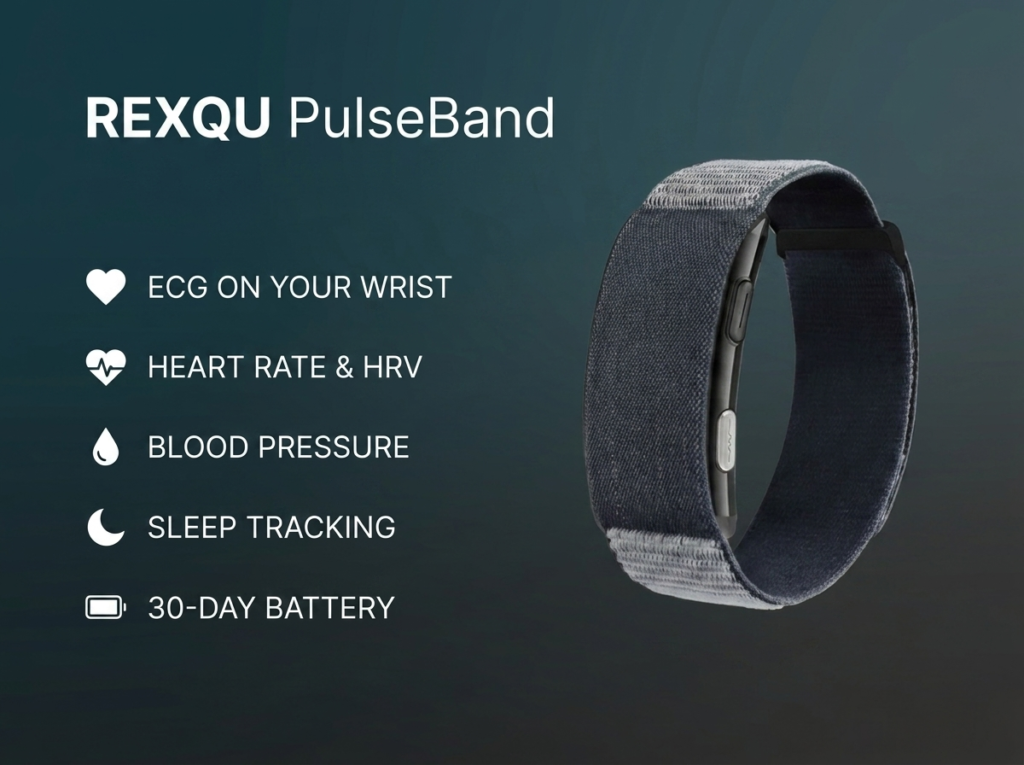
Do you actually need a screen on a fitness tracker? For many people, the answer is no. If your main goal is to track heart rate, HRV, sleep, activity and other wellness trends without another glowing display on your wrist, a fitness tracker without a screen can be a better fit than a traditional smartwatch.
The trade-off is straightforward: you give up on-wrist menus, message previews and instant data readouts, but you gain a slimmer band, fewer distractions and often much longer battery life. Detailed information moves to the companion app on your phone rather than being shown on the band itself.
What Does a Fitness Tracker Without a Screen Actually Do?
A screenless fitness tracker still contains the sensors that do the measuring. Depending on the model, it can collect heart-rate, HRV, sleep, activity, blood-oxygen and other wellness data, then sync those measurements to a phone app over Bluetooth.
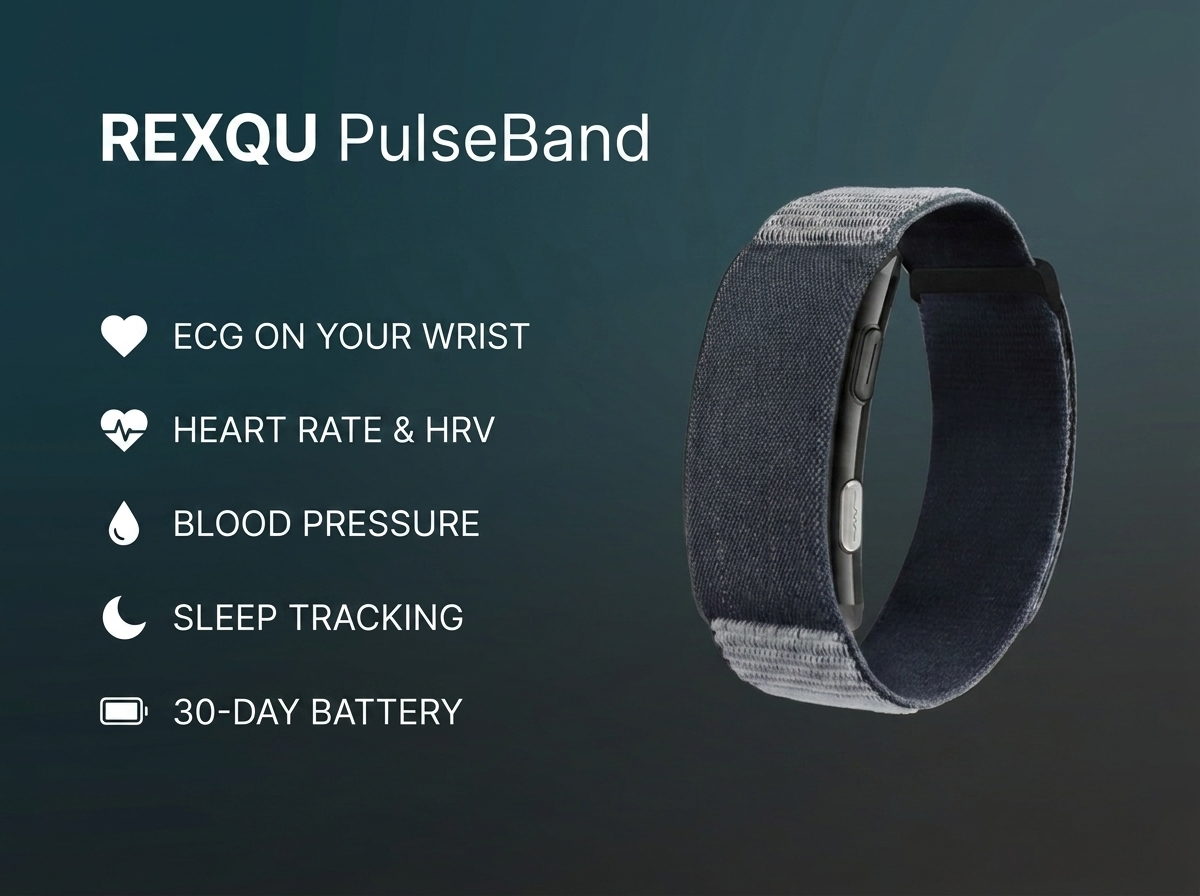
The screen is only the interface. Removing it does not automatically remove the underlying sensors. That is why a band such as the REXQU PulseBand can include 24/7 heart rate, HRV, sleep and an on-band ECG feature even though there is no display to show the waveform directly on your wrist.
What You Give Up When You Remove the Screen
A screenless band is not better in every situation. You lose several conveniences that a smartwatch provides immediately:
- No instant time or health readout: you cannot glance at the band to see heart rate, steps or sleep score.
- No message preview: a vibration can alert you, but the text itself stays on your phone.
- No on-wrist menus: settings, history and detailed graphs live in the app.
- No maps or visual workout metrics on the wrist: route details and charts are reviewed afterward on the phone.
- No large emergency interface: safety-oriented screenless bands rely on simple physical actions rather than visual menus.
If you frequently use a smartwatch to check the time, read messages, follow turn-by-turn directions or view workout stats in real time, you may miss the screen more than you expect.
What You Gain With a Screenless Fitness Tracker
The advantages become clearer when the wearable is meant to be worn almost all the time:
- Longer battery life: no display means less power consumption.
- Less distraction: there is nothing constantly lighting up or inviting you to check it.
- More comfortable sleep wear: no bright screen wakes you when you move at night.
- More discreet design: a slim band can disappear under a sleeve.
- More complete trend data: if longer battery and comfort lead you to wear it more consistently, you get fewer gaps in your history.
That last benefit matters. A wearable cannot collect useful trends while it is off the wrist. Battery life and comfort may therefore have more practical value than another display feature you rarely use.
Screenless Fitness Tracker vs Smartwatch
| Feature | Screenless Fitness Tracker | Traditional Smartwatch |
|---|---|---|
| Display | None | Touchscreen or watch display |
| Detailed data | Phone app | Wrist + phone app |
| Notifications | Usually vibration alerts | Text previews, apps, calls and more |
| Battery potential | Often days to weeks | Often shorter because of the display |
| Sleep comfort | Very discreet, no glow | Depends on size/display settings |
| Distraction level | Low | Higher |
| Best for | Passive tracking and trends | Interactive wrist use |
Four Ways REXQU Approaches Screenless Tracking
REXQU currently has four screenless bands, all linked from the static Screenless Fitness Trackers category:
- PulseBand: heart-focused tracking with on-band ECG and roughly 25–30 days of battery life.
- CardioBand: 24/7 heart rate and HRV, on-demand ECG, cycle tracking and 7–10 day normal battery life.
- AeroBand: simple everyday heart-rate, blood-oxygen, sleep and activity tracking with roughly 11–30 days per charge depending on use.
- GuardBand: a safety-first band adding real-time GPS position upload, one-press SOS and automatic fall detection.
Those differences are why this article is deliberately about the screen vs no-screen decision, while the screenless buying guide handles the commercial model comparison.
Do Screenless Trackers Still Give You Notifications?
Yes, but the experience is different. Some REXQU bands use vibration alerts for calls or messages. The band can tell you that something happened without showing the full message on a display.
For people trying to reduce wrist distractions, that can be a feature rather than a limitation: you decide whether the vibration is worth checking on the phone instead of having every message displayed in front of you.
See Screenless Fitness Tracker Notifications: How They Work for a model-specific explanation.
Does Screenless Mean Better Battery Life?
Usually, yes — because the display is one of the major power users in a wearable. Current REXQU examples show the range clearly:
- PulseBand: roughly 25–30 days typical use
- AeroBand: roughly 11–30 days depending on use
- CardioBand: roughly 7–10 days normal use, 15–20 standby
- GuardBand: roughly 7–10 days normal use, 15–20 standby
The more detailed comparison is in Screenless Fitness Tracker Battery Life Compared.
Is a Fitness Tracker Without a Screen Better for Sleep?
It can be more comfortable because there is no display to light up when you move, and the slimmer form factor may be easier to forget about overnight. Longer battery life also reduces the chance that the device is sitting on a charger during sleep.
That does not mean the absence of a display makes sleep measurement inherently more accurate. Sleep estimates still depend on the sensors, algorithms, fit and the limits of consumer wearables. See Screenless Fitness Tracker for Sleep Tracking for the sleep-specific discussion.
Is a Screenless Fitness Tracker More Accurate?
No. Accuracy is not determined by whether a screen exists. Heart-rate accuracy depends more on sensor quality, fit, skin contact, motion and the type of exercise being performed.
A snug band with good skin contact can provide useful heart-rate trends, while loose fit or vigorous wrist movement can make optical readings noisier. Read Screenless Fitness Tracker Heart Rate Accuracy Explained for practical ways to improve consistency.
What About ECG on a Band With No Screen?
An ECG feature does not require a display. On the PulseBand and CardioBand, the user touches the ECG sensor while holding still, and the trace is then shown in the G BAND app.
That is a consumer wellness feature, not a replacement for a clinical ECG. For a fuller explanation of single-lead wrist ECG technology, read Single-Lead ECG Smartwatch: What It Can and Can’t Show.
Who Should Choose a Fitness Tracker Without a Screen?
A screenless tracker is a particularly good fit if you:
- want health and activity trends without another screen
- already prefer reviewing data on your phone
- want better battery life than most smartwatches
- wear a tracker to sleep
- prefer a discreet band under a shirt cuff
- are easily distracted by notifications
- want a safety band such as GuardBand without a complicated interface
Who Should Keep the Screen?
A traditional smartwatch is probably better if you regularly:
- check the time on your wrist
- read messages without taking out your phone
- want live workout metrics
- use navigation on the wrist
- need large on-device health numbers
- answer calls through a visual call interface
If large on-wrist health information is important, browse the REXQU Health Smartwatches category instead.
The App Becomes More Important When There Is No Screen
Because the phone becomes the main interface, app compatibility should be checked before purchase. PulseBand, CardioBand and GuardBand currently use the free G BAND app and support Android 8.0+ and iOS 13.0+. AeroBand works with a free companion app on Android and iOS.
Read Screenless Fitness Tracker App Compatibility Explained before buying for an older phone.
Frequently Asked Questions
Can a fitness tracker work properly without a screen?
Yes. The sensors collect the data and the companion app displays it. The screen is not required for continuous tracking.
Can I see my heart rate without my phone?
Not as a visual number on a truly screenless band. The detailed reading and history are viewed in the app.
Do REXQU screenless trackers require a subscription?
No. REXQU does not charge a recurring subscription for the core companion-app data and trend history described here.
Which REXQU screenless tracker has ECG?
PulseBand and CardioBand include on-demand/on-band ECG features according to their current product specifications.
Which one is best for safety?
GuardBand is the safety-focused option, with real-time GPS position upload, one-press SOS and automatic fall detection.
Can I swim with a screenless REXQU band?
The current screenless range is rated around everyday splash exposure rather than swimming. Read What 1ATM Means before using one around water.
The Bottom Line
You do not need a screen on a fitness tracker if the screen is not part of what you value. A fitness tracker without a screen can still collect detailed wellness and activity trends while offering a quieter experience and much longer battery life. If that sounds right for you, compare PulseBand, CardioBand, AeroBand and GuardBand in the REXQU Screenless Fitness Trackers collection →
REXQU fitness trackers are consumer wellness devices intended for general awareness and lifestyle tracking. They are not medical devices and are not a substitute for professional medical advice, diagnosis or treatment.