
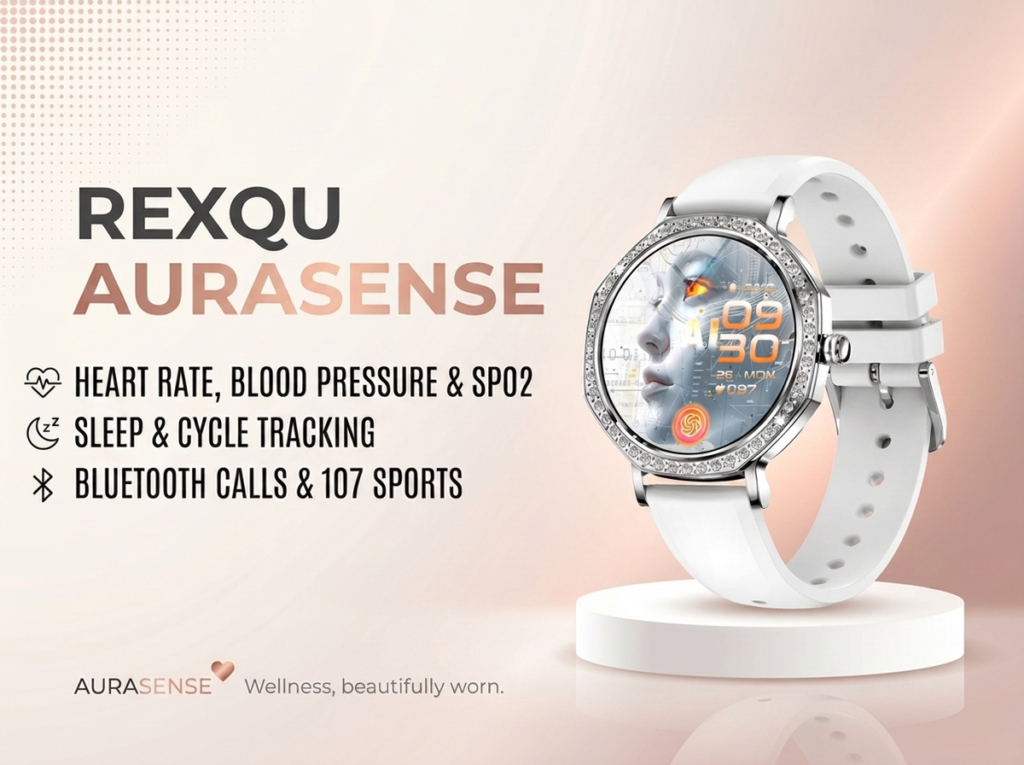
Smartwatch cycle tracking can be useful for logging periods, setting reminders and spotting patterns over time—but it is important to understand what the watch and app are actually doing. A consumer smartwatch does not independently “know” your menstrual cycle in the same way a medical test measures hormones. Most cycle features rely on the dates and information you enter, then use those records to estimate future timing and reminders.
REXQU’s women’s smartwatch collection includes cycle or women’s-health features across several models, with the information stored in the companion app. The best choice depends on whether you also want Bluetooth calling, NFC, a smaller case, wireless charging or longer battery life.
What Smartwatch Cycle Tracking Actually Does
Cycle tracking usually combines a calendar with reminders and estimates based on previously entered cycle dates. Depending on the app and model, you may be able to:
- Log the first day of a period
- Track cycle length over time
- Record symptoms or notes
- Receive reminders for an expected period
- Review cycle history in the companion app
- See cycle information alongside sleep, heart-rate or activity trends
The exact feature set varies by watch and companion app. That is why it is better to look for a product page that explicitly mentions cycle tracking, a women’s-health calendar or reminders rather than assuming every watch marketed to women includes the same function.
Can a Smartwatch Really Predict Your Period?
It can estimate future timing from the data you give it, but “predict” should not be interpreted as “guarantee.” Menstrual cycles naturally vary, and travel, stress, illness, age, medication, pregnancy, perimenopause and many other factors can change timing.
The U.S. Office on Women’s Health explains that cycle length can vary and that changes are not automatically abnormal. Their menstrual-cycle guide is useful background for understanding the calendar a smartwatch app is trying to estimate.
Best REXQU Smartwatches for Cycle Tracking
| Model | Cycle / Women’s Health | Standout Feature | Best For |
|---|---|---|---|
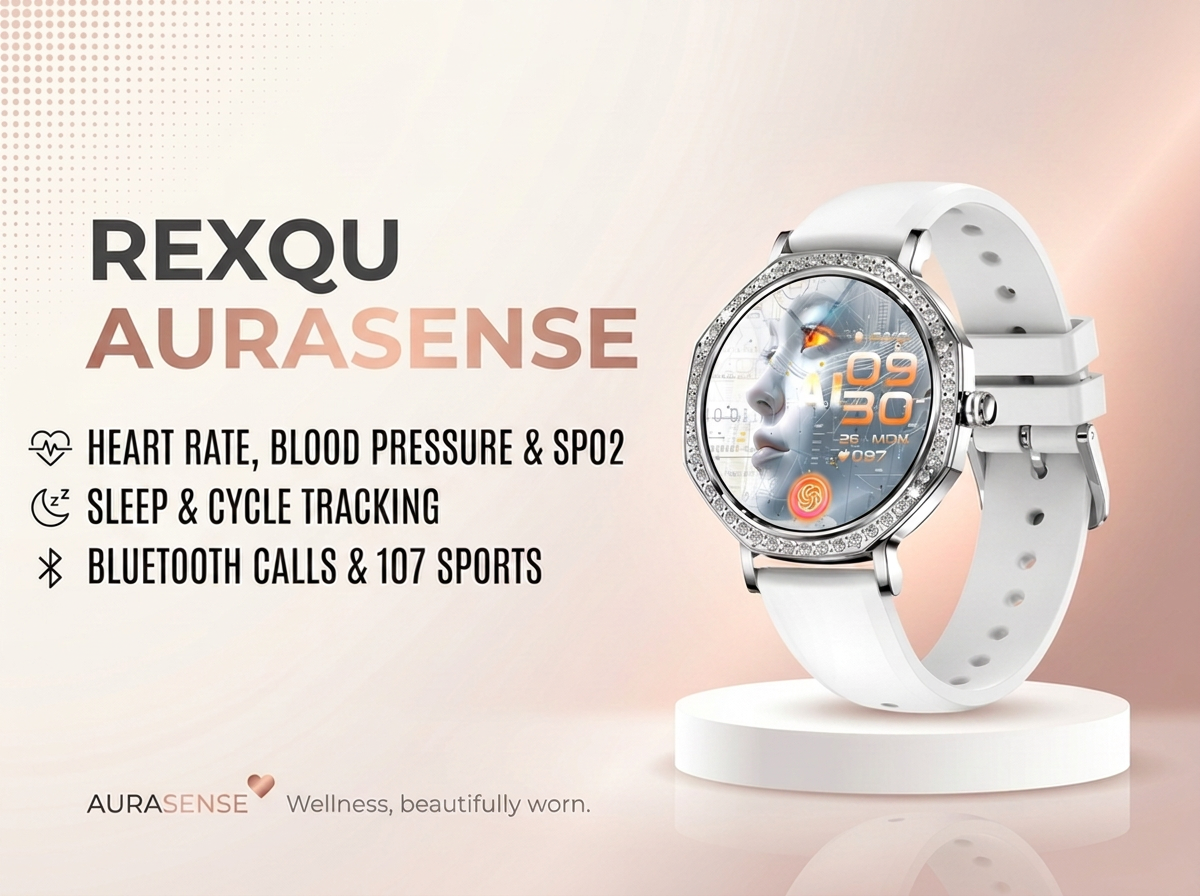
| AuraSense | Cycle tracking/reminders | Bluetooth calls + AI voice assistant | Best all-round smart features |
| VitaLuxe | Private cycle calendar + reminders | 1.75″ AMOLED + NFC | Large display and style |
| GraceFit | Cycle tracking + reminders | Wireless charging + 8 strap styles | Style flexibility |
| SlimPulse | Women’s health tracking | 6.8mm-thin case | Small wrists |
| SereneIQ | Women’s health tracking | 23.5g + Bluetooth calls | Lightweight classic look |
| VitaGlow | Women’s health tracking | 100+ sport modes + wireless charging | Fitness-focused users |
| HarmonySync | Women’s health tracking | Sleep tracking + long standby | Balanced everyday use |
| LumaGrace | Women’s health features | 40+ day standby | Battery-first shoppers |
AuraSense: Cycle Tracking Plus Calls and AI
The REXQU AuraSense is the strongest fit if cycle tracking is only one of several smartwatch functions you want. It combines women’s-health tracking with Bluetooth calling and an AI voice assistant, so it behaves more like a full smartwatch than a simple cycle calendar on the wrist.
If calling matters more than cycle tracking alone, compare AuraSense with the other models in Bluetooth Calling Smartwatch for Women Compared.
VitaLuxe: Private Cycle Calendar on a Bigger Display
The REXQU VitaLuxe uses a large 1.75-inch AMOLED and lists female cycle tracking with a private calendar and reminders in the app. It also adds NFC, heart-rate tracking and sleep tracking.
If you prefer seeing more information on the watch itself, the larger display may be a better fit than a smaller fashion watch. VitaLuxe is also a good option if NFC matters to you; see the NFC Smartwatch for Women comparison for alternatives.
GraceFit: Cycle Reminders With Wireless Charging
The REXQU GraceFit combines women’s-health management, cycle tracking and reminders with wireless charging and eight strap styles.
That makes it attractive if you want the watch to work as both a health-and-fitness accessory and a fashion item. The ability to switch between mesh, leather and silicone straps is more relevant for everyday wear than many technical features people rarely use.
Does a Smartwatch Use Heart Rate to Detect Your Cycle?
Do not assume that the watch is directly identifying cycle phase from heart rate or other wrist sensors. Some research is exploring whether physiological signals can contribute to cycle-related estimates, but the consumer feature you see in a smartwatch app is usually centred on your calendar history and logged information.
Heart rate, sleep and other wellness metrics can still be interesting to review alongside cycle dates because you may notice personal patterns. But a correlation in your app is not proof that a particular cycle phase caused a change in heart rate, sleep or blood-pressure-style estimates.
Can Smartwatch Cycle Tracking Confirm Ovulation?
No consumer cycle-tracking watch should be assumed to confirm ovulation unless it is specifically validated and regulated for that purpose. A calendar estimate can suggest a likely window based on previous cycles, but it is not the same as hormone testing, ultrasound or another clinically appropriate method.
If you are trying to become pregnant, managing infertility or investigating irregular cycles, use the watch as a record-keeping aid rather than a substitute for professional guidance.
Can You Use Smartwatch Cycle Tracking for Birth Control?
Do not rely on a general smartwatch cycle prediction as your sole contraceptive method. A missed or shifted cycle can make calendar predictions inaccurate, and a wellness watch is not automatically a regulated fertility-awareness contraceptive device.
If pregnancy prevention is the goal, use an appropriate contraceptive method and discuss options with a qualified healthcare professional.
How to Get More Useful Cycle Data From Your Smartwatch
- Enter dates consistently. A calendar cannot estimate future timing well if the history is incomplete.
- Correct mistakes. If a date was entered incorrectly, fix it instead of leaving the app to build future estimates on bad data.
- Use symptom notes. If your app supports notes or symptom tracking, record information consistently rather than only on unusual days.
- Review several cycles. One month is a poor basis for assuming a reliable pattern.
- Keep the watch/app synced. Regular syncing helps keep your history current.
- Use reminders as planning prompts. Treat them as estimates, not guarantees.
Privacy: Cycle Data Is Personal Data
Cycle information can be sensitive. Even when a watch keeps reminders discreet, the detailed history still lives in an app on your phone or associated account.
Use a phone passcode or biometric lock, review app permissions, and avoid sharing account credentials. A screenless or jewellery-style watch may make cycle information less visible on the wrist, but privacy also depends on how the app and phone are secured.
Battery Life Matters More Than It Seems
Cycle tracking works best when you use the same app consistently over time. If you also want sleep and heart-rate trends alongside cycle dates, a watch that stays on the wrist for several days creates fewer gaps in the supporting data.
LumaGrace leads the women’s collection on published standby time, while GraceFit, HarmonySync and SlimPulse also offer long standby figures. Compare them in Smartwatch Battery Life for Women.
Small Wrists and Cycle-Tracking Watches
If most smartwatches feel too large, you do not need to give up women’s-health features. SlimPulse and SereneIQ both include women’s-health tracking while being designed around smaller or lighter cases.
See Best Smartwatch for Small Wrists: SlimPulse vs SereneIQ for the fit comparison.
Smartwatch Cycle Tracking vs a Phone-Only App
| Feature | Smartwatch + App | Phone-Only App |
|---|---|---|
| Cycle calendar | Yes, depending on model/app | Yes |
| Reminders on wrist | Often available | Phone only |
| Sleep/heart/activity context | Automatically collected by watch | Usually requires another device or manual entry |
| Cost | Hardware purchase | May be free or subscription-based |
| Best for | People who want cycle history beside everyday wearable trends | People who only need a calendar/log |
Smartwatch Cycle Tracking FAQs
Does a smartwatch automatically know when my period starts?
Usually not. Cycle features depend heavily on the dates and information you enter into the companion app.
How many cycles should I log before trusting the estimate?
More history generally gives the app a better picture of your usual timing, but even a long history cannot guarantee future dates because cycles can change.
Which REXQU smartwatch is best for cycle tracking?
AuraSense is the strongest all-round option if you also want calls and an AI voice assistant. VitaLuxe is a strong choice for a larger display and NFC, while GraceFit is attractive if wireless charging and strap variety matter.
Do REXQU cycle features require a subscription?
REXQU does not require a subscription to access the core companion-app features of its women’s smartwatches.
Can cycle tracking diagnose PCOS, endometriosis or another condition?
No. A smartwatch calendar can help you keep a record to discuss with a clinician, but it cannot diagnose reproductive-health conditions.
What should I do if my cycle suddenly changes?
One unusual cycle can happen for many reasons. If changes are persistent, severe or accompanied by concerning symptoms, speak with a healthcare professional rather than relying on the watch to explain them.
Which REXQU Cycle-Tracking Smartwatch Should You Choose?
Choose AuraSense if you want the most complete smartwatch experience around cycle tracking. Choose VitaLuxe for the largest women’s display and NFC, GraceFit for wireless charging and strap variety, or SlimPulse if a very thin case matters most.
For the complete commercial comparison, read the Best Smartwatch for Women buying guide or go directly to the REXQU Women’s Smartwatches collection →.
REXQU smartwatches are wellness and fitness devices, not medical devices. Cycle tracking and reminders are intended for general personal tracking and should not be used for diagnosis, fertility treatment or contraception decisions.