
Choosing the best smartwatch for construction workers is less about how many apps it has and more about whether it fits the conditions of a real job site: dust, rain, knocks, bright sunlight, gloves and long shifts.

The REXQU EnduroMax is one REXQU model positioned for rugged everyday use. If your work also needs navigation or route context, compare the TrailGuard and the wider GPS smartwatch range.
View EnduroMax specs and current price →
What a job site actually does to a watch
Choosing a smartwatch for construction workers is mostly a process of matching hazards to specs. Six things break watches on site, and each one is defeated by a different number on the spec sheet — which is why a watch that looks bulletproof on paper can still fail on its first week.
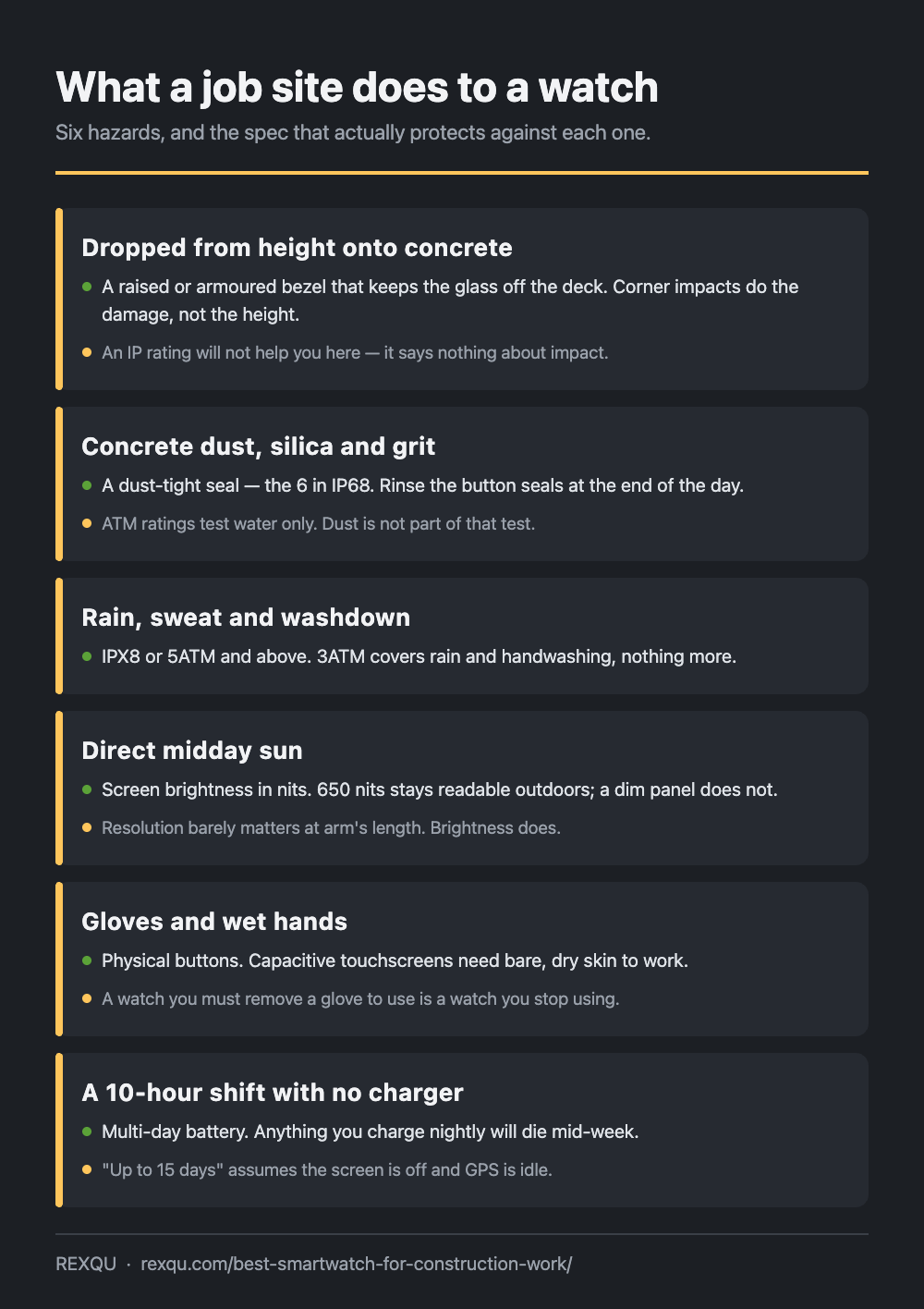
The pattern worth noticing: no single rating covers everything. IP68 handles dust and water but says nothing about impact. An ATM number covers water only. Brightness, button count and battery are not covered by any durability rating at all. A watch is only as tough as its weakest relevant spec, and on a site the weakest one is usually the screen.
What Durability Ratings Mean for a Smartwatch for Construction Workers
Most “rugged” smartwatch marketing leans on water-resistance ratings, but on a job site, the bigger risk usually isn’t water — it’s impact. Dropped tools, brushing against rebar or framing, getting knocked against a truck bed. That’s why case construction matters as much as the IP rating on the spec sheet. The EnduroMax’s zinc-alloy body with reinforced side armor is designed to take that kind of daily knock without the screen or housing cracking, on top of IP68 water resistance for rain, sweat, and dust.
If your work also involves navigating a large site or working somewhere without cell service — think land surveying, remote installation, or utility work — the TrailGuard is worth a look instead. It trades some battery life for a built-in compass, altitude/air-pressure sensing, and GPS track syncing, plus a Gorilla Glass display for scratch resistance, which matters if your watch is brushing against tool belts and gear all day.
Watch or smartwatch — what do you actually need?
Plenty of trades search for a durable watch rather than a smart one, and it is a fair question: if the job is telling the time and surviving abuse, a $40 field watch does that and takes a beating no smartwatch will match. The case for a smartwatch is not toughness — it is the three things a mechanical watch cannot do.
Notifications without pulling your phone out. On a lift, in a trench, or with a tool in each hand, a wrist buzz that tells you whether a call matters is worth more than it sounds — and it keeps the phone in your pocket, which is where it survives.
Heat strain awareness. Continuous heart rate won’t diagnose anything, but a resting rate that stays elevated through a hot afternoon is a useful prompt to get in the shade and drink something. In summer trades that is the feature people keep.
A record of the day. Steps, active time and sleep add up over a season into a picture of how the work is treating you.
If none of those matter to you, buy a field watch and spend the difference on boots. If they do, the durability question becomes: which smartwatch survives the site? That is the rest of this page.
Battery life: the number that actually matters
A watch that needs a nightly charge is a watch you’ll eventually forget to charge before an early shift. This is where a lot of “rugged” watches fall short — many mainstream fitness watches are rated for 1–2 days of active use. The EnduroMax is rated for up to 15 days on normal use (about 2.5 hours to fully recharge), which comfortably covers a full work week, including a few days off, without needing to think about it. The TrailGuard runs 7–10 days per charge, still well beyond typical smartwatch battery life, with the tradeoff going toward the extra navigation sensors.
Can you actually read the screen in direct sunlight?
This gets overlooked until it’s a problem. A dim display is unreadable at a glance in full sun, which defeats the point of a wrist-worn device on an outdoor job. The EnduroMax’s AMOLED panel runs at 650 nits — bright enough to stay legible outdoors — with an always-on display option so you’re not tapping the screen with work gloves on just to check the time.
What About Heart Rate and Heat on a Job Site?
Hot construction work can create a genuine heat-illness risk. A smartwatch heart-rate trend may give you extra context about exertion, but it should not be used as a heat-stress alarm or as a substitute for site safety procedures. Follow your employer’s heat plan and the OSHA heat-exposure guidance, including water, rest, shade and attention to symptoms.
If you feel faint, confused, unusually weak, nauseated or otherwise unwell in the heat, act on the symptoms and workplace emergency procedure rather than waiting for a watch reading. REXQU heart-rate data is for wellness awareness, not diagnosis or occupational-safety clearance.
Construction Smartwatch Buyer Checklist
Before buying a smartwatch for construction work, check these points against the conditions on your actual site:
- Dust: prefer a model with a published IP dust rating rather than water resistance alone.
- Impact: look for reinforced side protection, a raised bezel or protected glass; IP68 does not certify drop resistance.
- Sunlight: compare display brightness, not just resolution. A bright screen is more useful outdoors than extra pixels you cannot see.
- Gloves: physical buttons matter if you cannot reliably use a capacitive touchscreen with work gloves.
- Shift length: allow battery headroom for notifications, health sensors and any GPS use rather than relying on standby figures.
- Night work: if a built-in light would be useful, compare the REXQU smartwatch-with-flashlight buying guide.
If impact resistance is your main concern, read the drop-resistant smartwatch comparison. For the wider category, see the best rugged smartwatch guide.
Three REXQU models, compared for site work
These are the three from the rugged smartwatches range that make sense on a job site. Full specs on all six are in the rugged smartwatch buying guide.
| Model | Price | Dust & water | Impact protection | Battery | Screen | Best for |
|---|---|---|---|---|---|---|
| EnduroMax | $149.97 | IP68 | Zinc-alloy case, reinforced side armour | Up to 15 days | 1.43″ AMOLED, 650 nits | General site work — the all-rounder |
| TerraPulse | $149.97 | IP68 | Zinc-alloy bezel | Up to 15 days | 1.43″ AMOLED, 466×466 | Same durability, 90-day money-back |
| BaseCamp | $119.97 | IP68 | 50mm tough frame | Not specified | 1.52″, 360×360 | Kitting out a crew on a budget |
The FlareTrail is worth a mention for anyone working nights because it carries a built-in LED flashlight. For dusty environments, however, check the full dust-protection specification rather than assuming a water rating covers airborne grit. The same rule applies to every model: use the current product page and manufacturer guidance for the conditions that matter on your site.
Set Up the Watch Before the First Shift
- Turn off nonessential notifications. Keep calls, supervisor messages and genuinely useful alerts; remove the rest.
- Set screen brightness outdoors. Test it in actual daylight rather than indoors.
- Choose a practical watch face. Time, battery and heart rate are usually more useful on site than decorative complications.
- Test buttons with your normal gloves. Do this before you need them on a ladder or lift.
- Check the band fit. It should be secure without restricting circulation.
- Start the week charged. Leave enough battery margin for longer shifts and heavier-than-normal use.
Smartwatch for Construction Workers — FAQs
Will an IP68 watch survive being dropped off scaffolding?
IP68 tells you nothing about that. It is a dust and water rating — the 6 means dust-tight, the 8 means continuous immersion. Impact survival comes from the case and bezel design, not the IP code. What decides a drop is what the watch lands on and which part hits first: a corner strike onto a hard edge concentrates the force into one point and is far more damaging than a flat landing from the same height.
Can I wear it under work gloves?
Physically yes, on most sites, though a 50mm case like the BaseCamp’s is a tight fit under a tight cuff. The real problem is operating it — capacitive touchscreens need bare, dry skin, so with gloves on you are working from the physical buttons only. If you are gloved most of the day, count the buttons before you count the pixels.
How often should I clean it?
Rinse the case and buttons with fresh water at the end of any dusty or sweaty day. Grit works its way into the button seals, and that is where water eventually gets in. Water resistance degrades from the day you buy the watch — treating it as permanent is the most common way people flood one.
Does the heart rate sensor work through concrete dust and sweat?
Optical sensors read through skin, not through whatever is on top of the watch, so dust on the case is not the issue — a loose fit is. Sweat and a slipping band cause far more bad readings than dirt does. Snug it up one notch before a hot shift and the data gets noticeably steadier.
Is a more expensive watch more durable?
Not reliably. Between the models above, the $119.97 BaseCamp and the $149.97 EnduroMax carry the same IP68 rating; the extra money buys a brighter AMOLED screen, side armour and a published battery figure — not a fundamentally tougher seal.
Bottom line
For most construction and trade work, the priority order is: does it survive impact and water, does it last the week, can you read it outside, and does it give you basic health awareness. On REXQU’s rugged, fitness & outdoor lineup, the EnduroMax is the strongest smartwatch for construction work for general job-site use, and the TrailGuard is the better pick if your work also requires navigation — compass, altitude, or GPS tracking — on top of durability.
This article is informational and reflects product specifications published by REXQU; it is not medical advice. Consult a healthcare provider for concerns about heat stress or heart health.