
A daily health monitoring watch with ECG gives you two different kinds of heart information on one wrist: passive everyday trends such as heart rate, sleep and blood oxygen, plus a deliberate single-lead ECG recording when you want a closer look at rhythm. Within REXQU’s current range, the HealthLink is one of the clearest fits for that combination.
This article explains what the ECG adds, how the HealthLink compares with other REXQU health watches, and when a daily-health model makes more sense than a specialist ECG watch.
What Does a Daily Health Monitoring Watch With ECG Track?
A health-focused smartwatch can gather several types of data, but the sensors do not all work the same way.
- Heart rate: optical PPG sensors estimate pulse repeatedly through the day.
- Blood oxygen (SpO₂): light-based sensing estimates oxygen saturation for wellness awareness.
- Sleep: movement and heart-rate signals help estimate sleep duration and stages.
- Temperature trends: selected models track changes at the wrist.
- ECG: electrical contacts record a short single-lead rhythm trace when you deliberately start a measurement.
The ECG is therefore not simply a “better heart-rate reading.” It measures the heart’s electrical signal rather than estimating pulse optically, which is why the result is a waveform rather than just beats per minute.
REXQU HealthLink: Daily Health Monitoring With On-Demand ECG
The REXQU HealthLink combines daily wellness tracking with an on-demand ECG on a 1.95-inch AMOLED display. Its core health feature set includes heart-rate tracking, SpO₂, sleep, temperature trends and a short wrist ECG that can be reviewed later in the companion app.
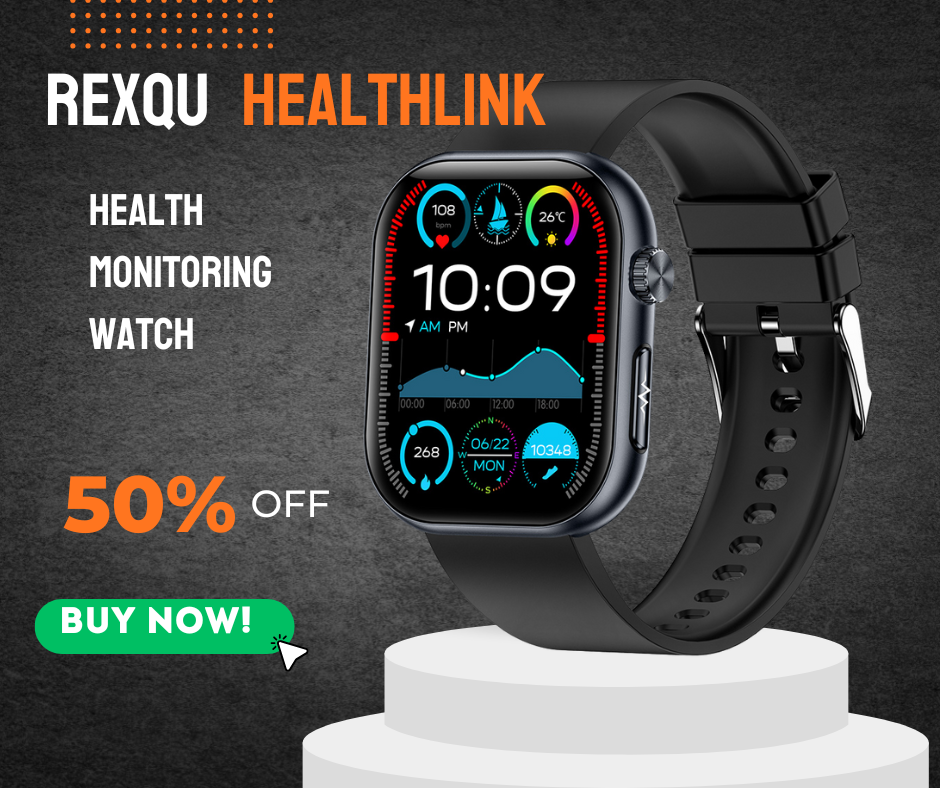
The advantage is convenience: you can wear one watch for routine wellness trends and still have the option to record a rhythm trace when you deliberately choose to do so.
View HealthLink specs and current price →
How Does the HealthLink ECG Work?
When you start an ECG reading, you sit still and maintain contact with the watch’s electrode for the full recording period. The watch captures a single-lead electrical trace and stores it in the companion app.
A single-lead wrist ECG is useful for collecting rhythm information because it is available at the moment you want to take a reading. It is still much simpler than a clinical 12-lead ECG, which views the heart’s electrical activity from multiple directions and is interpreted in a medical setting.
For the evidence and limitations, read REXQU’s Can a Smartwatch Detect AFib? Health Guide and the supporting article Single-Lead ECG Smartwatch: What It Can and Can’t Show.
HealthLink vs VitaCore vs CardioSense
HealthLink is not the only REXQU watch with ECG capability, so it helps to separate the use cases.
| Model | Best for | ECG | Other health focus |
|---|---|---|---|
| HealthLink | General daily health monitoring plus ECG | On-demand single-lead trace | Heart rate, SpO₂, sleep, temperature |
| VitaCore | Multi-vital checks | Included in health-focused workflow | BP wellness trends, SpO₂, temperature, stress |
| CardioSense | Heart-focused display and ECG/BP combination | On-demand wrist ECG | Blood-pressure wellness trends, heart rate, sleep |
If you want the broadest commercial comparison of ECG-first products, use the Best ECG Smartwatch buying guide. If your priority is a general health watch that happens to include ECG, HealthLink remains the more natural starting point.
Why Combine ECG With Daily Health Monitoring?
Daily trend data and ECG answer different questions. Heart-rate and sleep data can show what your normal routine looks like over days and weeks. An ECG is a short snapshot of electrical rhythm at one particular moment.
Keeping both types of information in a companion app can make it easier to review context. For example, you can note when you took an ECG and compare that time with your recent sleep, resting heart-rate or activity trends. That context may be useful in a conversation with a healthcare professional, even though the watch itself does not make a diagnosis.
Can a Smartwatch ECG Detect AFib?
Consumer single-lead ECG technology can capture rhythm information that may be useful for identifying a trace worth discussing with a healthcare professional, but performance depends on device design, signal quality and the situation in which the recording is taken. REXQU watches are wellness devices and should not be used to diagnose atrial fibrillation on their own.
If AFib is your specific concern, use the evidence-focused REXQU AFib Health Guide rather than relying only on a product page.
How to Take a Cleaner Wrist ECG Reading
- Sit down and stop moving. Motion creates noise in an electrical trace.
- Rest your arm on a table. This helps keep the wrist stable.
- Keep the watch snug against the skin. Consistent electrode contact matters.
- Touch the electrode lightly and steadily. Do not repeatedly change pressure during the recording.
- Let the full recording finish. An incomplete trace is less useful.
- If the trace is noisy, repeat it once under calmer conditions.
What About Blood Oxygen and Sleep?
The benefit of choosing a daily health monitoring watch with ECG is that ECG is only one part of the picture. HealthLink also brings blood-oxygen and sleep information into the same general wellness routine.
SpO₂ readings have known limitations. The FDA notes that factors such as circulation, skin pigmentation and skin temperature can affect pulse-oximetry performance. REXQU’s SpO₂ Accuracy Health Guide explains the wearable-specific context in more detail.
Sleep tracking is similarly best used as a trend rather than a diagnosis. See Daily Health Monitoring Watch Sleep Tracking Explained.
Who Should Consider the HealthLink?
HealthLink makes the most sense if:
- you want one general health watch instead of separate specialized devices;
- heart rate, SpO₂ and sleep matter to you every day;
- you also want the option to record an ECG;
- you prefer a display-based smartwatch rather than a screenless tracker;
- you want product features available through the companion app without making ECG the only reason to own the watch.
If ECG is not important, compare the broader Best Daily Health Monitoring Watch guide. If ECG is the main feature you care about, browse REXQU ECG Smartwatches.
Frequently Asked Questions
How long does an ECG reading take?
HealthLink records a short on-demand wrist ECG. Follow the prompts in the companion app and stay still until the recording completes.
Is the HealthLink ECG medical grade?
No. REXQU positions HealthLink as a consumer wellness device. Its ECG can provide a single-lead rhythm trace for awareness and discussion, but it is not a replacement for a clinical ECG or professional diagnosis.
Can I show the ECG to my doctor?
You can review saved recordings in the companion app and show relevant information during an appointment. Export or sharing options can vary by app version, so check the current app workflow before your visit.
Does HealthLink also track blood oxygen?
Yes. HealthLink includes SpO₂ wellness tracking alongside heart rate, sleep, temperature trends and its on-demand ECG feature.
Where can I compare other ECG watches?
See the REXQU ECG Smartwatch Buying Guide or browse the ECG Smartwatch category.
The Bottom Line
A daily health monitoring watch with ECG is most useful when you want ECG as part of a broader wellness routine rather than as an isolated feature. REXQU HealthLink combines everyday heart-rate, blood-oxygen, sleep and temperature information with an on-demand wrist ECG in one device. Compare its current specifications on the HealthLink product page, or browse REXQU Health Smartwatches for the wider range.
This article is for general information and wellness education. REXQU smartwatches are not intended to diagnose, treat, cure or prevent disease.