
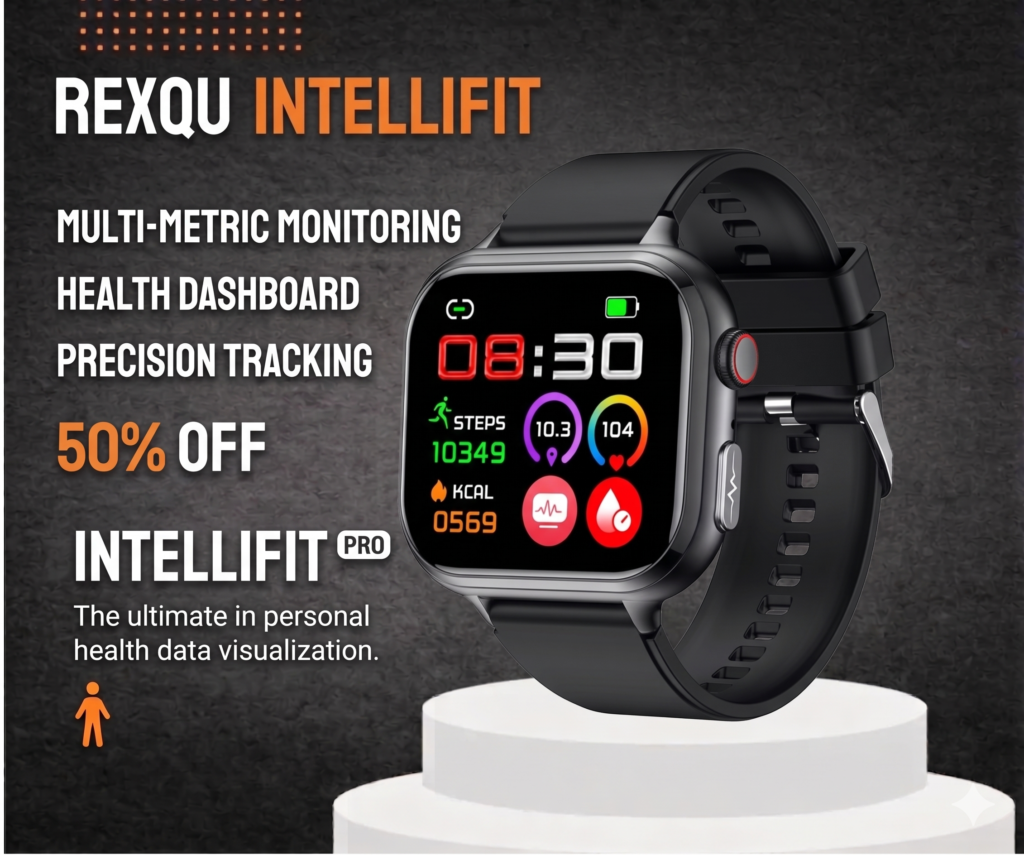
Daily health monitoring watch sleep tracking is most useful when it helps you understand patterns across many nights—not when it turns one night’s estimate into a score you worry about. A wearable can estimate sleep duration and stages by combining motion and heart-rate signals, then place those results alongside daytime wellness data such as resting heart rate, activity and stress.
This guide explains how smartwatch sleep tracking works, what the numbers can and cannot tell you, and how REXQU models such as IntelliFit and CardioSense fit different users.
How Daily Health Monitoring Watch Sleep Tracking Works
A sleep-tracking smartwatch normally relies on two main inputs:
- Movement: an accelerometer detects when your wrist is moving, still or changing position.
- Heart-rate signals: an optical sensor tracks pulse patterns and can add context about changes during the night.
The watch’s software combines those signals to estimate when you fell asleep, how long you slept and when you were likely in lighter, deeper or REM sleep. The exact algorithm varies by device, so sleep-stage numbers should be treated as estimates rather than direct measurements of brain activity.
What Are Light, Deep and REM Sleep?
The National Heart, Lung, and Blood Institute explains that normal sleep cycles through non-REM and REM phases several times per night. Clinical sleep staging is based on measurements such as brain activity and eye movements, which a consumer watch does not record directly.
That is why a wearable can be useful for trend tracking without being equivalent to a sleep laboratory. For a reliable overview of the actual sleep stages, see the NHLBI guide to sleep phases and stages.
What Sleep Data Is Actually Worth Watching?
The most useful smartwatch sleep metrics are usually the ones that remain meaningful even if stage estimates are imperfect:
- Total sleep time — how long you were likely asleep.
- Bedtime and wake-time consistency — whether your schedule is stable.
- Night-to-night changes — whether a particular week looks noticeably different from your normal pattern.
- Resting heart-rate context — useful alongside sleep duration and activity.
- Longer-term trends — more informative than reacting to one unusual night.
NHLBI notes that most adults generally need around 7–9 hours of sleep, but individual needs and circumstances vary. A watch can help you see whether your own routine is consistently short or irregular; it cannot determine why.
REXQU IntelliFit vs CardioSense for Sleep Tracking
| Feature | REXQU IntelliFit | REXQU CardioSense |
|---|---|---|
| Best for | Simple health monitoring with family/safety features | Sleep tracking plus heart-focused tools |
| Sleep information | Automatic sleep-stage estimates | Automatic sleep-stage estimates |
| Display | 1.91-inch HD | Large 2.01-inch display |
| Other wellness features | Temperature trends, everyday health monitoring | Heart rate, BP wellness trends, ECG, guided breathing |
| Water resistance | IP68 | IP67 |
REXQU IntelliFit: A Simpler Daily Sleep-and-Wellness Option
REXQU IntelliFit makes sense for someone who wants sleep tracking as one part of a broader everyday wellness watch. Its large display and health-focused features make it especially relevant for users who value simple day-to-day readability.
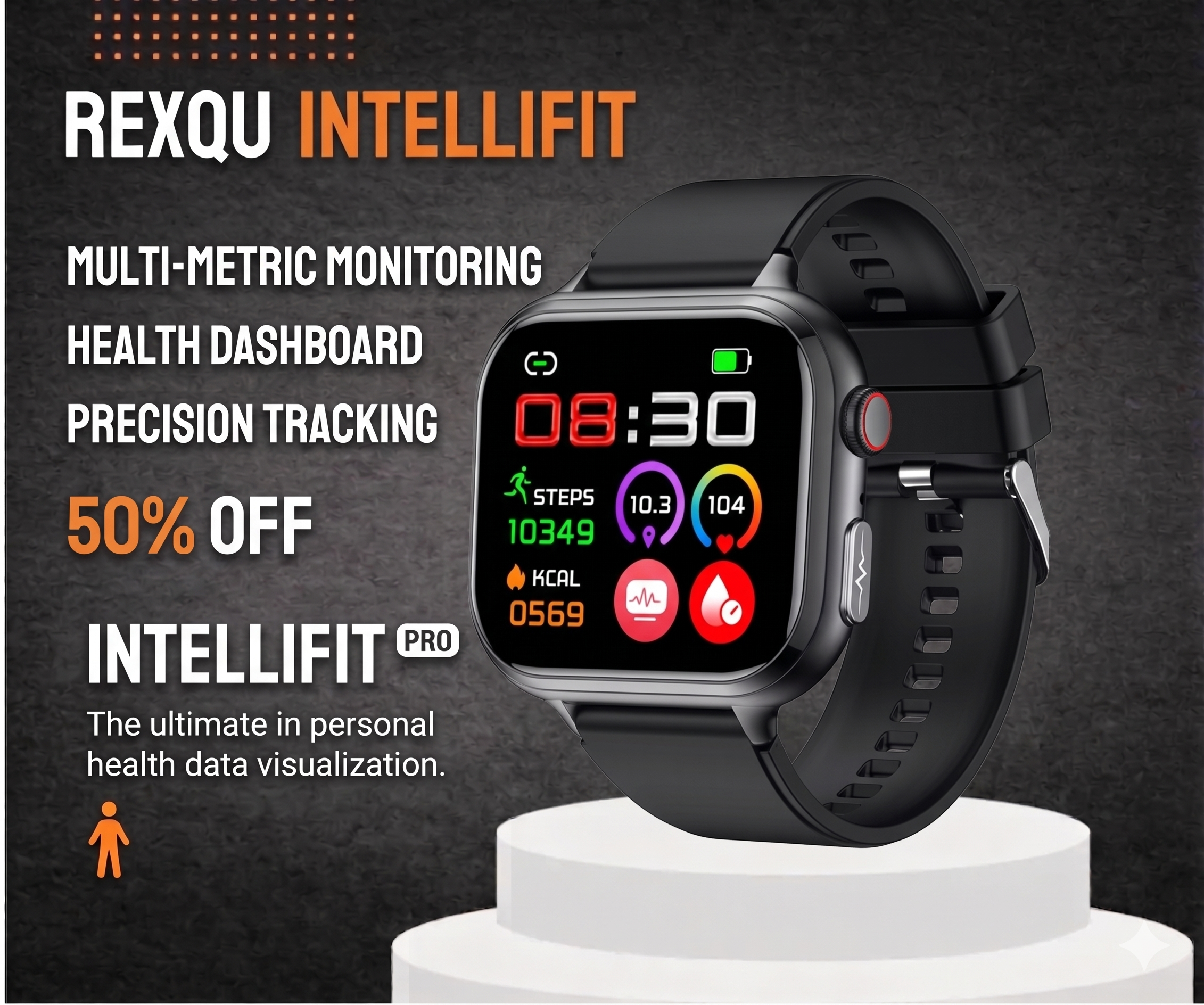
View IntelliFit specs and current price →
REXQU CardioSense: Sleep Tracking Plus Heart-Focused Features
REXQU CardioSense is the stronger fit when you want sleep tracking alongside a larger heart-health feature set. It combines sleep-stage estimates with heart-rate tracking, blood-pressure wellness trends, on-demand ECG and guided breathing.
If ECG and blood-pressure tracking matter as much as sleep, see our dedicated Blood Pressure Smartwatch With ECG: CardioSense guide.
How Accurate Is Smartwatch Sleep Tracking?
Consumer watches are generally better suited to estimating broad sleep-wake patterns than precisely classifying every minute into a clinical sleep stage. The limitation is straightforward: a wrist device does not directly measure the brain waves used in polysomnography.
That does not make the data useless. If the watch is worn consistently, the same device can still help you compare your own routine over time. Think “Is my sleep pattern changing?” rather than “Was my REM number exactly correct last night?”
What Can Affect a Watch’s Sleep Estimate?
- Loose fit: inconsistent skin contact can reduce heart-rate signal quality.
- Not wearing the watch for the full night: missing time creates incomplete trend data.
- Very still wakefulness: lying awake without moving can sometimes be mistaken for sleep.
- Frequent movement: restless periods can complicate stage estimates.
- Changing devices: different algorithms may classify the same night differently.
How to Get Better Sleep-Tracking Data
- Wear the watch every night for at least one to two weeks. A trend needs enough nights to become meaningful.
- Keep the band snug but comfortable. The sensor should maintain contact without being overly tight.
- Charge before bed when necessary. Missing the second half of the night defeats the purpose.
- Keep your routine reasonably consistent. Similar bedtimes make comparisons easier.
- Use notes or memory for context. Late caffeine, travel, alcohol, illness or stress can help explain an unusual night.
- Review the week, not only yesterday. Weekly patterns are more useful than a single score.
Can a Daily Health Monitoring Watch Detect Sleep Apnea?
REXQU watches should not be used to diagnose sleep apnea. Sleep apnea diagnosis requires appropriate medical evaluation, and a clinical sleep study can measure signals that a consumer smartwatch does not.
If you have symptoms such as persistent loud snoring, repeated breathing pauses reported by another person, or significant daytime sleepiness, discuss them with a healthcare professional rather than relying on a wearable score.
How Sleep Tracking Fits With Other Health Metrics
One reason a daily health monitoring watch can be more useful than a standalone sleep gadget is that the sleep trend sits beside other wellness information.
For example, you may notice that shorter sleep coincides with a higher resting heart rate or a different stress score. That correlation does not prove cause and effect, but it can help you identify habits worth paying attention to.
For a broader explanation of the sensor mix, read Daily Health Monitoring Smartwatch: What It Tracks & How It Works.
Which REXQU Watch Should You Choose for Sleep?
Choose based on the features you want around sleep tracking:
- IntelliFit: better if simplicity, readability and general health monitoring come first.
- CardioSense: better if ECG and heart-focused features matter alongside sleep.
- Need more options? Use the Best Daily Health Monitoring Watch buying guide or browse REXQU Health Smartwatches.
Frequently Asked Questions
Does a smartwatch know when I am asleep?
It estimates sleep from movement and physiological signals rather than directly observing brain activity. That is why it is useful for trends but not identical to a clinical sleep study.
How many nights should I track before judging the data?
At least one to two weeks gives you a much better baseline than one or two nights. Longer-term patterns are generally more useful.
Do I need to start sleep mode manually?
Many health watches detect sleep automatically when worn overnight. Check the individual product page and companion-app settings for the current model behavior.
Should I worry about one night with very little deep sleep?
Not from the watch estimate alone. Sleep-stage classification varies, and a single night can be influenced by many normal factors. Look for a consistent pattern and consider how you actually feel.
Where can I compare REXQU health watches?
Browse the REXQU Health Smartwatches category or use the daily health monitoring watch buying guide.
The Bottom Line
Daily health monitoring watch sleep tracking is most valuable when you use it as a consistent trend rather than a nightly diagnosis. IntelliFit is the simpler everyday-health choice, while CardioSense adds a stronger heart-health toolkit. For more options, compare the full REXQU Health Smartwatch range →.
REXQU smartwatches are consumer wellness devices and are not intended to diagnose sleep disorders or other medical conditions.