
If you keep seeing the term multi-satellite GPS smartwatch on hiking watch spec sheets and aren’t sure whether it’s a real feature or just marketing language, here’s the short version: it changes how reliably your watch finds you under tree cover, in canyons, or between tall buildings — and it comes with a real battery trade-off worth knowing about before you buy.
What a Multi-Satellite GPS Smartwatch Actually Does
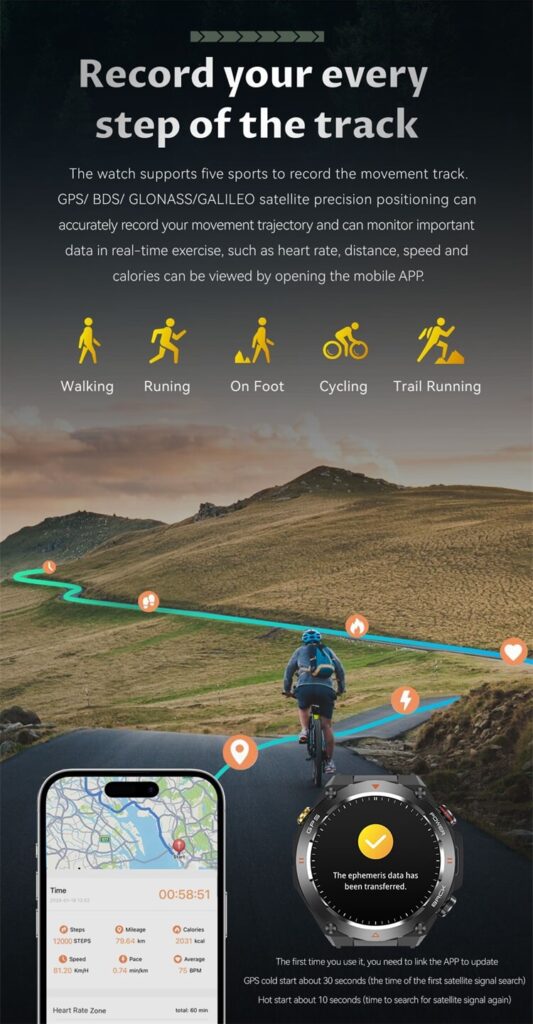
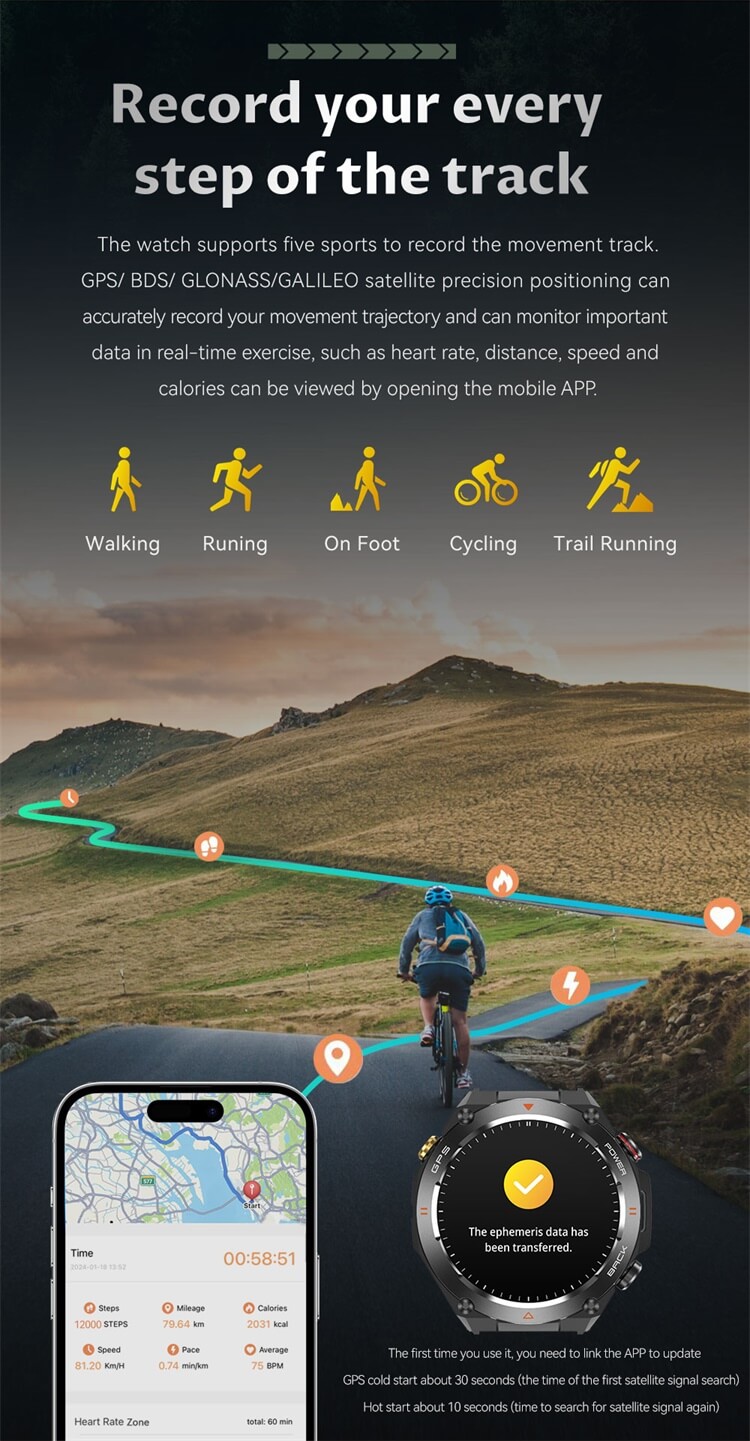
Standard GPS relies on a single U.S.-operated satellite constellation. A multi-satellite GPS smartwatch instead pulls positioning data from several independent satellite networks at once — GPS, BDS (China), GLONASS (Russia) and Galileo (EU) are the four most common. More visible satellites in more orbital planes means the watch has a better chance of locking a strong signal even when your view of the sky is partially blocked. You can read more about how these systems work together on satellite navigation generally.
Multi-Satellite GPS vs Dual-Band GPS: They Are Not the Same
One of the most common buying mistakes is treating multi-satellite and dual-band as interchangeable. They solve related problems, but in different ways.
- Multi-satellite or multi-GNSS means the watch can use more than one global navigation constellation, such as GPS, Galileo, GLONASS and BeiDou. That gives the receiver more satellites to work with when part of the sky is blocked.
- Dual-band or dual-frequency GPS means the receiver can listen on more than one radio frequency from compatible satellites. That can help reduce certain signal errors caused by reflections and the atmosphere.
A watch can support multiple constellations without being dual-band. So if a product page says “multi-satellite,” do not automatically assume it has dual-frequency hardware. The useful question is whether the feature improves tracking in the terrain you actually use.
What Affects Multi-Satellite GPS Smartwatch Accuracy?
More satellites can improve the odds of a stable position fix, but no wrist receiver is immune to the environment. Dense tree cover can weaken and scatter signals. Tall buildings can reflect them before they reach the watch. Deep valleys reduce the amount of sky visible to the receiver. Even body position matters: a watch tucked under a sleeve or held close to your torso can have a less open view than one exposed on top of the wrist.
The U.S. government’s GPS and GNSS overview explains how GPS sits alongside other global navigation satellite systems. In practical terms, a multi-GNSS watch has more potential reference points available, but the final track still depends on the watch antenna, software filtering, sampling rate and the surrounding terrain.
REXQU’s Multi-Satellite Option: the Adventurer
Of REXQU’s GPS & hiking smartwatch collection, the Adventurer ($159.97) is the model built specifically around multi-satellite positioning, drawing on all four systems — GPS, BDS, GLONASS and Galileo — for its track recording. That extra signal reliability is exactly why it’s the pick for hikers who spend real time in forest canopy, narrow canyons, or dense urban corridors where a single-network GPS watch is more likely to lose or drift its fix.
The trade-off is battery life while actively tracking: running continuous GPS logging on all four networks draws down the Adventurer’s 650mAh cell in around 10 hours. Off that mode, it still rates up to 12 days of normal daily use, 7–10 days under heavier use, and a dedicated 90-day low-power endurance mode for genuinely long expeditions where you’re not tracking continuously.
Multi-Satellite vs. Single-GPS: What You’re Trading
Not every REXQU outdoor watch takes this approach, and that’s a legitimate choice rather than a downgrade. The Horizon ($159.97) runs a single built-in GPS radio alongside a compass and barometer, and stretches that simpler setup into 15 days of active use and roughly 30 days on standby — longer than the Adventurer manages outside endurance mode. The TrailGuard ($149.97) similarly uses standard GPS with track syncing, a compass, and Gorilla Glass durability, running 7–10 days per charge.
| Model | GPS Type | Battery (Normal Use) | Continuous GPS | Price |
|---|---|---|---|---|
| Adventurer | 4-network (GPS, BDS, GLONASS, Galileo) | Up to 12 days | ~10 hours | $159.97 |
| Horizon | Standard built-in GPS + compass + barometer | Up to 15 days | Not specified | $159.97 |
| TrailGuard | Standard GPS + track sync + compass | 7–10 days | Not specified | $149.97 |
Who Actually Needs This Kind of GPS Accuracy?
If most of your hiking happens on open trail, ridgelines, or above the treeline, a single-GPS watch like the Horizon will track just as reliably while giving you a longer runtime between charges. A multi-satellite GPS smartwatch earns its keep specifically in signal-challenged terrain: dense forest, steep-walled canyons, or urban hikes where buildings block part of the sky. If you’re regularly in those conditions and want the most dependable track record for a route, the Adventurer’s four-network positioning is the more accurate choice, even with the shorter continuous-tracking window.
All three watches also track heart rate around the clock, and the Adventurer adds blood pressure, blood oxygen and sleep tracking. None of these are medical-grade measurements — treat them as a general wellness signal rather than a diagnostic one, and check with a healthcare provider for specific health concerns.
How to Decide Whether Multi-Satellite GPS Is Worth It
Use this simple decision test before paying for the extra capability:
- Choose multi-satellite GPS if you regularly run or hike under dense tree cover, between tall buildings, in steep valleys or in other places with a restricted view of the sky.
- Choose standard built-in GPS if most of your activity is under open sky and you value longer battery life more than marginally better positioning in difficult terrain.
- Prioritize battery first if your longest outings approach the published continuous-GPS runtime. A more accurate receiver is not useful if it runs out of power before the route ends.
- Check the navigation tools around the GPS too. For hiking, a compass, altimeter, barometer and route-back function can matter as much as the number of satellite systems supported.
For the broader decision, use the REXQU GPS smartwatch buying guide. You can also compare current navigation models on the GPS & hiking smartwatch category.
Multi-Satellite GPS Smartwatch FAQs
Does multi-satellite GPS mean the watch is more accurate everywhere?
No. The biggest benefit appears where sky visibility is poor. On an open road or exposed trail, a good single-constellation receiver may already be accurate enough that the difference is small.
Does multi-satellite GPS use more battery?
Usually, yes. Keeping more positioning resources active generally increases power use compared with ordinary watch mode. That is why continuous-GPS runtime should be checked separately from normal-use battery life.
Does multi-satellite GPS work without a phone?
It can, provided the watch has its own built-in GNSS receiver. A connected-GPS watch that relies on a phone is a different category. Always check that distinction on the product page.
Which REXQU watch is the main multi-satellite option?
The REXQU Adventurer is built around support for GPS, BeiDou, GLONASS and Galileo. If that feature is not important to your terrain, compare the Horizon and TrailGuard for different battery and ruggedness trade-offs.
Bottom Line
A multi-satellite GPS smartwatch like the Adventurer is worth the extra battery draw during active tracking if you hike where signal is genuinely unreliable. If your routes are mostly open sky, the Horizon or TrailGuard from REXQU’s rugged smartwatch lineup will track just as well with a longer charge cycle. Compare all three side by side, along with the rest of the lineup, on the GPS & hiking smartwatch collection page.
This article is informational and reflects product specifications published by REXQU; it is not medical advice. Consult a healthcare provider for concerns about heart health or other medical conditions.