
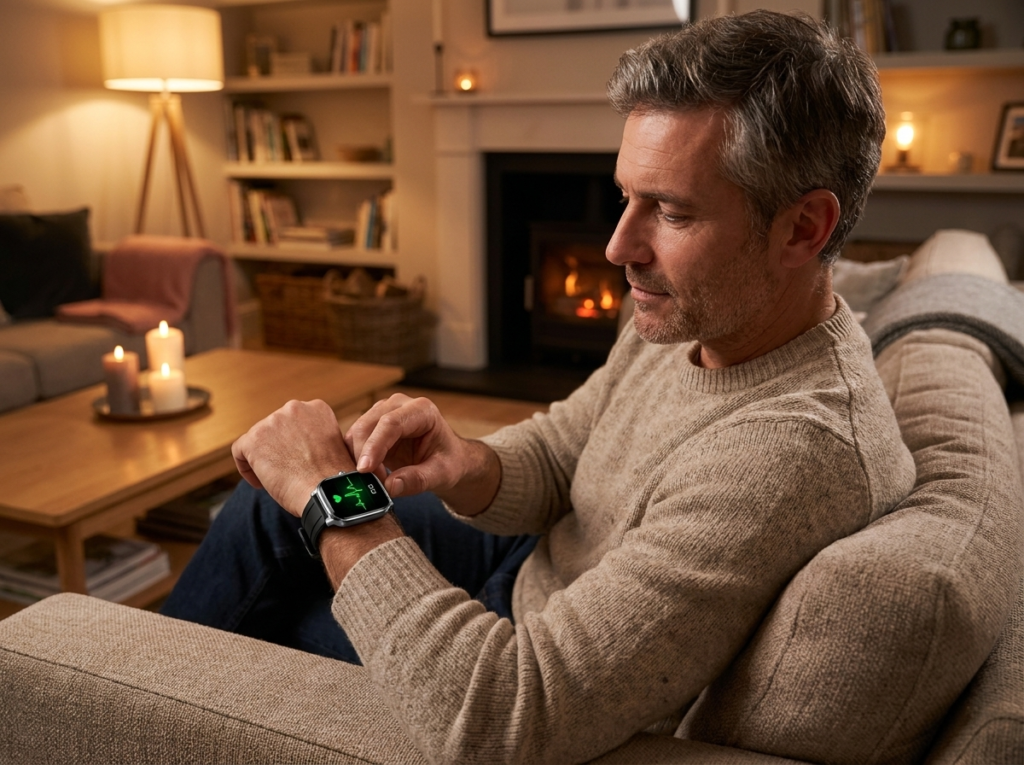
A daily health monitoring watch with stress tracking can be useful for spotting changes in your routine, but the number on the screen is a wellness estimate—not a direct measurement of how stressed you feel. The REXQU VitaCore includes stress in its multi-vitals check alongside heart rate, blood-pressure wellness readings, SpO₂ and temperature.
This article is for general wellness information. REXQU watches are consumer wellness devices, not medical devices.
Which REXQU Watch Has Daily Health Monitoring Watch Stress Tracking?
Of REXQU’s daily health monitoring lineup — VitaCore, BioVision, HealthLink and BioTrack Pro — only the VitaCore lists stress as one of its tracked metrics. It’s built into the watch’s 30-second multi-vitals check, which captures heart rate, blood pressure, blood oxygen, body temperature and stress in a single tap, all shown on the 2.04″ always-on AMOLED display.
The other three models focus on a narrower set of readings — BioVision pairs ECG with 24-hour blood pressure and body composition, HealthLink covers ECG and blood oxygen with an AI voice assistant, and BioTrack Pro keeps things to big-digit heart rate and SpO₂ readings. If a stress number is specifically what you’re after, VitaCore is currently the only one of the four built around it.
How Daily Health Monitoring Watch Stress Tracking Actually Works
Wrist-worn stress scores do not measure a feeling directly. Consumer wearables generally infer a stress or recovery estimate from physiological signals such as heart-rate patterns, heart-rate variability (HRV), movement and other inputs processed by the device’s algorithm. HRV is the variation in time between heartbeats, but a lower or higher HRV value by itself does not automatically mean a person is mentally stressed.
REXQU lists stress as one of the readings included in VitaCore’s 30-second multi-vitals check, but the public product specifications do not publish the exact formula used to calculate the score. That is why the safest interpretation is as a personal wellness trend: press once, stay still, and compare the resulting stress estimate with your own previous readings taken under similar conditions.
For a deeper, clinically grounded explanation of what HRV is and why it moves the way it does, the Cleveland Clinic’s guide to heart rate variability is a good outside reference.
View VitaCore specs and current price →
Reading a Smartwatch Stress Score Without Overreacting
A single stress reading is a snapshot, not a verdict. Exercise, poor sleep, caffeine, dehydration, illness, alcohol, emotional strain and even the time of day can all change heart-rate and HRV patterns. That means a higher-than-usual score after climbing stairs or finishing a workout may reflect normal physical strain rather than anxiety or a medical problem.
| Factor | Why it may change the score |
|---|---|
| Recent exercise | Raises heart rate and changes short-term HRV. |
| Poor or short sleep | Can alter recovery-related heart-rate patterns the next day. |
| Caffeine or alcohol | May temporarily change heart rate and autonomic activity. |
| Illness or fever | Can shift resting heart rate and recovery signals. |
| Emotional strain | Can influence autonomic nervous-system activity. |
| Movement or loose fit | Can make an optical reading noisier. |
The more useful question is whether your resting pattern changes consistently over days or weeks. Use the companion app to review trends and add context from sleep, activity and how you actually feel. If you have persistent symptoms or a health concern, discuss them with a healthcare professional rather than relying on a wearable score.
How to Use Daily Health Monitoring Watch Stress Tracking Day to Day
The most useful routine is consistency rather than constant checking. Pick one or two calm times of day, use the same wrist and a similar seated position, and compare your own trend rather than someone else’s score.
- Rest for a few minutes first. Avoid checking immediately after exercise or rushing around.
- Wear the watch snugly. Stable skin contact helps optical sensing.
- Keep your wrist still during the 30-second check.
- Note the context. Sleep, caffeine, illness, exercise and mood can all matter.
- Review weekly patterns. One unusual score is less informative than a repeated change from your normal range.
VitaCore also reports sleep-stage and sleep-efficiency information, which can provide useful context for a stress trend. If the app shows a breathing-related flag or any other health warning, treat it as a prompt for appropriate follow-up rather than as a diagnosis.
REXQU currently lists VitaCore at $149.97 with approximately 5–10 days of battery life depending on features such as the always-on display, calls and workouts. The companion app does not require a subscription for the watch’s standard health features. For a broader comparison, see the Best Daily Health Monitoring Watch guide.
Frequently Asked Questions About Smartwatch Stress Tracking
Is a smartwatch stress score a medical measurement?
No. It is a consumer-wellness estimate derived from physiological signals and a device algorithm. It should not be used to diagnose anxiety, chronic stress or another medical condition.
Is HRV the same thing as stress?
No. HRV is variation in the timing between heartbeats. It can be influenced by recovery, exercise, sleep, illness, age and many other factors. Some wearables use HRV as one input in a stress or recovery score, but the two terms are not interchangeable.
When is the best time to check a stress score?
A calm, repeatable time is best for trend comparison—often after a few minutes of sitting quietly in the morning or evening. Avoid comparing a post-workout reading with a rested reading as though they were taken under the same conditions.
Does VitaCore require a separate stress sensor or subscription?
No separate accessory is required. REXQU lists stress as part of VitaCore’s built-in 30-second multi-vitals workflow, and its standard companion-app features do not require a subscription.
Where can I compare VitaCore with other health watches?
Use the Daily Health Monitoring Watch buying guide for a feature-by-feature comparison or browse the full REXQU Health Smartwatches category.
The Bottom Line
A daily health monitoring watch with stress tracking is most useful as a consistency tool. VitaCore brings the stress estimate into the same 30-second check as heart rate, BP wellness readings, SpO₂ and temperature, but the value comes from comparing your own patterns under similar conditions rather than treating one number as a diagnosis.
See REXQU VitaCore → Compare REXQU Health Smartwatches →
This article is for general wellness education. REXQU smartwatches are consumer wellness devices and are not intended to diagnose, treat, cure or prevent disease.