Smartwatch heart rate accuracy is one of the most common questions we get from runners and hikers deciding between a rugged GPS watch and a dedicated chest strap. The honest answer is that REXQU’s optical sensors, like the wrist-based sensors in every competing smartwatch, are genuinely useful for tracking trends but have real, well-documented limits during hard efforts. Knowing where those limits sit helps you use the numbers correctly instead of over-trusting them.
How REXQU’s Optical Heart Rate Sensors Work
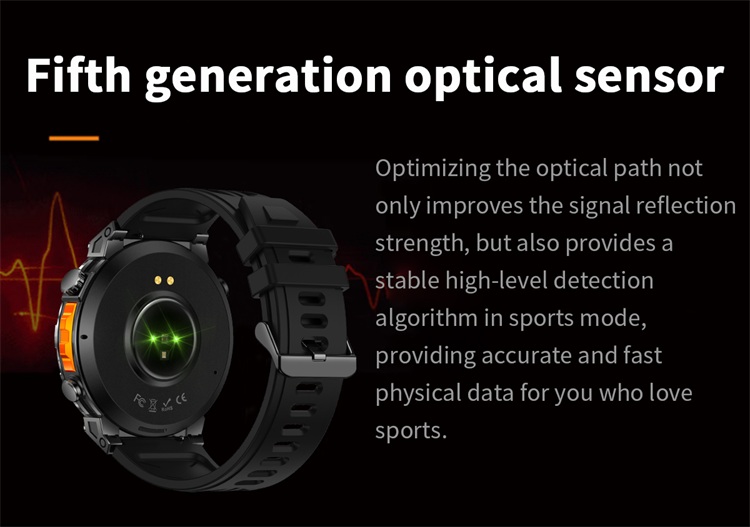
REXQU’s outdoor and rugged watches use photoplethysmography (PPG) — green LEDs shine light into the wrist, and a sensor measures how much light bounces back as blood volume changes with each heartbeat. The REXQU Zenith Pro uses a fifth-generation optical sensor built around this method, described on its own product page as optimizing “the optical path” for stronger signal reflection and a more stable detection algorithm in sports mode. The REXQU Adventurer uses the HX3605 optical sensor for heart-rate trends alongside blood-pressure and SpO₂ estimates, and the REXQU EnduroMax tracks 24-hour heart-rate trends the same way.
Why Smartwatch Heart Rate Accuracy Varies by Activity
Every wrist-based optical sensor, not just REXQU’s, performs best at rest or during steady, low-motion activity and gets noisier during high-intensity or high-motion efforts. A peer-reviewed device validation study published via the National Institutes of Health’s PubMed Central found that wrist-worn wearables track heart rate closely during sedentary and light activity but show larger deviations from reference ECG readings as intensity and arm motion increase. That’s consistent with what REXQU’s own product pages say — the sensors are described as wellness trackers, not medical devices, and not a replacement for clinical-grade monitoring.
Three things reliably hurt smartwatch heart rate accuracy on a wrist sensor: rapid arm motion (trail running with poles, gripping handlebars), a loose-fitting band that lets the watch slide, and anything that blocks steady skin contact, like a cold wrist restricting blood flow or a tattoo directly under the sensor. None of these are REXQU-specific — they’re inherent to how PPG sensors read blood flow through skin.
Getting More Reliable Readings on the Trail
A few habits noticeably improve smartwatch heart rate accuracy in practice. Wear the watch snug enough that it doesn’t shift, one to two finger-widths above the wrist bone rather than loose over it. Give the sensor a minute to lock onto a stable signal before starting an interval or a hard climb. And treat the number as a trend across a run or a season rather than a precise instant-by-instant reading during sprints or scrambles — that’s exactly where every optical sensor, REXQU’s included, is least reliable.
For runners training by heart-rate zones specifically, a chest strap paired over Bluetooth remains the more precise option during intervals and hill repeats. For everyday trail use, general fitness tracking, and long steady hikes, REXQU’s built-in sensors on watches like Zenith Pro and Adventurer are accurate enough to be genuinely useful without adding another piece of gear.
One More Practical Difference: Running vs. Cycling
Wrist position affects smartwatch heart rate accuracy differently depending on the activity. On a run, arm swing is the main source of motion noise, and a snug, higher-on-the-wrist fit helps the most. On a bike, the issue is usually a bent wrist gripping the handlebars, which can restrict blood flow right where the sensor is reading — shifting the watch slightly, or loosening your grip at intervals, often steadies the reading more than any setting change would. It’s a small adjustment, but it’s the kind of detail that explains why the same watch can read cleanly on one ride and noisily on the next.
Which REXQU Watch Fits Your Training
If you want multi-satellite GPS route tracking alongside heart-rate, blood-pressure and SpO₂ estimates, the Zenith Pro is built for that combination — see it on REXQU’s GPS smartwatches shop page. If durability on rough terrain matters as much as the sensor data, the Adventurer pairs the same category of heart-rate tracking with a tougher build, listed on the rugged smartwatches page alongside REXQU’s other trail-ready models.
FAQ
Is REXQU’s heart rate sensor accurate enough for training zones?
It’s reliable for trend tracking and steady-state training. For precise zone-based interval training, pairing with a chest strap gives more consistent numbers during high-motion efforts.
Are REXQU watches medical devices?
No. They’re wellness and fitness trackers designed for day-to-day awareness, not diagnostic or medical-grade monitoring, and shouldn’t replace guidance from a healthcare provider.