
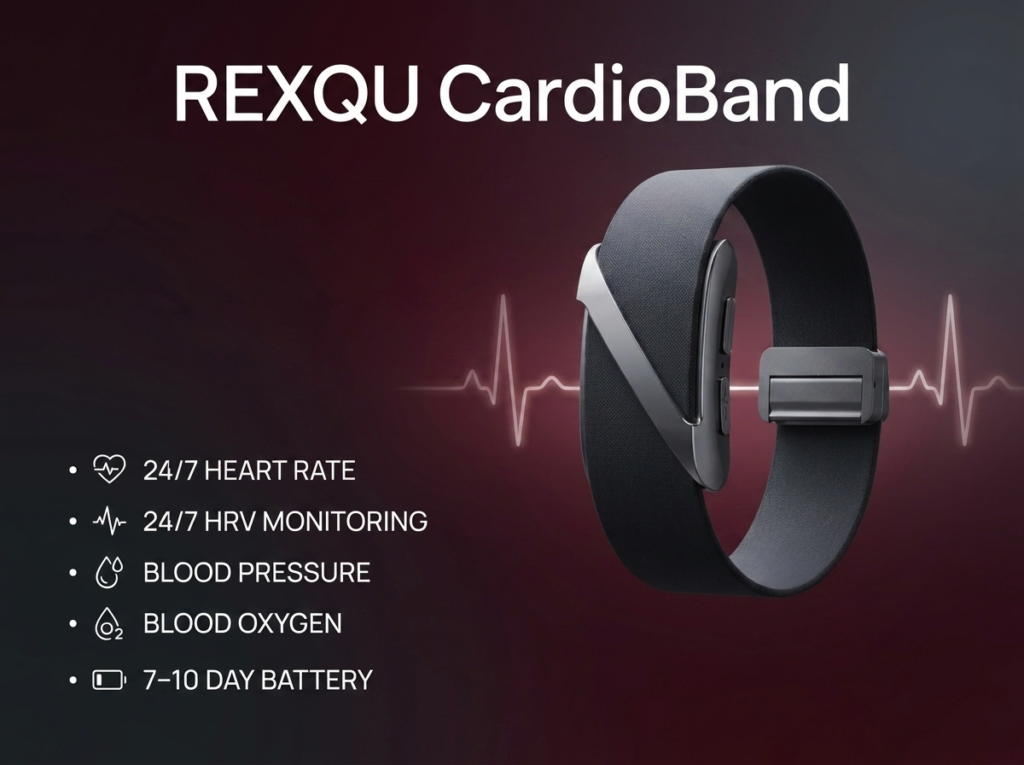
Wondering about screenless fitness tracker heart rate accuracy before you commit to a band with no display? It’s a fair question — without a screen to check your reading against another device mid-run, you’re trusting the sensor and the app to get it right.
The short version: REXQU’s screenless bands use continuous wrist-worn heart rate sensors that read well for everyday tracking and steady-state cardio, with the usual wearable caveat that fit and motion matter more than the brand. Here’s what actually affects screenless fitness tracker heart rate accuracy, and how REXQU’s CardioBand and PulseBand compare.
What affects screenless fitness tracker heart rate accuracy
Every wrist-worn heart rate sensor — screenless or not — works the same basic way: it reads blood flow through your skin and calculates a pulse from the pattern. That means accuracy depends less on whether there’s a screen attached and more on a few practical factors:
- Fit. A loose band lets light leak in and out, which can throw off readings. Snug — not tight — is the rule, especially during a run.
- Placement. Wearing the band slightly higher on the wrist, away from the wrist bone, tends to give a cleaner reading.
- Motion and intensity. Fast, jerky arm movement (think sprint intervals or rowing) is harder for any optical-style sensor to track than steady jogging or walking.
Independent research backs this up: a peer-reviewed study on wrist-worn wearable accuracy published via the National Library of Medicine found that consumer wearables generally track heart rate reasonably well at rest and during steady activity, with accuracy dropping off as exercise intensity and movement become more erratic — a pattern that holds across brands, not just REXQU’s.
CardioBand vs PulseBand for heart rate tracking
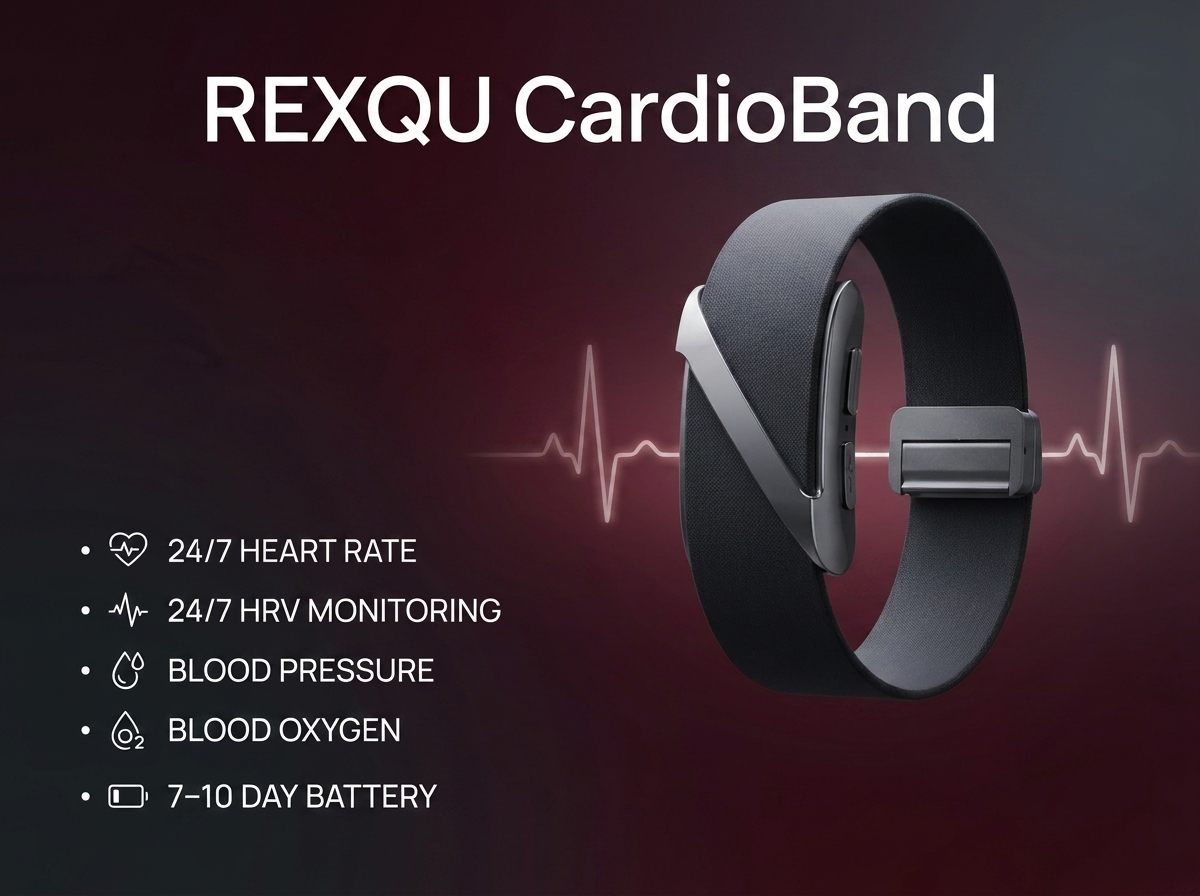
Both of REXQU’s screenless bands track heart rate continuously, but they’re built for slightly different priorities:
| Feature | CardioBand | PulseBand |
|---|---|---|
| Heart rate + HRV | 24/7 | 24/7 |
| On-band ECG | Touch-sensor ECG | Touch-sensor ECG |
| Step tracking | Steps, calories, sport modes | Steps, sleep, body composition |
| Battery life | 7–10 days | 25–30 days |
| Water resistance | 1ATM | 1ATM |
| Price | $139.97 | $139.97 |
| See product | View CardioBand → | View PulseBand → |
Both use a touch-sensor ECG — rest a finger on the sensor and it records a full electrocardiogram trace, separate from the continuous background heart rate reading. That combination (always-on wrist HR plus an on-demand ECG spot-check) is what gives you the fuller picture, rather than relying on the wrist sensor alone for every kind of reading.
Getting the most accurate readings day to day
A few habits make a real difference in screenless fitness tracker heart rate accuracy over time. Clean the sensor and your skin before a workout — sweat, sunscreen, and lotion residue can all interfere with the reading. Give the band a minute to settle after you put it on, especially if you just came in from the cold. And for the touch-sensor ECG specifically, sit still and rest your other hand’s finger firmly on the sensor for the full reading — moving mid-check is the most common reason for a failed trace.
Optical Heart Rate vs ECG on a Screenless Fitness Tracker
The continuous heart-rate number and the on-demand ECG are not the same measurement. During normal wear, the band uses an optical sensor to estimate pulse from changes in blood flow at the wrist. That is why it can keep tracking automatically throughout the day and night.
An ECG reading uses electrical contact instead. On CardioBand and PulseBand you deliberately touch the sensor and stay still while a trace is recorded. The ECG is therefore a short, on-demand rhythm recording, while optical heart rate is the background metric used for all-day trends.
When Wrist Heart Rate Is Usually Most Reliable
Wrist optical sensors tend to perform best when the band has stable skin contact and your movement is relatively predictable. Resting periods, walking, sleep and steady-state aerobic exercise are generally easier conditions than sprint intervals, heavy lifting or activities involving repeated wrist flexion.
- Resting and sleep: little arm movement usually makes the signal easier to capture.
- Walking and steady running: consistent movement is generally easier for an optical algorithm to follow.
- Intervals and rapid pace changes: the watch may lag behind a fast rise or fall in heart rate.
- Strength training and rowing: wrist bending, gripping and impact can create more motion artefact.
Why Heart Rate Readings Can Be Wrong
Several factors can interfere with a wrist sensor even when the tracker itself is functioning normally. Cold skin can reduce peripheral blood flow. Tattoos, heavy hair, skin contact, sweat, band movement and very rapid changes in intensity can also affect the optical signal. Some devices can occasionally lock onto the rhythm of repetitive arm movement instead of the pulse, a problem often called cadence lock.
This is why one strange reading should not automatically be treated as a health event. If a number looks implausible, stop moving, make sure the band is positioned correctly, wait briefly and check again. If you have symptoms or a persistently concerning pattern, use appropriate medical equipment and professional advice rather than trying to diagnose the issue from the band.
How to Check Your Screenless Tracker Against Another Device
- Choose a calm period rather than the middle of a hard workout.
- Wear the tracker snugly and let the reading stabilize.
- Compare the displayed app reading with a manually counted pulse or another established heart-rate device at roughly the same moment.
- Repeat on several occasions rather than judging accuracy from one comparison.
- If exercise accuracy matters to you, compare trends during a steady workout and during intervals to learn where the wrist sensor performs best for your own routine.
For most buyers, consistency is more important than demanding that every second match another device exactly. A tracker is most useful when it helps you follow your own resting and exercise trends over weeks and months.
Does Skin Tone Affect Optical Heart Rate Accuracy?
Optical wearables use light at the skin, so researchers continue to study how skin characteristics, device design and algorithms affect performance across different users. The evidence varies by device and measurement type, which is another reason not to assume every wrist wearable performs identically for every person.
REXQU’s screenless bands are best treated as wellness trackers for personal trend monitoring. If you want a broader evidence-based discussion of optical wearables and measurement limitations, REXQU’s SpO₂ Accuracy & Skin Tone Health Guide explains why optical measurements can be affected by sensor conditions and skin-related factors.
Heart Rate Accuracy vs Battery Life
A longer battery can indirectly improve the usefulness of heart-rate tracking because fewer charging gaps mean a more complete history. PulseBand’s 25–30 day battery is therefore attractive if continuity is a priority, while CardioBand’s 7–10 day runtime still covers a full week of heart-rate and HRV monitoring between charges.
See the screenless fitness tracker battery-life comparison if uninterrupted tracking matters as much as the sensor feature set.
The bottom line
Neither band replaces a chest strap for lab-grade precision, and REXQU is upfront that these are wellness devices, not medical equipment. But for everyday tracking, sleep, and steady cardio, both the CardioBand and PulseBand deliver consistent readings when worn correctly — and the choice between them comes down to whether you’d rather have CardioBand’s activity-focused feature set or PulseBand’s much longer battery life.
Frequently asked questions
Can a screenless band be as accurate as a smartwatch with a screen? Yes — the screen has no bearing on the sensor underneath. Accuracy comes down to the same optical-style wrist sensor technology either way; a screen just changes how you view the number, not how it’s measured.
Why does my reading jump around during a workout? This is normal for any wrist-worn sensor during high-intensity or erratic movement, as noted in the research above. If you need lab-grade precision during intervals specifically, a chest strap paired to the app is the more accurate option.
Do I need to recalibrate the sensor? No manual calibration is required for day-to-day heart rate tracking on either band — just make sure the fit is snug and the sensor area is clean.
Explore REXQU screenless trackers
If you want continuous heart-rate and wellness tracking without a distracting screen, compare the current REXQU screenless tracker range or view the two models featured in this guide.