
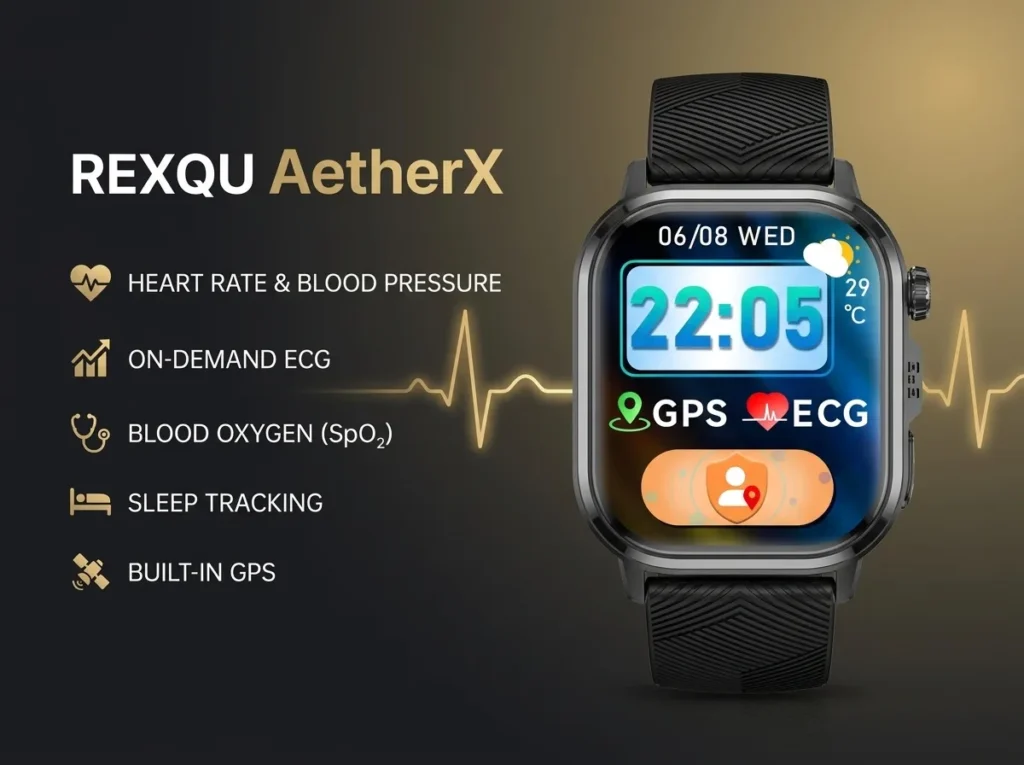
If you’re weighing a GPS smartwatch vs fitness tracker, the decision really comes down to one part: a satellite receiver. A fitness tracker records what your wrist feels — steps, heart rate, sleep. A GPS smartwatch adds where you went, how fast, and how much you climbed, read straight from satellites instead of borrowed from your phone.
That one component changes almost everything else about the watch: what it can show you mid-workout, how long the battery lasts, and what it actually costs.
GPS Smartwatch vs Fitness Tracker: The Core Difference
A fitness tracker like REXQU’s screenless models in the Screenless Fitness Trackers lineup is built around a heart-rate sensor and an accelerometer. It counts steps, estimates distance from your stride length, and logs sleep stages overnight. All of that happens without ever talking to a satellite.
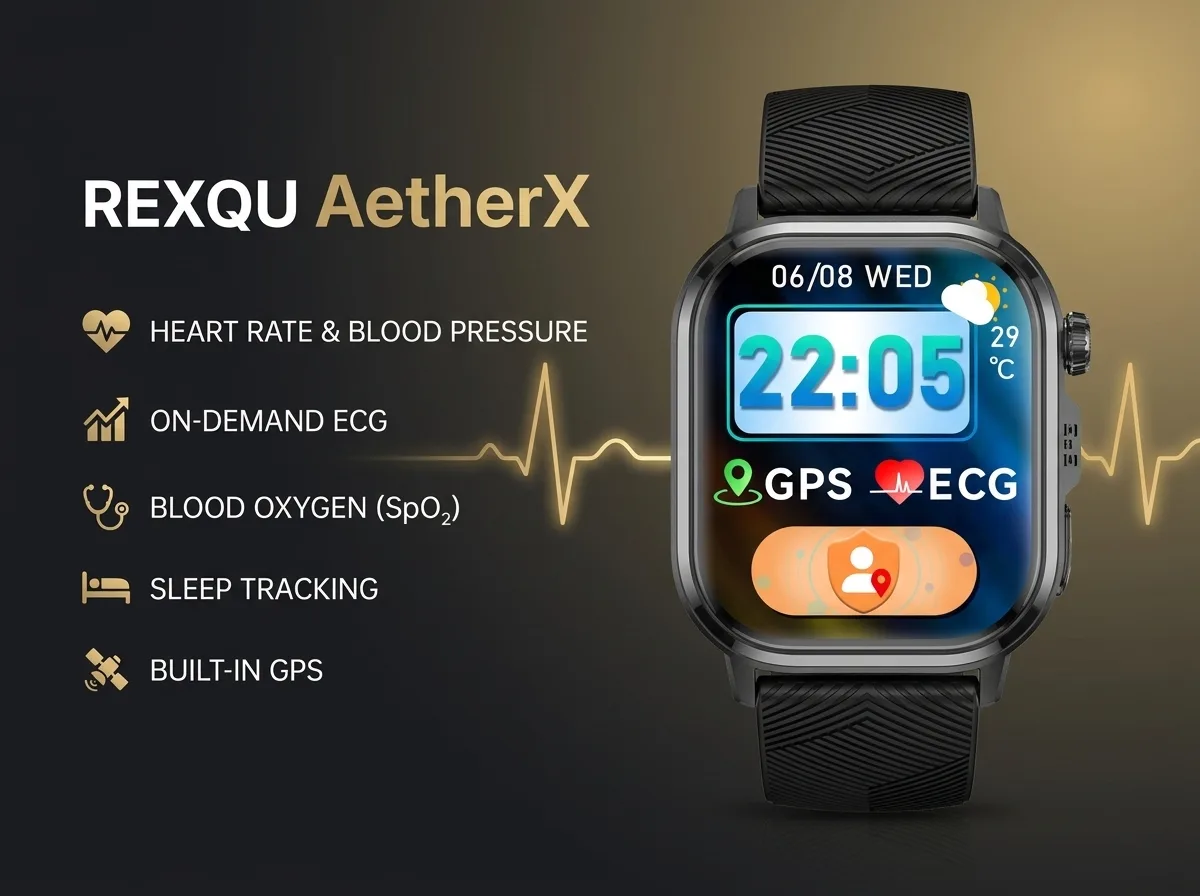
A GPS smartwatch such as the REXQU AetherX adds a dedicated GPS receiver on top of those same sensors. That receiver locks onto satellites to record your actual route, your real-time pace over distance rather than an estimate, and elevation gain as you climb. If you’ve ever finished a trail run and wondered exactly how many feet you climbed, that number only comes from GPS — a wrist sensor has no way to know it.
What You Give Up With a Fitness Tracker
The honest tradeoff runs both directions. A plain fitness tracker is smaller, lighter, and noticeably cheaper than a GPS smartwatch, and its battery routinely lasts a week or more because it isn’t powering a satellite radio. For walking, gym sessions, and general activity tracking where you already know the route, that’s a perfectly reasonable trade.
Where it falls short is anywhere you’d want a map after the fact, or anywhere your phone might not be with you — a long trail run, a bike ride out of signal range, a hike where you want to retrace your steps. A fitness tracker simply has no record of where you physically went.
What a GPS Smartwatch Costs You in Battery Life
GPS is, by a wide margin, the most power-hungry thing any watch does, because the receiver has to stay awake and locked onto satellites for the entire activity. A watch quoted at weeks of standby will typically manage a long day or two of continuous GPS recording before it needs a charge. That’s the real-world number to plan around — not the headline standby figure on the box.
This is the main reason the GPS smartwatch vs fitness tracker choice isn’t just about features. If you’re only ever walking the dog or lifting at the gym, you’re paying a battery-life tax for satellite hardware you’ll rarely use.
Which One Actually Fits You
If your workouts happen somewhere you already know — a gym, a treadmill, your usual neighborhood loop — a screenless fitness tracker covers the basics with better battery life and a lower price. If you run trails, cycle long distances, or hike routes where you’d want a recorded map and your phone might be zipped away in a pack, a GPS smartwatch like AetherX from REXQU’s GPS Smartwatches or Rugged Smartwatches lineup earns its extra weight and price.
Some people land in the middle and keep both: a screenless band for daily wear and sleep tracking, and a GPS watch reserved for longer outdoor sessions. There’s no wrong answer in the GPS smartwatch vs fitness tracker debate — just a clear-eyed look at what each one is actually built to do.
Frequently Asked Questions
Does a GPS smartwatch replace a fitness tracker?
Largely, yes — most GPS smartwatches include the same heart-rate, step, and sleep tracking a dedicated fitness tracker offers, plus route recording on top. The main reasons to still pick a plain tracker are price, weight, and battery life.
Do I need GPS if my phone already has it?
Only if you want your route recorded when your phone isn’t with you, or you want pace and distance that don’t depend on carrying a phone at all. According to the Global Positioning System, a GPS receiver calculates position directly from satellite signals rather than relying on a paired device.
Is GPS accuracy the same across all watches?
No — accuracy varies with the receiver and how many satellite systems it supports. Multi-satellite support generally improves lock time and accuracy in tree cover or urban canyons compared to single-system GPS.