
Screenless fitness tracker HRV numbers show up in your app every morning, but most people have no idea what a “good” one looks like. If you’ve glanced at a chart on your phone and shrugged, here’s what the number actually tracks and why chasing a specific score is the wrong way to read it.
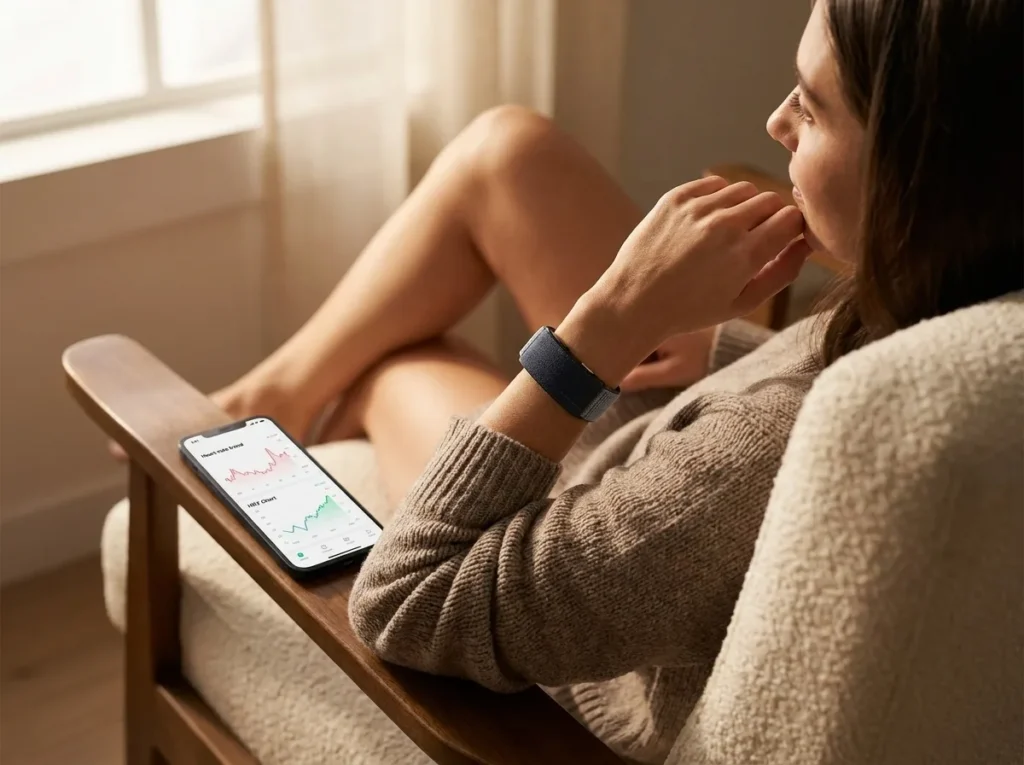
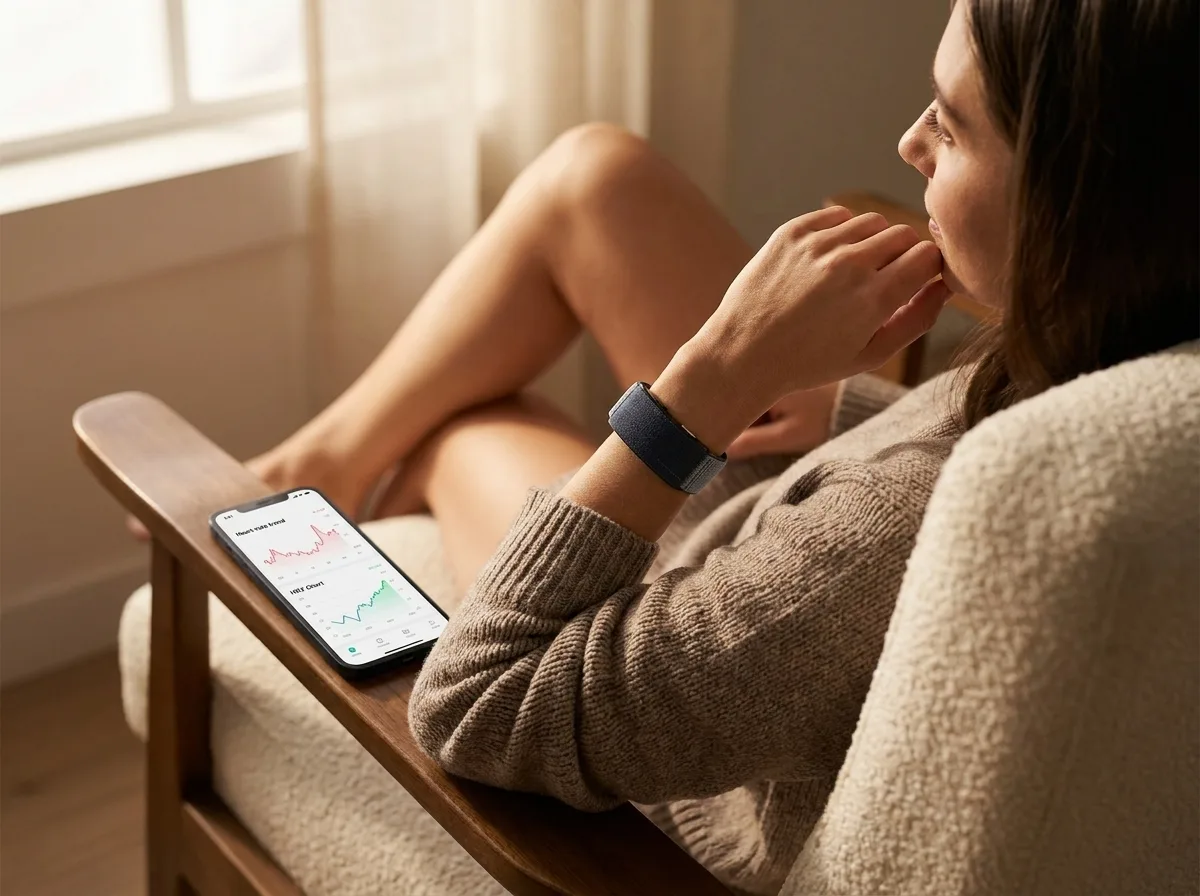
HRV stands for heart rate variability — the small, constantly shifting gaps between your heartbeats. A band with no screen can’t show you this on your wrist, but it still records it continuously and hands the full picture to a companion app, which turns out to be the more useful way to read a metric this noisy.
What Screenless Fitness Tracker HRV Is Actually Measuring
HRV reflects how your nervous system is balanced between stress and recovery. It measures how much the time between your heartbeats varies — more variation generally lines up with a well-rested, recovered body, while a run of lower-than-usual mornings often tracks with poor sleep, illness coming on, alcohol the night before, or a hard training block catching up with you.
REXQU’s screenless bands, including PulseBand and CardioBand, record HRV continuously overnight using the same wrist-worn optical sensor that tracks heart rate, then sync everything to the free G BAND app over Bluetooth — HRV, heart rate, blood pressure, ECG traces and sleep all in one dashboard.
Why There’s No “Good” HRV Score
A common mistake with screenless fitness tracker HRV data is hunting for a target number to hit. There is no universal good number, and any source quoting one is misleading you. HRV depends on age, genetics, fitness level and even the measurement method itself, so two perfectly healthy people can differ by a factor of three and both be completely normal. Comparing your reading against a friend’s, or against an average pulled from the internet, tells you almost nothing.
What actually matters is the trend against your own baseline. PulseBand builds that personal baseline over about two weeks before the readings start meaning much — give it that runway before you draw any conclusions from a single night’s number.
Reading the Trend Without a Screen
Because there’s no display to check mid-morning, the app does the interpreting. Open it after waking and you’ll see last night’s HRV plotted against your recent average, usually alongside your resting heart rate and sleep summary from the same night — three numbers that tend to move together and tell a more complete story than any one of them alone.
A few mornings of lower HRV isn’t a reason to panic. Treat it the way you’d treat feeling a bit run-down: maybe ease off training intensity, prioritize sleep, or just note it and move on. It becomes more useful as a longer-term pattern — a slow downward drift across a stressful month, say, or a steady climb as a training block pays off.
What to Check Before Buying for Screenless Fitness Tracker HRV Tracking
If HRV tracking is the main reason you’re looking at a screenless band, confirm two things on the product page: that the model records HRV overnight (not just on-demand), and that the battery comfortably covers multi-night wear so you’re not missing data on charging days. PulseBand runs 25–30 days on a charge with a magnetic charger that refills it in under 2.5 hours, which is enough runway to build that two-week baseline without a gap. It’s priced at $139.97, the same as CardioBand, which tracks HRV alongside cycle data for users who want that layered in.
Both are part of REXQU’s full screenless fitness tracker lineup, where every model shares the same underlying sensor approach.
A Wellness Signal, Not a Diagnosis
HRV from a wrist-worn consumer device is a general wellness trend, not a clinical measurement. It’s genuinely useful for spotting patterns in your own recovery and stress over time, but it isn’t a diagnostic tool, and a low reading on its own isn’t a medical finding. If something about your health concerns you, that’s a conversation for a doctor, not an app chart. For more on how the metric is measured clinically, the Wikipedia overview of heart rate variability is a reasonable starting point.
Frequently Asked Questions
Does a screenless fitness tracker measure HRV differently than a watch with a screen?
No — the sensor and the underlying measurement are the same. The only difference is where you read the result: on your wrist versus in the app.
How many nights of data before the HRV baseline is reliable?
Roughly two weeks of consistent overnight wear, per REXQU’s own guidance for PulseBand.
Can I see HRV without opening the app?
No — without a screen, the app is the only place to view it, which is part of the tradeoff for the smaller, lighter band.